
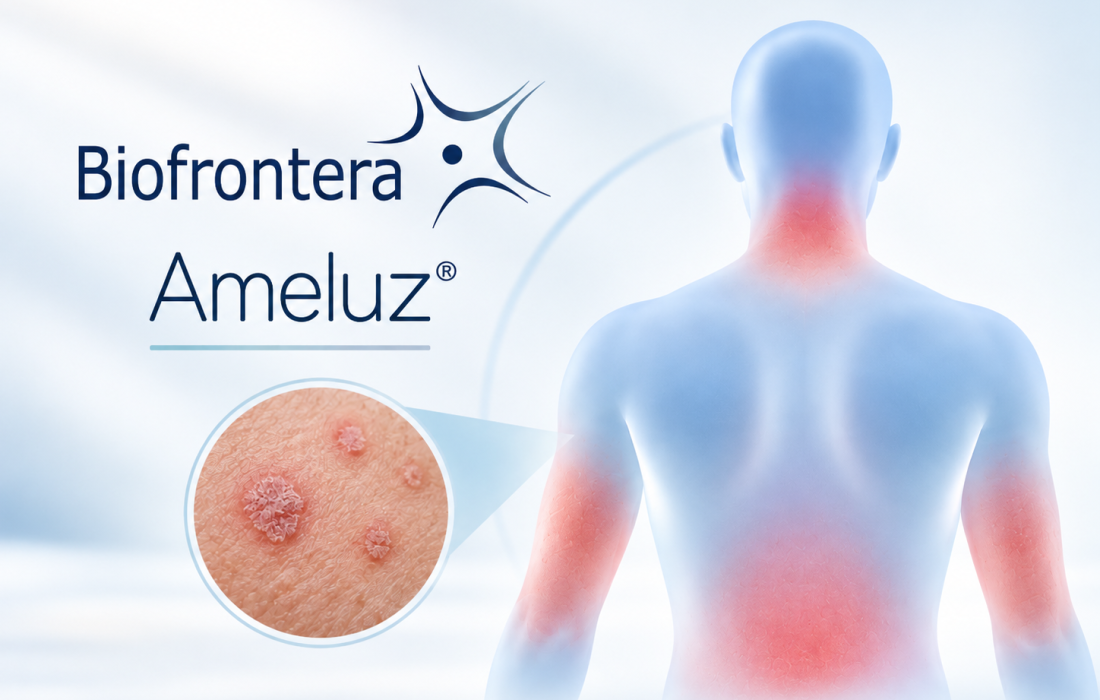
Biofrontera submits an sNDA to expand Ameluz red-light PDT for actinic keratoses on the extremities, neck and trunk, supported by Phase 3 data.
Written By: Mayuri Vaja, PharmD
Reviewed By: Pharmacally Editorial Team
Biofrontera Inc. has submitted a supplemental New Drug Application (sNDA) to the U.S. Food and Drug Administration (FDA) seeking to expand the use of Ameluz® (aminolevulinic acid hydrochloride) topical gel, 10%, in combination with photodynamic therapy (PDT) using the RhodoLED® lamp series.
The proposed indication would cover mild-to-moderate actinic keratoses (AKs) on the extremities, neck and trunk, extending Ameluz® PDT beyond its currently approved use for AKs on the face and scalp. The application seeks treatment fields of up to approximately 240 cm² on these additional body areas. If approved, Biofrontera said the expanded indication would make Ameluz® with red-light PDT the only PDT approved in the U.S. for AKs across the body.
Phase 3 Trial Supports Expanded Treatment Fields
The sNDA is supported by a multicenter, randomized, double-blind, vehicle-controlled Phase 3 trial involving 172 patients with AKs on the extremities, neck and trunk. The study evaluated patients with four to 15 AK lesions across treatment fields of approximately 80, 160 and 240 cm², corresponding to the use of one to three tubes of Ameluz®.
Patients received one PDT treatment, followed by a second treatment at Week 12 if any AK lesions remained. At 12 weeks after the final PDT treatment, 45.6% of patients treated with Ameluz® PDT achieved complete clearance of all treated AK lesions, compared with 16.7% of patients receiving vehicle PDT (p<0.0003, Full Analysis Set).
Patients are being followed for approximately one year after their final PDT treatment to further evaluate longer-term outcomes.
The submission is also supported by a Phase 1 maximal-use pharmacokinetic study designed to assess systemic exposure to aminolevulinic acid (ALA) and its metabolite protoporphyrin IX (PpIX) under treatment conditions involving larger treatment fields.
Ameluz® PDT Demonstrates Favorable Cosmetic Outcomes
The Phase 3 study also evaluated cosmetic outcomes and patient satisfaction following treatment.
Investigators rated the aesthetic appearance of treated skin as good or very good in 75.2% of patients, while 70.9% of patients reported similar assessments themselves. In addition, 86.3% of patients indicated that they would choose PDT again for future treatment.
These findings provide additional evidence supporting the potential use of Ameluz® PDT in larger treatment fields beyond the face and scalp.
Adjusted Illumination Protocol Designed to Improve Tolerability
The sNDA also includes an adjusted illumination protocol intended to improve patient tolerability during PDT. Biofrontera is seeking approval of the protocol across all RhodoLED® lamps and indications.
Under the proposed protocol, light intensity is gradually increased to full intensity, maintained for several minutes and then cycled on and off until a total light dose of 37 J/cm² is delivered within approximately 15 minutes.
Pain during PDT illumination can increase with larger treatment fields. However, Biofrontera reported that pain during illumination in the Phase 3 study was no higher than that observed in a comparable Ameluz® PDT study involving treatment fields four times smaller.
The adjusted illumination approach is therefore intended to facilitate treatment of larger areas while maintaining patient tolerability.
Ameluz® Currently Approved for Facial and Scalp AKs
Ameluz® is currently FDA approved for the treatment of AKs on the face and scalp in combination with PDT using the RhodoLED® lamp series. The product also received FDA approval in September 2026 for use with RhodoLED® red light in superficial basal cell carcinoma (sBCC).
The proposed AK expansion would allow the same Ameluz® formulation and RhodoLED® platform to be used for mild-to-moderate AKs affecting additional body areas, including the extremities, neck and trunk.
Importantly, the proposed expansion remains subject to FDA review and approval.
Broader Treatment Could Address an Unmet Need in Actinic Keratoses
Actinic keratosis is a common precancerous skin lesion associated with chronic sun exposure. AKs frequently occur on the face and scalp but can also develop on other sun-exposed areas, including the arms, legs, neck, chest and back.
Biofrontera cited estimates that approximately 58 million people in the U.S. were affected by AK in 2020, with approximately 13 million AK treatments performed that year.
AKs can progress to cutaneous squamous cell carcinoma, making effective field-directed treatment important for patients with multiple or widespread lesions.
The proposed Ameluz® expansion could provide dermatologists with an additional field-directed PDT option for AKs beyond the face and scalp, if approved by the FDA.
FDA Filing Review Will Determine Next Regulatory Step
The FDA will conduct a filing review to determine whether the sNDA is sufficiently complete to permit substantive review. Under standard FDA procedures, this filing review occurs within 60 days of receipt. Biofrontera said it will provide further updates as the regulatory review progresses.
The application therefore represents a regulatory submission rather than an FDA approval. Any expansion of the Ameluz® AK indication to the extremities, neck and trunk, as well as the proposed illumination protocol, will depend on the outcome of the FDA review.
Reference
Biofrontera Submits Supplemental New Drug Application to FDA to Expand Ameluz® Red Light PDT to Actinic Keratoses on the Full Body, Biofrontera, 08 October 2026

About the Writer
Mayuri Vaja (Linkedin) is a Pharm.D professional with a strong interest in clinical research, pharmacovigilance, and medical writing, supported by certifications in pharmacovigilance and academic projects exploring AI in healthcare and drug safety.
With a growing focus on evidence-based healthcare and scientific communication, she is developing expertise in clinical research and translating healthcare evidence into clear, meaningful content.
As a Pharmacally healthcare writer, Mayuri is committed to creating accurate, research-driven, and clinically relevant healthcare content while continuously strengthening her professional skills.