
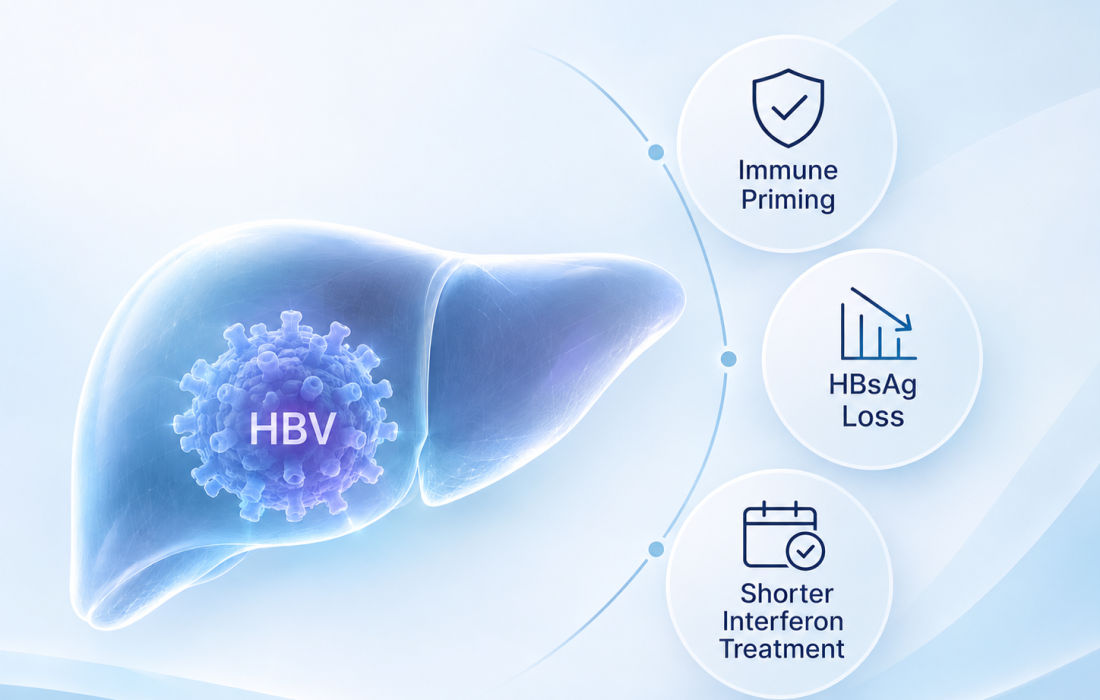
Brii Bio reports Phase 2 ENRICH and ENHANCE results showing improved HBsAg loss with BRII-179-based therapy and potential for 50% shorter interferon treatment.
Written By: Anshu Gupta, PharmD
Reviewed By: Pharmacally Editorial Team
Brii Biosciences (Brii Bio) has reported end-of-treatment (EOT) and follow-up results from its Phase 2b ENRICH and ENHANCE studies evaluating BRII-179-based treatment strategies in adults with chronic hepatitis B virus (HBV) infection. Presented in three late-breaking presentations at the American Association for the Study of Liver Diseases (AASLD) The Liver Meeting 2026, the findings provide further evidence supporting the investigation of immune priming to improve hepatitis B surface antigen (HBsAg) loss with combination therapies.
The studies evaluated BRII-179, an investigational HBV immunotherapeutic candidate, alongside elebsiran, an investigational small interfering RNA (siRNA), and pegylated interferon alfa (PEG-IFNα). The development strategy focuses on stimulating HBV-specific immune responses before or during antiviral treatment to improve the likelihood of HBsAg loss.
ENRICH prospectively reproduces the immune-priming effect
The Phase 2b ENRICH study evaluated BRII-179 as a priming treatment before elebsiran and PEG-IFNα. Participants received BRII-179 over 12 weeks using two dosing schedules, with administration every two or three weeks, followed by combination treatment.
Across the two study cohorts, 41.9% of participants (62/148) achieved HBsAg loss at EOT. The response was maintained in 32.4% (48/148) at 24 weeks after treatment completion.
Responses were also observed among participants with baseline HBsAg levels above 1,000 IU/mL and up to 3,000 IU/mL. In this subgroup, 32.1% achieved HBsAg loss at EOT, while 20.8% (11/53) maintained the response at 24 weeks post-EOT.
These findings prospectively reproduced the immune-priming signal previously observed in Cohort 4 of the ENSURE study, strengthening the rationale for evaluating BRII-179 before subsequent antiviral combination treatment.
ENHANCE demonstrates higher HBsAg loss with triple therapy
ENHANCE Part A1 evaluated concurrent treatment with BRII-179, elebsiran and PEG-IFNα against PEG-IFNα monotherapy in virologically suppressed adults with chronic HBV infection.
At EOT, HBsAg loss occurred in 25.5% (25/98) of participants receiving triple therapy, compared with 10.2% (5/49) receiving PEG-IFNα alone (p=0.0301). At 24 weeks post-EOT, the respective rates were 17.3% and 6.1%.
Among participants with baseline HBsAg levels above 1,000 IU/mL, HBsAg loss occurred in 24.2% (8/33) of those receiving triple therapy at EOT and 18.2% (6/33) at 24 weeks post-EOT. No HBsAg loss was observed in the corresponding monotherapy subgroup at either time point.
Triple therapy also induced stronger anti-HBs responses. At EOT, 50.0% (49/98) achieved anti-HBs levels of at least 10 IU/L, while 40.8% (40/98) reached at least 100 IU/L. Exploratory findings suggested an association between higher anti-HBs levels and subsequent maintenance of HBsAg loss.
ENHANCE A2 explores shorter interferon treatment
ENHANCE Part A2 investigated a sequential treatment strategy comprising 24 weeks of BRII-179 and elebsiran priming, followed by 24 weeks of elebsiran and PEG-IFNα. This approach reduced PEG-IFNα exposure by 50% compared with the 48-week regimen evaluated in Part A1.
Among 80 participants, 22.5% (18/80) achieved HBsAg loss at EOT, increasing to 25.0% (20/80) eight weeks after treatment completion.
At Week 24, following the priming phase, 45.0% (36/80) achieved anti-HBs levels of at least 10 IU/L, while 21.3% (17/80) reached at least 100 IU/L. Participants with anti-HBs levels of at least 10 IU/L subsequently demonstrated higher HBsAg loss rates than nonresponders, at 30.6% versus 15.9% at EOT. Among these responders, HBsAg loss reached 33.3% (12/36) at eight weeks post-EOT.
Responses were also observed in participants with higher baseline HBsAg levels. Among those above 1,000 IU/mL, HBsAg loss occurred in 14.6% (7/48) at EOT and 16.7% (8/48) at eight weeks post-EOT.
Safety and development outlook
Across ENRICH and ENHANCE, treatment regimens were generally safe and well tolerated. In ENRICH, commonly reported adverse events were consistent with the known PEG-IFNα safety profile, while ENHANCE Part A1 identified no new or unexpected safety signals. In Part A2, Grade 3 or higher adverse events were rare during the priming phase. Certain adverse events were reported less frequently than in Part A1, alongside shorter interferon exposure.
BRII-179 is a recombinant protein-based HBV immunotherapeutic candidate expressing Pre-S1, Pre-S2 and S surface antigens, designed to stimulate broad B-cell and T-cell immune responses. Elebsiran targets HBV RNA transcripts to reduce HBsAg production.
The findings add to data from five Phase 2 studies evaluating BRII-179 and support further investigation of immune priming as a strategy for improving HBsAg loss, particularly in participants with higher baseline HBsAg levels.
Clinical interpretation
ENRICH provides prospective support for BRII-179-mediated immune priming, while ENHANCE A1 demonstrates a statistically significant improvement in EOT HBsAg loss over PEG-IFNα monotherapy. ENHANCE A2 introduces a potentially important treatment-duration advantage by reducing interferon exposure by half. However, its results cannot establish equivalent efficacy to the longer A1 regimen because the treatment strategies and follow-up periods differ. Furthermore, HBsAg loss at eight or 24 weeks after treatment does not independently establish durable functional cure. Longer-term follow-up will be essential to determine the persistence of responses and assess potential antigen rebound.
Reference
Brii Bio Presents Late-Breaking Data from Its Phase 2 ENRICH and ENHANCE Studies at AASLD 2026, Supporting BRII-179-Based Priming and Enrichment Strategy for HBV Functional Cure, Brii Bioscience, 06 November 2026
Study to Investigate the Efficacy and Safety of Regimens Containing BRII-179, BRII-835, and PEG-IFNα Treating Chronic Hepatitis B Virus (HBV) Infection (ENRICH), ClinicalTrials.gov ID NCT06491563
A Study to Evaluate the Efficacy and Safety of Combination Therapy of BRII-179, BRII-835 and PEG-IFNα in Participants with Chronic Hepatitis B Virus (HBV) Infection (ENHANCE), ClinicalTrials.gov ID NCT06650852
About the Writer
Anshu Gupta (LinkedIn) is a PharmD professional and healthcare writer with interests in clinical research, pharmacovigilance, regulatory affairs, and medical writing. She has presented research at academic conferences and completed certifications in Good Clinical Practice (GCP), ICH-GCP, and drug safety. Passionate about clinical trials and evidence-based medicine, she is committed to translating scientific evidence into accurate, reliable, and accessible healthcare content.