
Lyell Immunopharma reports 91% and 95% response rates with ronde-cel across two LBCL treatment settings, with complete response rates of 77% and 76%.
Written By: Mayuri Vaja, PharmD
Reviewed By: Pharmacally Editorial Team
Lyell Immunopharma has reported updated clinical findings for rondecabtagene autoleucel (ronde-cel), its investigational dual-targeting CD19/CD20 CAR T-cell therapy, in patients with relapsed or refractory large B-cell lymphoma (R/R LBCL). Data from the pivotal PiNACLE trial in the third- or later-line (3L+) setting and a Phase 1/2 second-line (2L) cohort showed overall response rates (ORRs) of 91% and 95%, respectively, with complete response (CR) rates of 77% and 76%. Across the two cohorts, 101 patients had received treatment.
The updated findings will be presented at the 68th American Society of Hematology (ASH) Annual Meeting and Exposition, scheduled for December 12–15, 2026, in New Orleans. The 3L+ results have been accepted for an oral presentation, while the second-line findings will be presented as a poster.
PiNACLE Trial Shows Durable Responses in Later-Line LBCL
The ongoing pivotal PiNACLE trial (NCT05826535) is evaluating ronde-cel in patients with R/R LBCL who have received at least two prior lines of therapy. At the June 18, 2026, data cutoff, 58 patients had received treatment. The median patient age was 64 years, approximately 50% had primary refractory disease, and 64% were refractory to their most recent treatment.
Among 44 response-evaluable patients at Day 84, the ORR was 91% (40/44), including a CR rate of 77% (34/44). Median duration of complete response (DoCR) had not been reached. Among patients achieving CR, an estimated 92% remained in complete response at six months and 75% at 12 months.
Median progression-free survival (PFS) was also not reached. Estimated PFS rates were 76% at six months, 63% at 12 months and 54% at 24 months, with a median PFS follow-up of 12 months.
Regarding safety, no Grade 3 or higher cytokine release syndrome (CRS) was observed among the 58 treated patients. Grade 1 and Grade 2 CRS occurred in 48% and 22%, respectively. Grade 3 or higher immune effector cell-associated neurotoxicity syndrome (ICANS) was reported in 9%.
Second-Line Cohort Demonstrates High Response Rates
The fully enrolled Phase 1/2 second-line cohort included 43 patients who received ronde-cel, of whom 37 (86%) had primary refractory disease.
Among 37 response-evaluable patients at Day 84, the ORR was 95% (35/37), with a CR rate of 76% (28/37). Median DoCR had not been reached. An estimated 92% of patients achieving CR remained in complete response at six months, while 67% maintained their response at 12 months.
Median PFS was not reached, with estimated PFS rates of 75% at six months and 55% at 12 months. Median PFS follow-up was nine months.
No Grade 3 or higher CRS was observed among the 43 treated patients. Grade 1 and Grade 2 CRS occurred in 49% and 19%, respectively, while Grade 3 or higher ICANS was reported in 9%.
Ronde-cel is also being evaluated in PiNACLE-H2H, an ongoing randomized Phase 3 trial comparing the investigational therapy with investigator’s choice of approved CD19-directed CAR T-cell therapies in the second-line setting.
Dual-Targeting Approach and Manufacturing Strategy
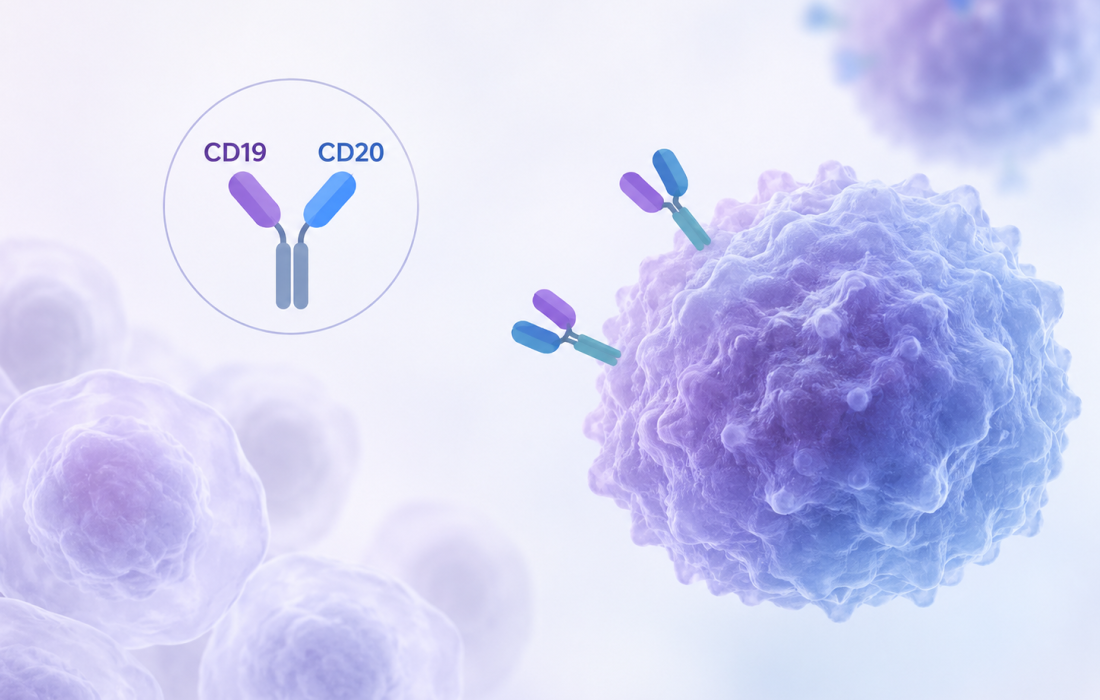
Ronde-cel is an autologous CAR T-cell therapy designed to target CD19 and CD20, two antigens expressed on B cells. Its dual-targeting approach is intended to recognize and eliminate tumour cells expressing either antigen, potentially addressing limitations associated with therapies targeting CD19 alone.
The manufacturing process enriches CD62L-positive T cells, which are associated with naïve and central memory T-cell populations. This strategy is designed to generate CAR T cells with improved persistence and antitumour activity, potentially supporting deeper and more durable responses.
Regulatory Designations and Development Timeline
The U.S. Food and Drug Administration (FDA) has granted ronde-cel Regenerative Medicine Advanced Therapy (RMAT) and Fast Track designations for R/R diffuse LBCL in the third- or later-line setting. The candidate has also received RMAT designation for LBCL in the second-line setting.
Lyell expects to report full pivotal data from PiNACLE in mid-2027, followed by a planned Biologics License Application (BLA) submission in the second half of 2027.
Updated Findings Support Further Clinical Evaluation
The updated findings demonstrate response rates above 90% and encouraging complete response durability across both treatment settings. The consistency of CR rates, which remained between 76% and 77%, is notable given the heavily pretreated populations, particularly the high proportion of patients with primary refractory disease.
However, these findings come from separate clinical cohorts and should not be interpreted as evidence of superiority over currently approved CAR T-cell therapies. The relatively limited follow-up, particularly in the second-line cohort, also warrants caution when interpreting long-term disease control.
The absence of Grade 3 or higher CRS in both cohorts, alongside the reported ICANS findings, provides an encouraging preliminary safety profile and supports further evaluation of potential outpatient administration. The randomized PiNACLE-H2H trial will be important in determining whether dual CD19/CD20 targeting translates into a meaningful clinical advantage over existing CD19-directed CAR T-cell therapies.
Reference
Lyell Immunopharma to Present Positive Updated Ronde-Cel Data in More than 80 Patients at ASH 2026 from PiNACLE Pivotal Trial in 3L+ and from Phase 1/2 2L Cohort in Patients with Relapsed/Refractory Large B-Cell Lymphoma, Lyell Immunopharma, 04 November 2026
Study of Rondecabtagene Autoleucel in Aggressive Large B-Cell Lymphoma, ClinicalTrials.gov ID NCT05826535

About the Writer
Mayuri Vaja (Linkedin) is a Pharm.D professional with a strong interest in clinical research, pharmacovigilance, and medical writing, supported by certifications in pharmacovigilance and academic projects exploring AI in healthcare and drug safety.
With a growing focus on evidence-based healthcare and scientific communication, she is developing expertise in clinical research and translating healthcare evidence into clear, meaningful content.
As a Pharmacally healthcare writer, Mayuri is committed to creating accurate, research-driven, and clinically relevant healthcare content while continuously strengthening her professional skills.