
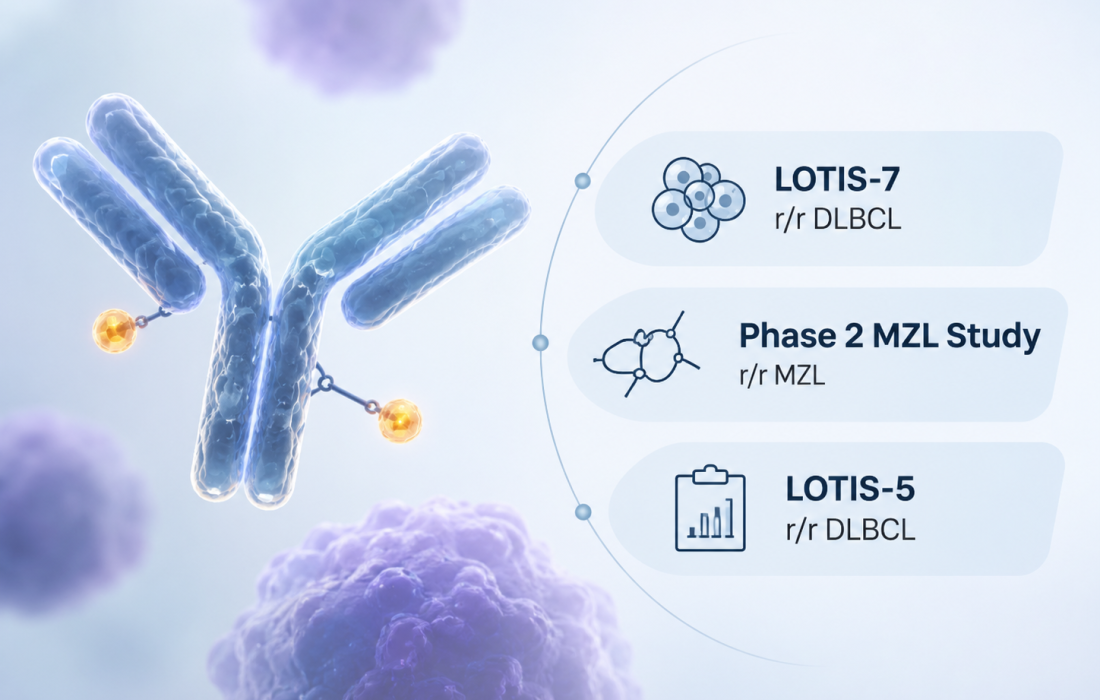
ADC Therapeutics reports updated ZYNLONTA results from LOTIS-7, LOTIS-5 and a Phase 2 MZL study, highlighting response rates and regulatory challenges ahead of ASH 2026.
Written By: Aasritha Thippavajjala, PharmD
Reviewed By: Pharmacally Editorial Team
ADC Therapeutics SA has announced five oral presentations highlighting its ZYNLONTA® (loncastuximab tesirine-lpyl) clinical development programme at the 68th American Society of Hematology (ASH) Annual Meeting and Exposition, scheduled for December 12–15, 2026, in New Orleans, Louisiana.
The presentations cover several B-cell malignancies, including relapsed or refractory diffuse large B-cell lymphoma (r/r DLBCL), marginal zone lymphoma (MZL), mantle cell lymphoma (MCL) and Waldenström macroglobulinemia (WM). The programme includes updated findings from LOTIS-7, a Phase 2 investigator-initiated MZL study and the Phase 3 LOTIS-5 trial.
ZYNLONTA: Mechanism of Action and Clinical Development
ZYNLONTA is a CD19-directed antibody-drug conjugate (ADC) designed to deliver a cytotoxic pyrrolobenzodiazepine (PBD) payload to CD19-expressing B cells. Following binding to CD19, the ADC is internalised, allowing enzymes to release the payload, which binds to DNA and induces cell-cycle arrest and tumour-cell death.
ZYNLONTA received accelerated approval from the US Food and Drug Administration (FDA) and conditional approval from the European Commission for adults with r/r large B-cell lymphoma following two or more lines of systemic therapy. Its clinical development programme continues to evaluate monotherapy and combination strategies across additional B-cell malignancies.
LOTIS-7: High Response Rates with ZYNLONTA Plus Glofitamab
The Phase 1b LOTIS-7 trial (NCT04970901) evaluated ZYNLONTA in combination with glofitamab, a CD20×CD3 bispecific antibody, in patients with r/r DLBCL.
Among 97 efficacy-evaluable patients receiving the selected ZYNLONTA starting dose of 150 µg/kg, the combination achieved an overall response rate (ORR) of 88.7% and a complete response (CR) rate of 75.3%. At a median follow-up of 10.35 months, median duration of response and progression-free survival (PFS) had not been reached. The estimated 12-month duration of complete response rate was 79.0%.
Responses were also observed in difficult-to-treat subgroups. Patients with primary refractory disease achieved an ORR of 78.4% and a CR rate of 64.7%, while previously CAR-T-treated patients demonstrated corresponding rates of 74.1% and 63.0%.
Exploratory minimal residual disease (MRD) analysis also showed undetectable MRD in six of 12 complete responders as early as Cycle 2, with 11 achieving undetectable MRD by the end of treatment.
Cytokine release syndrome (CRS) occurred in 32% of patients, predominantly Grade 1 and Grade 2 events. One Grade 3 event was reported, with no Grade 3 or higher immune effector cell-associated neurotoxicity syndrome (ICANS). Three Grade 5 treatment-emergent adverse events were reported.
Phase 2 MZL Study: Durable Responses with Monotherapy
A multicentre Phase 2 investigator-initiated study (NCT05296070) evaluated fixed-duration ZYNLONTA monotherapy in patients with r/r MZL.
Among 43 efficacy-evaluable patients, treatment achieved an ORR of 93% and a CR rate of 74.4%. At a median follow-up of 23.2 months, the two-year PFS rate was 90.8%, while the 24-month duration-of-response rate was 90.9%.
The study included patients with challenging disease characteristics: 37% had primary refractory disease, and 42% had experienced progression within 24 months of initial therapy. Patients had received a median of two previous treatment lines.
Safety findings included Grade 3 adverse events in 23 patients (50%) and Grade 4 events in five patients (10.9%). Four patients required dose reductions. The efficacy analysis included 43 patients, while the safety population comprised 46 treated patients.
LOTIS-5: Phase 3 PFS Benefit Amid Regulatory Concerns
The randomized Phase 3 LOTIS-5 trial (NCT04384484) compared ZYNLONTA plus rituximab with rituximab, gemcitabine and oxaliplatin (R-GemOx) in 420 patients with r/r DLBCL.
The trial met its primary PFS endpoint, with median PFS of 6.14 months versus 4.73 months (HR 0.73; 95% CI, 0.57–0.92; P=0.0083). ORR was 58.1% versus 45.2%, while CR rates were 39.5% and 26.7%, respectively. Median duration of complete response was 16.82 months versus 12.25 months. However, no statistically significant overall survival benefit was established.
Safety findings require particular consideration. Within the protocol-defined 105-day reporting window, Grade 5 treatment-emergent adverse events occurred in 13.2% of patients receiving ZYNLONTA plus rituximab, compared with 4.6% receiving R-GemOx. Under the standard 30-day post-treatment reporting window, the corresponding rates were 1.5% and 3.0%.
Following a pre-sBLA meeting, the FDA raised substantial concerns regarding the benefit-risk profile and verification of clinical benefit, considering the Grade 5 event imbalance in the context of a marginal treatment benefit. ADC Therapeutics is assessing the appropriate regulatory pathway for ZYNLONTA following this feedback.
Clinical Implications and Development Outlook
The ASH 2026 programme highlights the breadth of ZYNLONTA’s clinical evaluation across B-cell malignancies. LOTIS-7 demonstrates encouraging combination activity in r/r DLBCL, including previously CAR-T-treated and primary refractory patients. The MZL study adds evidence of durable responses with fixed-duration monotherapy.
However, LOTIS-5 illustrates the distinction between meeting a statistical PFS endpoint and establishing an acceptable overall benefit-risk profile for regulatory approval. The FDA’s concerns remain an important consideration for the programme.
ADC Therapeutics has completed LOTIS-7 enrolment and is evaluating a Phase 3 study of ZYNLONTA plus glofitamab. The company also expects to submit LOTIS-7 and MZL findings for Breakthrough Therapy Designation. These remain development plans rather than established regulatory milestones.
Further follow-up and confirmatory evaluation will be important in determining whether these findings translate into broader treatment options for patients with B-cell malignancies.
References
ADC Therapeutics Announces Abstracts at the 68th ASH Annual Meeting Highlighting Breadth of ZYNLONTA Clinical Program, ADC Therapeutics, November 4, 2026.
Open-label of Loncastuximab Tesirine (ADCT-402) in Relapsed/Refractory Marginal Zone Lymphoma, ClinicalTrials.gov ID NCT05296070
A Study to Evaluate the Safety and Anti-cancer Activity of Loncastuximab Tesirine in Combination with Other Anti-cancer Agents in Participants with Relapsed or Refractory B-cell Non-Hodgkin Lymphoma (LOTIS-7), ClinicalTrials.gov ID NCT04970901
Study to Evaluate Loncastuximab Tesirine with Rituximab Versus Immunochemotherapy in Participants with Relapsed or Refractory Diffuse Large B-Cell Lymphoma (LOTIS 5), ClinicalTrials.gov ID NCT04384484

About the Writer
Aasritha Thippavajjala (Linkedin) is a pharm D student and aspiring medical writer with medical writing, clinical training experience and a strong interest in clinical research and patient safety She has hands-on exposure to clinical pharmacy activities including medication profile assessment, clinical case review, identification of potential drug-related problems, ADR awareness, patient counselling, and clinical documentation. She has also gained experience in medical literature review, evidence synthesis, and scientific communication through her published review article on digital twin-based patient simulation and her poster presentation at the 74th Indian Pharmaceutical Congress. Certified in ICH Good Clinical Practice (E6(R3)) and Scientific Writing in Health Research, she is passionate about applying her clinical knowledge and research skills to medical writing ,clinical research and contributing to accurate, evidence-based healthcare.