
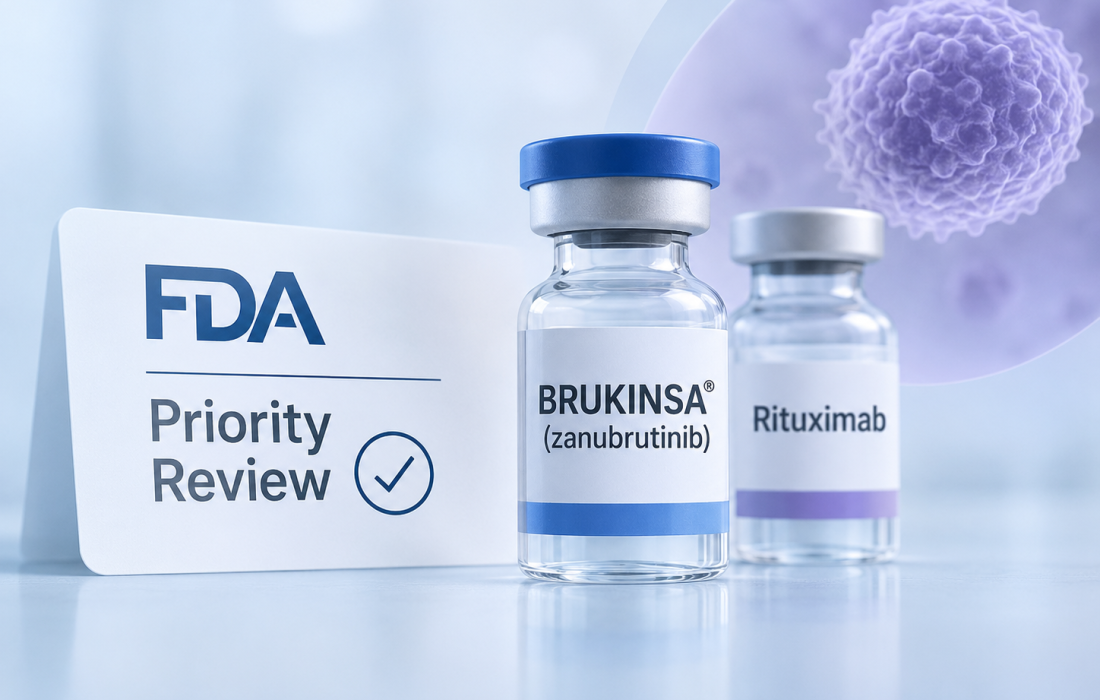
FDA grants Priority Review to BeOne Medicines’ BRUKINSA plus rituximab for first-line mantle cell lymphoma after Phase 3 MANGROVE showed a 43% reduction in progression or death risk.
Written By: Creola Gonsalves, MS, Biotech
Reviewed By: Pharmacally Editorial Team
BeOne Medicines Ltd. announced that the U.S. Food and Drug Administration (FDA) has accepted and granted Priority Review to its supplemental New Drug Application (sNDA) for BRUKINSA® (zanubrutinib) in combination with rituximab for adults with previously untreated mantle cell lymphoma (MCL).
The application is supported by positive results from the pivotal Phase 3 MANGROVE study, in which the chemotherapy-free combination reduced the risk of disease progression or death by 43% compared with bendamustine plus rituximab (BR), an established chemoimmunotherapy regimen. If approved, the combination could introduce a new first-line treatment option that avoids conventional cytotoxic chemotherapy.
Full MANGROVE results are scheduled for presentation during the Plenary Scientific Session at the 68th American Society of Hematology (ASH) Annual Meeting on December 13, 2026.
MANGROVE Demonstrates Significant Progression-Free Survival Benefit
MANGROVE (BGB-3111-306; NCT04002297) is a global, randomized, open-label Phase 3 trial evaluating zanubrutinib plus rituximab against bendamustine plus rituximab in adults with previously untreated MCL who are ineligible for stem cell transplantation.
The study enrolled 510 patients across 157 active sites worldwide. It is the first Phase 3 trial to evaluate a chemotherapy-free, BTK inhibitor-based regimen against standard chemoimmunotherapy in the frontline MCL setting.
At a prespecified interim analysis, zanubrutinib plus rituximab met the primary endpoint of progression-free survival (PFS), assessed by an independent review committee (IRC).
The combination demonstrated a 43% reduction in the relative hazard of disease progression or death compared with BR (hazard ratio [HR], 0.57; 95% confidence interval [CI], 0.43–0.76; p<0.0001).
The hazard ratio indicates a statistically significant improvement in PFS favouring the zanubrutinib combination. However, the reported 43% reduction represents a relative reduction in the hazard of progression or death, not a 43-percentage-point improvement in PFS or an established reduction in overall mortality.
Overall survival (OS), a key secondary endpoint, was immature at the interim analysis. BeOne Medicines previously reported a favourable trend in the experimental arm, with formal OS testing planned as part of the final analysis.
The safety profile of zanubrutinib plus rituximab was consistent with the known safety profiles of both medicines, with no new safety signals identified.
A Chemotherapy-Free Strategy for Frontline MCL
Mantle cell lymphoma is a relatively uncommon B-cell non-Hodgkin lymphoma that predominantly affects older adults. Treatment selection can be challenging because of disease heterogeneity, patient age, comorbidities and differences in treatment tolerance.
Bendamustine plus rituximab has been an established first-line treatment approach, particularly for patients who are not candidates for intensive treatment strategies. However, conventional chemoimmunotherapy can cause myelosuppression, prolonged immune suppression and increased infection risk.
MANGROVE evaluates a different treatment strategy: replacing conventional chemotherapy with targeted BTK inhibition while retaining rituximab.
Zanubrutinib is a next-generation Bruton tyrosine kinase (BTK) inhibitor that blocks signalling pathways involved in malignant B-cell proliferation and survival. Rituximab is a CD20-directed monoclonal antibody that targets B cells through a complementary mechanism.
By combining these agents, the regimen aims to achieve disease control without exposing patients to conventional cytotoxic chemotherapy.
Treatment Design and Clinical Endpoints
In the experimental arm, patients received zanubrutinib at 160 mg orally twice daily alongside rituximab during the initial treatment period, followed by zanubrutinib monotherapy until disease progression or intolerance.
Patients in the control arm received six cycles of bendamustine plus rituximab.
Beyond IRC-assessed PFS, secondary endpoints include OS, investigator-assessed PFS, overall response rate, duration of response, patient-reported outcomes and safety.
The continuous zanubrutinib treatment strategy is an important consideration when assessing the regimen’s clinical value. Although it avoids conventional chemotherapy, long-term BTK inhibitor exposure still requires appropriate safety monitoring and tolerability assessment.
FDA Priority Review and Global Regulatory Progress
The FDA’s Priority Review designation represents an important regulatory milestone for BeOne Medicines. However, the application remains under review, and the designation does not constitute marketing approval for the proposed first-line indication.
BeOne Medicines has also submitted an application for BRUKINSA in MCL to the European Medicines Agency (EMA), while China’s Center for Drug Evaluation (CDE), under the National Medical Products Administration (NMPA), has accepted the application.
BRUKINSA is already approved in the United States for several B-cell malignancies, including relapsed or refractory MCL, chronic lymphocytic leukemia/small lymphocytic lymphoma, Waldenström’s macroglobulinemia, relapsed or refractory marginal zone lymphoma and follicular lymphoma.
The latest application seeks to expand zanubrutinib’s role into the previously untreated MCL setting.
Clinical Implications and Next Milestone
The MANGROVE findings represent an important development in frontline MCL treatment because they evaluate whether targeted therapy can replace, rather than simply supplement, conventional chemotherapy.
The statistically significant PFS improvement over bendamustine plus rituximab provides clinical evidence supporting this approach in the studied population. Nevertheless, the full efficacy and safety dataset, longer-term outcomes and final OS analysis will be important in determining its place in clinical practice.
The presentation of complete MANGROVE results at ASH 2026 on December 13 will provide further insight into the durability of treatment benefit and the combination’s safety profile.
If approved, zanubrutinib plus rituximab could expand first-line treatment options for adults with previously untreated MCL who are ineligible for stem cell transplantation, potentially establishing a chemotherapy-free alternative to conventional chemoimmunotherapy.
References
U.S. FDA Grants Priority Review to BeOne Medicines’ BRUKINSA Combination in First-Line Mantle Cell Lymphoma, BeOne Medicine, 04 November 2026
A Study to Investigate the Efficacy of Zanubrutinib Plus Rituximab Compared with Bendamustine Plus Rituximab in Adults with Previously Untreated Mantle Cell Lymphoma Who Are Ineligible for Stem Cell Transplantation (MANGROVE), ClinicalTrials.gov ID NCT04002297

About the Writer
Creola Gonsalves (Linkedin) is an M.S. Biotechnology postgraduate with a strong interest in clinical research, evidence interpretation, and healthcare writing, with a focus on translating life-science knowledge into meaningful real-world insights.
She is trained in Good Clinical Practice (GCP), clinical research principles, and critical interpretation of randomized clinical trials, with certifications from NIH and Stanford University.
Her research background in biotechnological applications and microbial research strengthens her ability to understand scientific evidence and develop clear, accurate, and research-driven healthcare content.