
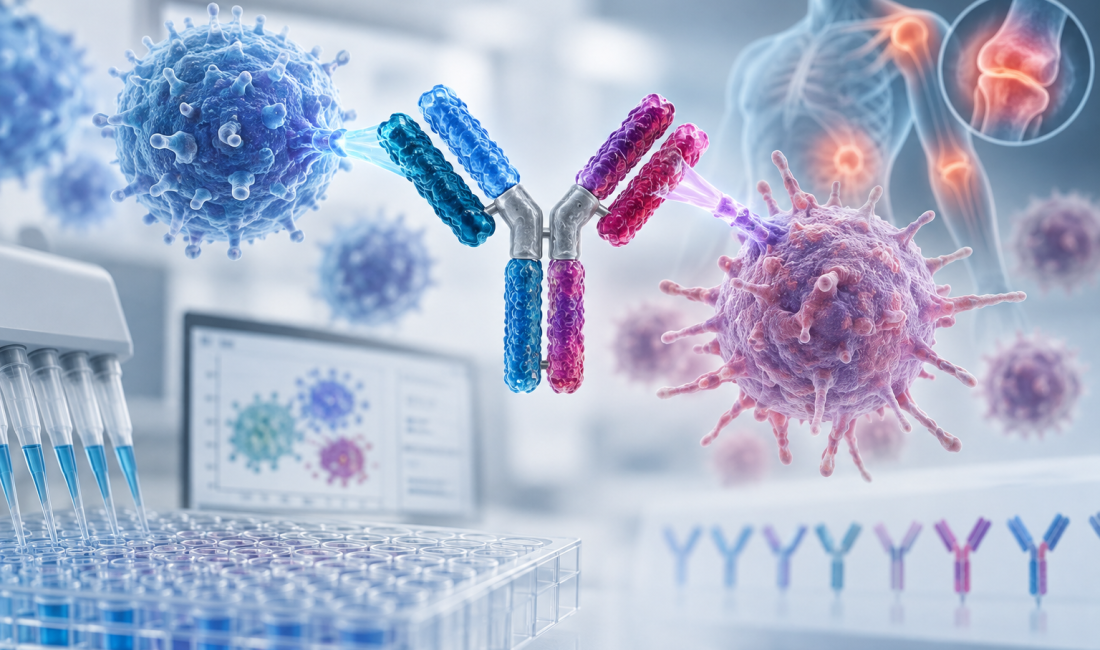
Roche and Dualitas will screen more than 300,000 bispecific antibody combinations for immunology and inflammation diseases under a deal worth up to $1 billion.
Written By: Anshu Gupta, PharmD
Reviewed By: Pharmacally Editorial Team
Dualitas Therapeutics has signed a research collaboration and license agreement with Roche to discover novel bispecific antibodies (BsAbs) for immunology and inflammation (I&I) diseases using its DualScreen™ Bispecific Discovery Engine.
The collaboration will evaluate more than 300,000 bispecific combinations, making it one of the largest reported efforts to systematically screen BsAb combinations for I&I applications. Dualitas will conduct the discovery work, while Roche will lead subsequent preclinical development, regulatory activities, manufacturing and commercialization.
Under the agreement, Dualitas will receive $36.5 million in upfront payments. The company is also eligible for research, development and commercial milestone payments that could bring the total deal value to up to $1 billion, plus tiered royalties on potential commercial products.
DualScreen Focuses on Proximity Biology
The collaboration centers on Dualitas’ approach to proximity biology, which examines how bringing two biological targets into close physical proximity can generate functional effects that individual therapies or conventional target combinations may not achieve.
Traditional bispecific antibody discovery often begins with predefined target pairs based on established biological hypotheses. Dualitas’ DualScreen platform instead uses high-throughput functional screening across cell surfaces to evaluate a much larger range of target and epitope combinations.
According to the company, the platform can interrogate hundreds of thousands of unique bispecific combinations to identify proximity-driven mechanisms and candidates showing synergistic activity.
This approach could expand the range of biological interactions available for BsAb development, particularly in I&I diseases where complex immune-cell signaling and interactions between multiple pathways contribute to disease.
No Clinical Candidates Identified Under the Collaboration Yet
The agreement represents a discovery-stage collaboration, rather than a clinical development partnership involving an identified drug candidate.
The source announcement does not disclose specific targets, bispecific molecules, disease indications, development candidates, clinical trial plans or efficacy and safety data from the Roche collaboration. The immediate objective is to use DualScreen to identify and develop potential BsAb candidates for subsequent Roche-led development.
Dualitas said its broader internal pipeline of proximity engager BsAbs is progressing separately, with the company expecting it’s I&I therapeutic programs to enter clinical development next year.
Roche to Lead Subsequent Development
Forbes Huang, co-founder, chief operating officer and chief business officer of Dualitas, said the agreement enables the companies to apply the company’s discovery platform at a scale previously difficult to achieve.
Karim Dabbagh, Ph.D., Dualitas’ CEO and board member, highlighted the potential of proximity-based mechanisms to produce amplified therapeutic effects compared with conventional antibody approaches. The company will continue advancing its internal pipeline alongside the Roche collaboration.
Boris L. Zaïtra, head of corporate business development at Roche, said bispecific antibodies remain an important component of Roche’s strategy across multiple disease areas and emphasized external partnerships as a route to advancing new approaches in I&I.
Large-Scale Screening Sets Up Next Development Phase
The immediate milestone is the functional screening of more than 300,000 bispecific combinations through DualScreen. Candidates emerging from this discovery effort would then move into Roche-led preclinical development, followed by regulatory, manufacturing and commercial activities if supported by subsequent data.
The agreement gives Roche access to a large-scale proximity-biology discovery approach while allowing Dualitas to retain focus on its own internal BsAb pipeline. For the field, the collaboration also illustrates a shift toward broader functional screening strategies that evaluate large numbers of target combinations rather than relying exclusively on predefined bispecific designs.
Reference
Dualitas Therapeutics Announces Proximity Biology Research Collaboration with Roche to Discover and Develop Novel Bispecific Antibodies for I&I Diseases, Dualitas Therapeutics, 17 September 2026

About the Writer
Anshu Gupta (LinkedIn) is a PharmD professional and healthcare writer with interests in clinical research, pharmacovigilance, regulatory affairs, and medical writing. She has presented research at academic conferences and completed certifications in Good Clinical Practice (GCP), ICH-GCP, and drug safety. Passionate about clinical trials and evidence-based medicine, she is committed to translating scientific evidence into accurate, reliable, and accessible healthcare content.