
FDA approves FAYUVI (rebisufligene etisparvovec-hopf; UX111), the first treatment for Sanfilippo syndrome type A, based on Transpher A data.
Written By: Siddhi Bhadekar, M. Pharm (QA)
Reviewed By: Pharmacally Editorial Team
The U.S. FDA has granted full approval to Ultragenyx Pharmaceutical’s FAYUVI (rebisufligene etisparvovec-hopf; formerly known as UX111), an AAV9-based gene therapy for pediatric patients with mucopolysaccharidosis type IIIA (MPS IIIA), also known as Sanfilippo syndrome type A.
First FDA-Approved Treatment for MPS IIIA
FAYUVI is the first FDA-approved treatment for Sanfilippo syndrome type A, a progressive and fatal lysosomal storage disease that primarily affects the central nervous system.
Children with MPS IIIA typically develop developmental delay in early childhood, followed by progressive loss of cognitive, language, and motor function. The disease results from deficiency of the sulfamidase enzyme, encoded by the SGSH gene, leading to accumulation of heparan sulfate and progressive neurologic damage.
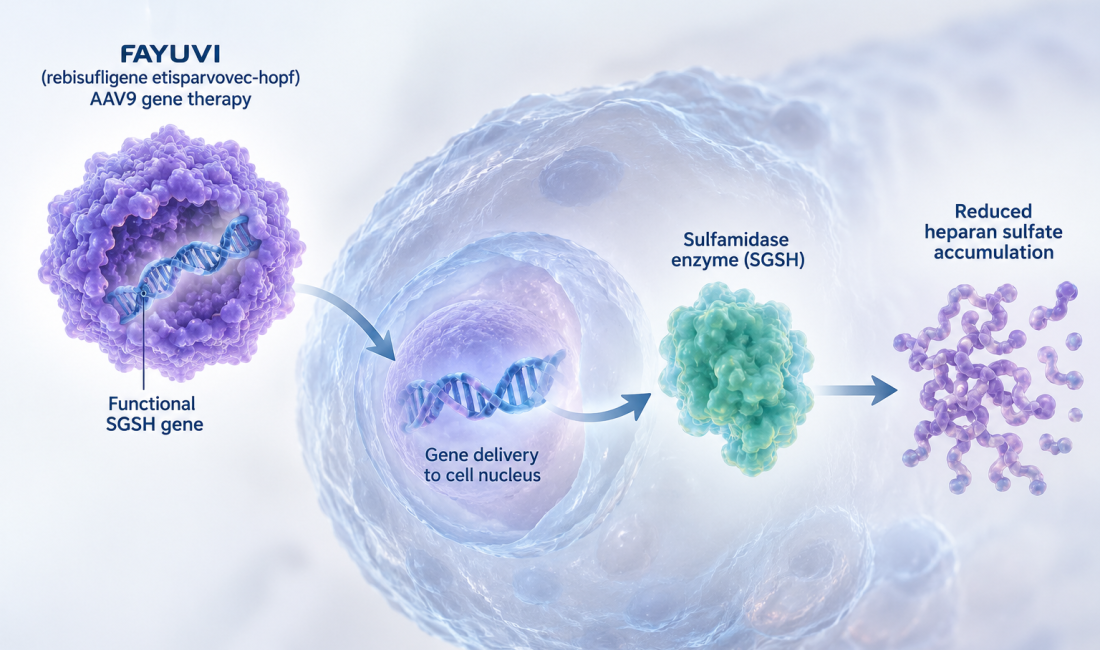
FAYUVI is administered as a single intravenous dose. The AAV9-based gene therapy delivers a functional copy of SGSH, enabling production of the deficient sulfamidase enzyme and reducing the accumulation of heparan sulfate.
Transpher A Data Supported Full Approval
FDA approval was supported by data from the pivotal Transpher A trial and long-term follow-up studies, with clinical data extending to nearly eight years.
Biochemical activity was demonstrated through reductions in cerebrospinal fluid (CSF) heparan sulfate levels across treatment groups and age ranges, supporting restoration of sulfamidase activity and reduction of accumulated substrate.
Clinical efficacy was assessed using the Bayley Scales of Infant and Toddler Development, Third Edition (Bayley-III) Cognitive raw score between 24 and 60 months of age.
In the modified intention-to-treat population, 17 FAYUVI-treated patients were compared with 27 untreated patients from a comparable external natural-history cohort. FAYUVI-treated patients demonstrated a 23.5-point higher cognitive score than the natural-history group over the study period (p<0.0001).
Ultragenyx said the clinical findings, biomarker responses, and durability of treatment effect supported the basis for standard full approval.
Safety Profile and FDA Warnings
The safety profile was considered acceptable across the clinical program. The most common adverse reactions occurring in ≥5% of patients included elevated liver enzymes, vomiting, abnormal behavior, diarrhea, and pyrexia.
The FDA-approved labeling includes warnings and precautions for hepatotoxicity, thrombocytopenia, thrombotic microangiopathy (TMA), and infusion-related reactions.
The safety findings are particularly relevant for a gene therapy administered as a single treatment, where monitoring for hepatic, hematologic, and infusion-related complications forms an important part of clinical management.
From UX111 to Approved Gene Therapy
FAYUVI marks Ultragenyx’s second gene therapy approval and sixth FDA approval overall. The company also received a Priority Review Voucher following the FDA decision.
The program originated from research by Haiyan Fu, PhD, and Doug McCarty, PhD, during their tenures at Ohio State University and Nationwide Children’s Hospital. The therapy was subsequently licensed to Abeona Therapeutics. After funding constraints affected development despite positive clinical data, Abeona out-licensed the program to Ultragenyx, which continued development through regulatory review.
Kevin M. Flanigan, MD, director of the Center for Gene Therapy at Nationwide Children’s Hospital and principal investigator of the study supporting approval, noted that the AAV9 vector used in the therapy was first developed at Nationwide Children’s more than a decade ago.
U.S. Treatment Access and Commercial Launch
Ultragenyx plans to make FAYUVI available through a network of Qualified Treatment Centers (QTCs) in the United States. These institutions will receive specialized training to administer the gene therapy.
Commercial product is expected to be available for shipment to QTCs within 30 to 60 days.
The company will support treatment access through its UltraCare program, which includes specialized Gene Therapy Guides to assist eligible patients and caregivers with insurance coverage, treatment logistics, and access-related questions.
FAYUVI will be manufactured in the United States at Ultragenyx’s gene therapy manufacturing facility in Bedford, Massachusetts, and at Andelyn Biosciences in Columbus, Ohio.
The approval establishes FAYUVI as the first FDA-approved therapy for Sanfilippo syndrome type A and advances an AAV9 gene-replacement approach into clinical use for this ultra-rare pediatric neurodegenerative disorder.
Reference
Ultragenyx Announces Approval of FAYUVI™ Gene Therapy, the First-Ever FDA-Approved Treatment for Sanfilippo Syndrome Type A (MPS IIIA), Ultragenyx, 17 September 2026
Phase I/II/III Gene Transfer Clinical Trial of scAAV9.U1a.hSGSH, ClinicalTrials.gov ID NCT02716246
Follow-up Study of AAV-Mediated Gene Transfer (UX111; Previously Known as ABO-102) for MPS Type IIIA, ClinicalTrials.gov ID NCT04360265

About the Writer
Siddhi Rajendra Bhadekar (Linkedin) is an M.Pharm professional with expertise in medical and scientific writing, literature review, publication writing, and evidence synthesis, supported by four peer-reviewed publications.
She brings working knowledge of ICH-GCP, MedDRA, pharmacovigilance, ADR/AE reporting, clinical data management, and regulatory documentation.
With experience across pharmaceutical R&D, Quality Control, and Quality Assurance, she combines scientific research skills with strong attention to accuracy and detail.
Her background in manuscript development, publication planning, and scientific communication enables her to translate complex healthcare information into clear, reliable content.