
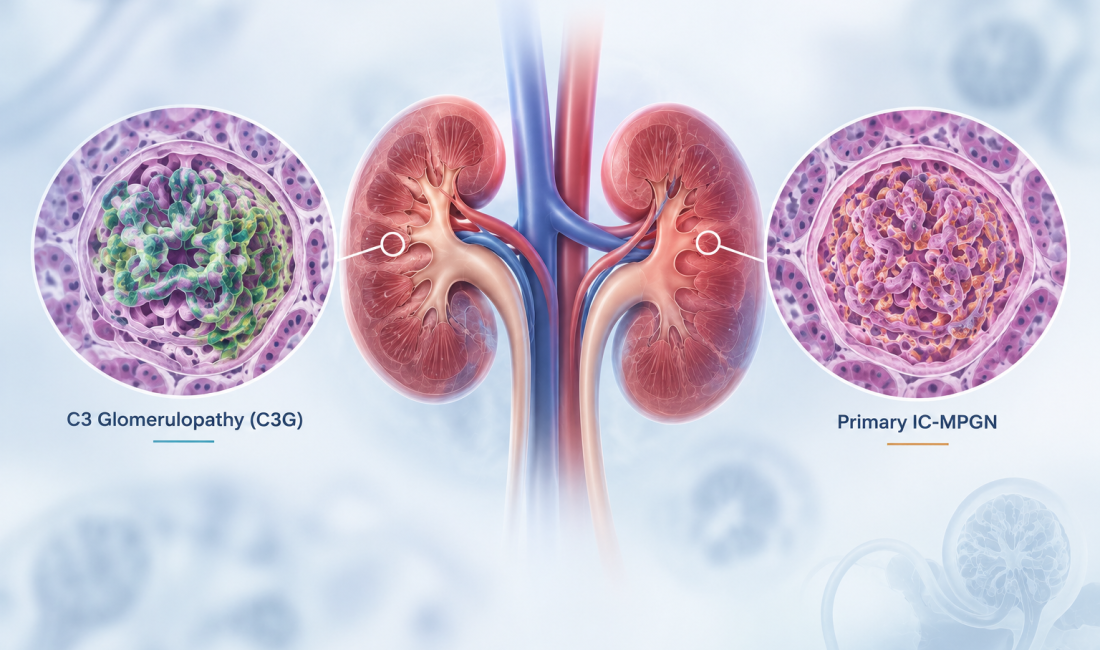
Empaveli reduced proteinuria by 75% versus placebo in adolescents with C3G or primary IC-MPGN in the Phase 3 VALIANT study, with stable kidney function.
Written By: Mayuresh Salvi, PharmD
Reviewed By: Pharmacally Editorial Team
Empaveli (pegcetacoplan) produced a 75% relative reduction in proteinuria versus placebo after 26 weeks in adolescents aged 12 to 17 years with C3 glomerulopathy (C3G) or primary immune complex membranoproliferative glomerulonephritis (IC-MPGN), while kidney function remained stable. The findings from a prespecified VALIANT subgroup analysis provide additional evidence on pegcetacoplan in this younger population.
Complement-Driven Kidney Disease in Adolescents
C3G and primary IC-MPGN are rare, chronic kidney diseases driven by dysregulation of the complement system. Excessive complement activation promotes accumulation of C3 effectors in the glomeruli, inflammation and progressive kidney damage.
Both diseases are frequently diagnosed during adolescence or early adulthood. Approximately half of patients with C3G are diagnosed before age 18, while the median age at diagnosis for primary IC-MPGN is about 21 years. Despite standard-of-care treatment, approximately 20% of children with C3G or primary IC-MPGN progress to kidney failure within 10 to 15 years of diagnosis.
Pegcetacoplan is a targeted C3/C3b inhibitor that acts centrally in the complement cascade. It blocks C3 cleavage and downstream complement activation, including the amplification loop implicated in C3G and primary IC-MPGN.
VALIANT Shows 75% Reduction in Proteinuria
VALIANT (NCT05067127) was a multicenter, randomized, double-blind, placebo-controlled Phase 3 study evaluating pegcetacoplan in patients aged 12 years and older with C3G or primary IC-MPGN. The adolescent subgroup included 55 patients, with 28 receiving pegcetacoplan and 27 receiving placebo.
Patients received pegcetacoplan or placebo twice weekly for 26 weeks alongside stable, optimized supportive care. Adolescent dosing was age- and weight-based, with regimens modeled to achieve exposures comparable with the adult 1,080 mg twice-weekly dose.
At Week 26, adolescents treated with pegcetacoplan achieved a 75% relative reduction in urine protein-to-creatinine ratio (UPCR) versus placebo (95% CI, 59%-84%; nominal P<0.001). Proteinuria reduction emerged as early as Week 4 and continued through Week 26.
Because this was a prespecified adolescent subgroup analysis and the reported comparisons were not corrected for multiplicity, the P-values are nominal and should be interpreted accordingly.
At least a 50% reduction in proteinuria occurred in 71% of adolescents receiving pegcetacoplan versus 4% receiving placebo. A composite renal endpoint, defined as stable or improved eGFR together with at least a 50% UPCR reduction, was reached by 57% and 4% of patients, respectively (nominal P=0.002).
The analysis also showed a shift toward lower proteinuria levels. Among pegcetacoplan-treated adolescents, the proportion with UPCR of 1 g/g or lower increased from 11% at baseline to 46% at Week 26, while the proportion with nephrotic-range proteinuria decreased from 39% to 11%.
Kidney Function Remained Stable
eGFR remained stable in the pegcetacoplan group during the 26-week randomized period. The least-squares mean change was 0.7 mL/min/1.73 m² with pegcetacoplan versus a 9.0 mL/min/1.73 m² decline with placebo, producing a between-group difference of 9.7 mL/min/1.73 m² (95% CI, 0.0-19.4; nominal P=0.05).
The adolescent findings were consistent with those observed in the overall VALIANT population. However, the adolescent subgroup did not undergo protocol-directed repeat kidney biopsies, so histological outcomes were not assessed. In the overall population, more than 70% of adults with paired biopsies achieved clearance of glomerular C3 staining by Week 26, but a comparable histological assessment was not available for adolescents.
Safety Profile Consistent With VALIANT
Treatment-emergent adverse events occurred in 82% of pegcetacoplan-treated adolescents and 96% of placebo-treated adolescents. Serious adverse events occurred in three patients in each group. No deaths occurred, and no adverse event led to treatment discontinuation in the pegcetacoplan group.
One adolescent receiving pegcetacoplan developed fever considered treatment-related by the investigator. The episode occurred shortly after infusion, resolved rapidly and recurred with the subsequent administration. No infection was identified, and the patient continued treatment. No serious infections caused by encapsulated bacteria were reported among adolescents.
Longer-Term Kidney Outcomes Remain Under Evaluation
The findings follow the U.S. FDA label expansion for Empaveli to patients aged 12 years and older with C3G or primary IC-MPGN, covering reduction of proteinuria and loss of kidney function.
The current analysis covers the first six months of treatment. Longer-term efficacy and safety are being evaluated during the VALIANT open-label period and the ongoing VALE long-term extension study (NCT05809531). The investigators also identified the limited number of adolescents with prior kidney transplantation and the absence of serial biopsy data as limitations requiring further study.
Reference
Vivarelli, M, et al, (2026). Pegcetacoplan for Adolescents with C3 Glomerulopathy or Primary Immune Complex Membranoproliferative GN: Phase 3 VALIANT Subgroup Analysis. Clinical Journal of the American Society of Nephrology, 21(8), 1404–1413. https://doi.org/10.2215/CJN.0000001077
Phase 3 Pediatric EMPAVELI Data Published in Clinical Journal of the American Society of Nephrology Show Reduction in Proteinuria and Stabilized Kidney Function in Adolescents with C3G or Primary IC-MPGN, Biogen, 17 September 2026
Phase III Study Assessing the Efficacy and Safety of Pegcetacoplan in Patients with C3 Glomerulopathy or Immune-Complex Membranoproliferative Glomerulonephritis (VALIANT),

About the Writer
Mayuresh Sunil Salvi (Linkedin) is a PharmD professional and healthcare writer with a strong interest in pharmacovigilance, drug safety, and emerging medical research. He is passionate about exploring new drug discoveries, clinical research, and advances in evidence-based medicine. His interests also include ward rounds, prescription audits, and treatment analysis to support rational pharmacotherapy and improved patient care.