
Updated Phase III HARMONi data show sustained overall survival benefit with ivonescimab plus chemotherapy in EGFR-mutated NSCLC after third-generation EGFR TKI treatment.
Written By: Mansi Nakum, PharmD
Reviewed By: Pharmacally Editorial Team
Summit Therapeutics reported updated overall survival results from the global Phase III HARMONi trial showing that ivonescimab plus platinum-doublet chemotherapy continued to improve survival versus placebo plus chemotherapy in patients with EGFR-mutated non-small cell lung cancer (NSCLC) previously treated with a third-generation EGFR tyrosine kinase inhibitor (TKI). The survival benefit remained consistent across Western and Asian patients, with no new safety signals after longer follow-up.
HARMONi Builds on a Strong PFS Benefit
HARMONi previously demonstrated a statistically significant progression-free survival (PFS) benefit, with median PFS of 6.8 months for ivonescimab plus chemotherapy versus 4.4 months for placebo plus chemotherapy (HR, 0.52; 95% CI, 0.41-0.66; p<0.0001). The updated analysis adds a more mature assessment of overall survival, one of the trial’s two primary endpoints.
At the April 2025 primary OS analysis, ivonescimab showed a favorable survival trend that narrowly missed statistical significance, with an HR of 0.79 (95% CI, 0.62-1.01; p=0.057). Median OS was 16.8 months with ivonescimab plus chemotherapy versus 14.0 months with placebo plus chemotherapy.
By the June 2026 data cutoff, the global intention-to-treat population showed an OS HR of 0.76 (95% CI, 0.61-0.95; nominal p=0.0151). In Western patients, median follow-up had increased to 23.2 months, with an OS HR of 0.76 (95% CI, 0.52-1.10). Median OS in this subgroup was 17.5 versus 14.0 months.
A Bispecific Approach to PD-1 and VEGF
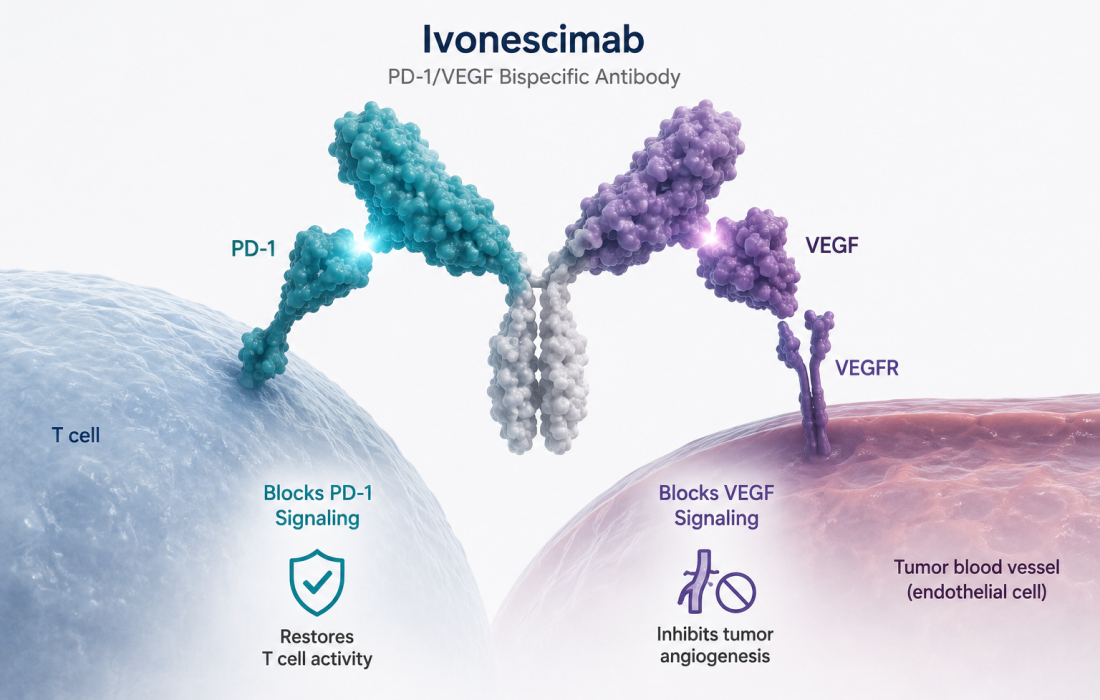
Ivonescimab is an investigational bispecific antibody that combines PD-1 immune checkpoint blockade with VEGF-targeted anti-angiogenic activity in a single molecule. Its tetravalent structure provides four binding sites and enables cooperative binding, with higher affinity for PD-1 in the presence of VEGF. The approach is intended to increase activity within the tumor microenvironment, where both targets can be more prevalent than in normal tissue.
The HARMONi population represents a treatment setting with continued unmet need: patients with locally advanced or metastatic non-squamous EGFR-mutated NSCLC whose disease has progressed after a third-generation EGFR TKI. The combination therefore tests ivonescimab alongside chemotherapy after targeted therapy rather than as an initial treatment.
HARMONi-2 Tests a Different Treatment Setting
Separate Phase III evidence comes from HARMONi-2, a China-only study evaluating ivonescimab monotherapy against pembrolizumab monotherapy. At a median follow-up of 36 months, ivonescimab reduced the risk of death by 27%, with an OS HR of 0.73 (95% CI, 0.57-0.95; p=0.009). Median OS was 30.8 months versus 22.6 months with pembrolizumab.
HARMONi-2 should be viewed separately from HARMONi because it compares two immunotherapy monotherapies rather than testing ivonescimab plus chemotherapy after EGFR-targeted treatment. The supplied source does not specify the first-line or PD-L1 eligibility criteria in its detailed HARMONi-2 description, so those details are not incorporated here.
No New Safety Signals
Longer follow-up in HARMONi did not identify additional safety signals, and the overall profile remained acceptable and manageable. The same assessment was reported for HARMONi-2 despite longer treatment exposure.
FDA Decision Expected in November
Summit has submitted a biologics license application to the U.S. Food and Drug Administration based on HARMONi. The application carries a Prescription Drug User Fee Act goal action date of November 14, 2026.
The updated OS findings strengthen the evidence supporting ivonescimab in post-EGFR TKI EGFR-mutated NSCLC, while the consistency of the survival signal across geographic populations provides additional support for its potential use beyond the original Asian-heavy clinical development setting.
Reference
Updated HARMONi Data Presented at WCLC 2026 Demonstrate Consistent Overall Survival Results with Ivonescimab Plus Chemotherapy in Western and Asian Patients, Summit Therapeutics, 15 September 2026

About the Writer
Mansi Nakum (Linkedin) is a Pharm.D professional with a strong foundation in clinical pharmacy, evidence-based healthcare writing, and clinical data interpretation.
She has published work on Brugada syndrome and has a keen interest in guideline integration, multimodal therapy, pharmacogenomics, and antibiogram utilization.
As a healthcare writer, she focuses on translating clinical evidence into clear, accurate, and clinically relevant content, while continuously developing her expertise in evolving pharmacy practice.