
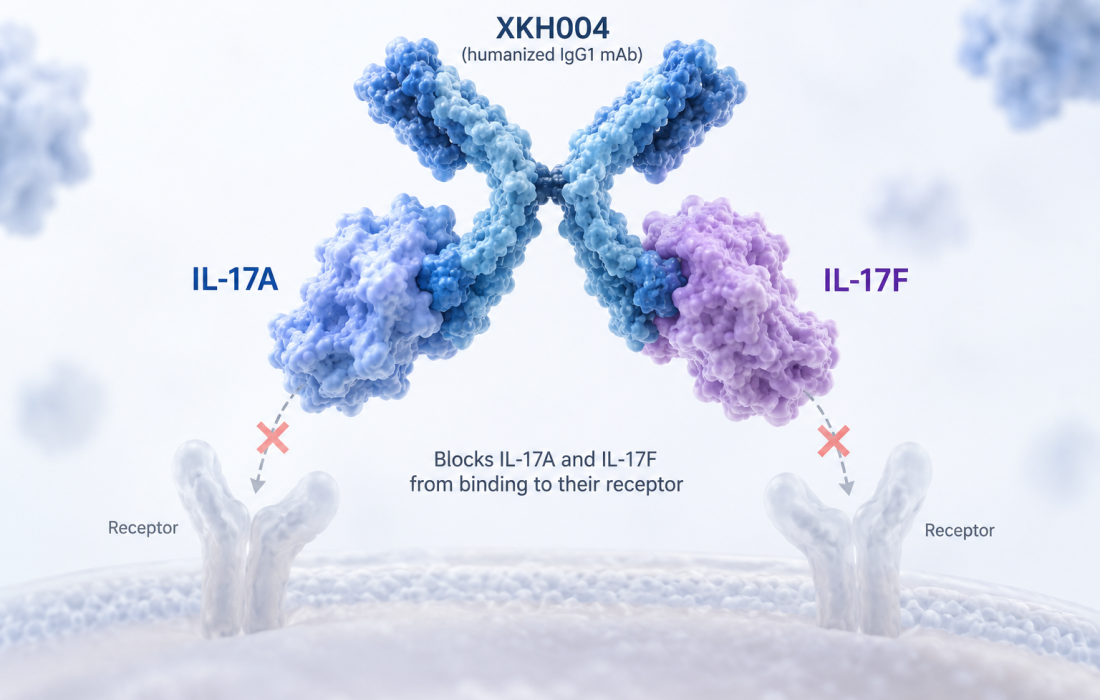
XKH004 achieved a 45.4% ASAS40 response at week 16 versus 19.4% with placebo in a phase 3 ankylosing spondylitis trial.
Written By: Anamika Koshti, PharmD
Reviewed By: Pharmacally Editorial Team
Kanova Biopharmaceutical’s investigational dual IL-17A/F antibody XKH004 significantly improved disease activity in patients with active ankylosing spondylitis (AS), with 45.4% achieving an ASAS40 response at week 16 versus 19.4% with placebo. Responses continued to strengthen through 52 weeks, including in patients previously exposed to TNF inhibitors (TNFi).
Dual IL-17A/F blockade targets two inflammatory drivers
XKH004 is a humanized IgG1 monoclonal antibody that inhibits both interleukin-17A (IL-17A) and IL-17F. The two cytokines share about 50% structural homology and can act synergistically to amplify inflammatory signaling. Both are implicated in AS pathogenesis, providing the rationale for blocking the pair rather than IL-17A alone.
The approach places XKH004 in the same mechanistic class as bimekizumab, although the paper states that XKH004 has distinct molecular characteristics and was generated using hybridoma technology with IL-17A/F double-gene knockout mice. The authors describe it as the first domestically developed humanized IgG1 antibody targeting IL-17A/F in China.
Phase 3 trial shows rapid and sustained responses
The randomized, double-blind, placebo-controlled phase 3 trial enrolled 323 patients across 37 sites in China. Participants received subcutaneous XKH004 160 mg every four weeks or placebo for 16 weeks. Patients then entered an open-label period, with the placebo group switching to XKH004, followed by safety follow-up through week 52.
The primary endpoint was ASAS40 at week 16. XKH004 produced a 45.4% response rate compared with 19.4% for placebo, with a statistically significant treatment difference and P<0.001. The response increased to 66.2% at week 52 among patients who received continuous XKH004.
Secondary measures also favored XKH004. At week 16, ASAS20 was achieved by 62.1% versus 34.2% of patients, while ASAS50 reached 35.4% versus 14.7%, respectively. Improvements in BASDAI, physical function, patient global assessment and quality of life were also greater with XKH004 and persisted through week 52.
The drug also showed activity after prior TNFi exposure. Week-16 ASAS40 responses reached 50.0% with XKH004 versus 20.0% with placebo. By week 52, responses reached 72.7% in the continuous-treatment group.
Safety profile warrants continued monitoring
During the placebo-controlled period, treatment-emergent adverse events occurred in 71.4% of XKH004-treated patients and 62.3% of placebo-treated patients. Serious adverse events occurred in 1.2% and 2.5%, respectively. Across 52 weeks, 4.8% of 313 XKH004-exposed patients experienced serious adverse events, with no treatment-emergent adverse event leading to death.
Upper respiratory tract infections and laboratory abnormalities involving liver enzymes and lipids were among the more common events. Candidiasis occurred in 0.3% of XKH004-exposed patients, while hypertriglyceridemia occurred in 10.9% over 52 weeks, prompting the authors to recommend monitoring metabolic parameters.
Immunogenicity remained low, with baseline anti-drug antibodies detected in 3.8% of XKH004-treated patients. No increasing trend in antibody positivity emerged during follow-up.
Path Forward
The study supports further development of XKH004 for active AS, but the authors note that 52 weeks of observation cannot establish very long-term safety. The trial also lacked serial MRI assessments, limiting conclusions about structural spinal and sacroiliac changes. Long-term extension studies are expected to provide additional durability and safety data.
The paper identifies XKH004 as the second worldwide dual IL-17A/F candidate to reach the Biologics License Application registration stage. Kanova participated in study design, supplied XKH004 and placebo, and contributed to statistical analysis.
Reference
Ling Zhou et al, Efficacy and safety of XKH004, a novel dual interleukin-17A/F inhibitory monoclonal antibody, in active ankylosing spondylitis: A 52-week phase 3 randomized study, HLife, 2026, https://doi.org/10.1016/j.hlife.2026.07.005

About the Writer
Anamika Koshti (LinkedIn) is a PharmD professional and healthcare writer with interests in clinical research, pharmacovigilance, and evidence-based medicine. She has authored peer-reviewed publications on Alzheimer’s disease and PCOS, presented research at national conferences, and gained hands-on experience in medical content development and clinical data interpretation. She is committed to translating complex medical research into accurate, accessible content for healthcare professionals and patients.