
Spyre Therapeutics’ SPY003 reduced RHI scores by 10 points in Phase 2 SKYLINE, with 20% clinical remission and 30% endoscopic improvement in ulcerative colitis.
Written By: Mayuresh Salvi, PharmD
Reviewed By: Pharmacally Editorial Team
Spyre Therapeutics’ investigational anti-IL-23 antibody SPY003 significantly reduced disease activity in patients with moderately-to-severely active ulcerative colitis (UC), supporting clinical proof-of-concept for the third component of the company’s combination strategy. In the Phase 2 SKYLINE trial (NCT07012395), SPY003 produced a 10.0-point reduction from baseline in Robart’s Histopathology Index (RHI) score at Week 12 (p<0.0001), alongside clinical remission in 20% of patients and endoscopic improvement in 30%.
SPY003 delivers significant histologic improvement
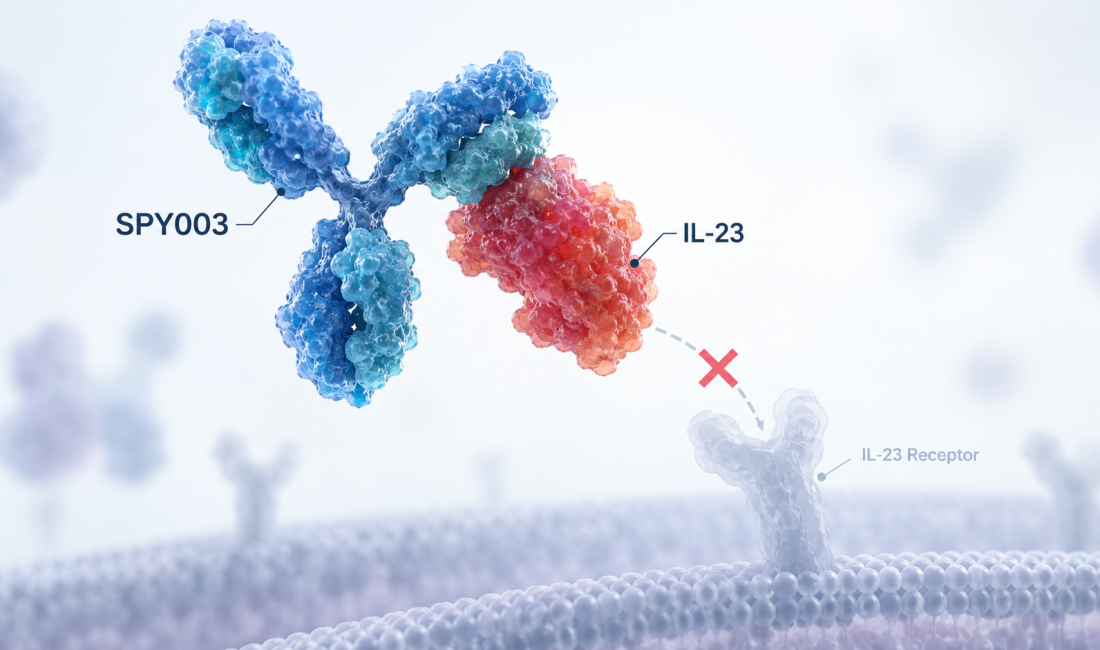
SPY003 is an investigational extended-half-life monoclonal antibody targeting interleukin-23 (IL-23), a cytokine involved in sustaining intestinal inflammation in inflammatory bowel disease. IL-23 inhibition has become an established therapeutic approach in UC, but treatment response and durability remain variable, particularly among patients with prior exposure to advanced therapies.
The SKYLINE Part A cohort included patients with moderately-to-severely active UC, with 41% previously exposed to advanced therapies. Patients had a mean disease duration of 7.1 years, a mean baseline RHI score of 17.2 and a mean modified Mayo Score (mMS) of 6.9. Nearly 60% had a baseline endoscopy score of 3, indicating severe endoscopic disease.
SPY003 reduced mean RHI by 10.0 points at Week 12 from baseline, meeting the primary endpoint with high statistical significance. The treatment also reduced the modified Mayo Score by 3.5 points, while 20% of patients achieved clinical remission and 30% achieved endoscopic improvement.
The magnitude of histologic improvement was comparable with the reductions previously reported for Spyre’s SPY001, an anti-α4β7 antibody, and SPY002, an anti-TL1A antibody, which produced RHI reductions of 9.2 and 10.7 points, respectively.
Safety supports further development
SPY003 was generally well tolerated through Week 12, with a safety profile consistent with the established IL-23 class. Among 44 treated patients, 19 (43%) experienced treatment-emergent adverse events. Five patients (11%) experienced Grade 3 or higher events, while only one patient (2%) had a drug-related adverse event, Grade 1 pruritus that resolved without intervention or treatment interruption.
Three serious adverse events occurred, including hospitalization for UC flare, hemorrhoid thrombosis and acute cholecystitis. None were considered drug-related. No patients discontinued treatment because of an adverse event, and no deaths or adverse events of special interest were reported.
Results complete Spyre’s three-component UC strategy
The SPY003 findings give Spyre positive monotherapy proof-of-concept across all three mechanisms in its IBD portfolio: α4β7, TL1A and IL-23. The company is now testing whether combining these mechanisms can produce greater disease control than individual therapies.
SKYLINE Part B is evaluating two dose levels of each monotherapy alongside three high-dose pairwise combinations: SPY120, SPY130 and SPY230. The randomized, placebo-controlled portion is actively enrolling, with topline induction data expected in 2027.
Spyre expects additional clinical catalysts across its immunology pipeline. SPY072 in psoriatic arthritis and axial spondyloarthritis is expected to produce data in the fourth quarter of 2026, while the company expects results from the SKYLIGHT study evaluating SPY072 with an IL-17A/F inhibitor in hidradenitis suppurativa in late 2027 or early 2028.
Reference
Spyre Announces Potential Best-in-Class SPY003 (anti-IL-23) Part A Induction Results from SKYLINE Trial, Completing Proof-of-Concept for All Three Components of its IBD Combinations, SPYRE Therapeutics, 08 September 2026

About the Writer
Mayuresh Sunil Salvi (Linkedin) is a PharmD professional and healthcare writer with a strong interest in pharmacovigilance, drug safety, and emerging medical research. He is passionate about exploring new drug discoveries, clinical research, and advances in evidence-based medicine. His interests also include ward rounds, prescription audits, and treatment analysis to support rational pharmacotherapy and improved patient care.