
Upstream Bio’s verekitug cut asthma exacerbations by 56% in Phase 2 VALIANT, supporting quarterly 400 mg dosing in planned Phase 3 trials.
Written By: Siddhi Bhadekar, M. Pharm (QA)
Reviewed By: Pharmacally Editorial Team
Upstream Bio presented Phase 2 VALIANT results for verekitug in adults with severe asthma during a late-breaking oral presentation at the European Respiratory Society (ERS) Congress 2026 in Barcelona. The investigational monoclonal antibody targets and inhibits the thymic stromal lymphopoietin (TSLP) receptor.
VALIANT (NCT06196879) was a global, randomized, double-blind, placebo-controlled, dose-ranging Phase 2 trial involving 478 adults with severe asthma. Patients were enrolled regardless of baseline blood eosinophil count or other type-2 biomarker levels. All participants received at least 24 weeks of treatment, while those enrolled earlier could receive treatment for up to 60 weeks.
56% Reduction in Asthma Exacerbations
VALIANT met its primary endpoint, showing statistically significant and clinically meaningful reductions in annualized asthma exacerbation rate (AAER) across all dose regimens studied.
The 100 mg every-12-week regimen reduced AAER by 56% versus placebo (p<0.001). The other two dose arms also produced statistically significant AAER reductions, although specific results for those regimens were not disclosed in the September 8 company release.
Verekitug also improved key secondary outcomes at week 24, including forced expiratory volume in one second (FEV1), fractional exhaled nitric oxide (FeNO), and asthma symptom control measured by the six-item Asthma Control Questionnaire (ACQ-6). Improvements across these measures were observed as early as week 2.
Favorable Safety Profile
Verekitug was generally well tolerated across the active dose regimens, with a safety profile consistent with previous studies. Immunogenicity had no meaningful impact on safety or efficacy results. More than 500 participants have received verekitug across the company’s clinical development programs.
Phase 3 Program Planned for 2027
Upstream Bio remains on track to initiate Phase 3 trials in severe asthma and chronic rhinosinusitis with nasal polyps (CRSwNP) in Q1 2027.
The planned Phase 3 studies will evaluate 400 mg verekitug every 12 weeks versus placebo in broad patient populations without restrictions based on baseline biomarkers. The company aims to establish best-in-class efficacy with quarterly at-home administration.
The Phase 3 strategy follows positive Phase 2 results in both severe asthma and CRSwNP. Verekitug is also being evaluated in an ongoing Phase 2 trial in chronic obstructive pulmonary disease (COPD).
TSLP Receptor Blockade
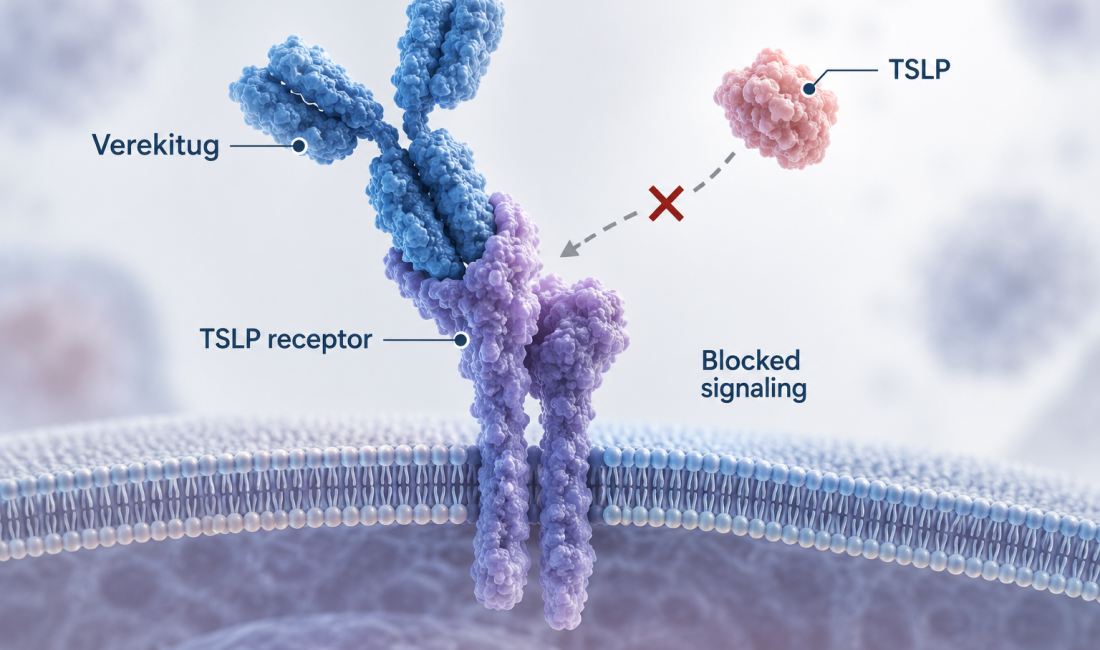
Verekitug is a recombinant, fully human IgG1 monoclonal antibody that binds the TSLP receptor and inhibits pro-inflammatory signaling initiated by TSLP.
TSLP acts upstream in the inflammatory cascade and can be activated by allergens, viruses and other triggers. Its signaling can drive downstream inflammatory mediators including IL-4, IL-5, IL-13, IL-17 and IgE. By targeting the TSLP receptor, verekitug is designed to interfere with multiple downstream inflammatory pathways through a single target.
Long-Term Development
Patients completing VALIANT were offered enrollment in VALOUR (NCT06966479), a long-term extension study evaluating the safety and efficacy of verekitug. VALOUR completed enrollment in March 2026 with more than 90% retention of eligible VALIANT participants, and data are expected in the second half of 2027.
The VALIANT findings strengthen the clinical case for verekitug’s continued development, with quarterly dosing emerging as a key feature of the program. The planned Phase 3 evaluation of 400 mg every 12 weeks will determine whether the efficacy observed in Phase 2 can be reproduced in larger, broad severe asthma and CRSwNP populations.
Reference
Upstream Bio Presents Results from the Phase 2 VALIANT Trial of Verekitug for the Treatment of Severe Asthma in Oral Presentation at ERS Congress 2026, Upstream Bio, 08 September 2026

About the Writer
Siddhi Rajendra Bhadekar (Linkedin) is an M.Pharm professional with expertise in medical and scientific writing, literature review, publication writing, and evidence synthesis, supported by four peer-reviewed publications.
She brings working knowledge of ICH-GCP, MedDRA, pharmacovigilance, ADR/AE reporting, clinical data management, and regulatory documentation.
With experience across pharmaceutical R&D, Quality Control, and Quality Assurance, she combines scientific research skills with strong attention to accuracy and detail.
Her background in manuscript development, publication planning, and scientific communication enables her to translate complex healthcare information into clear, reliable content.