
Encoded Therapeutics reports Phase 1/2 POLARIS data showing sustained seizure reductions and neurodevelopmental gains with ETX101 in Dravet syndrome.
Written By: Creola Gonsalves, MS Biotech
Reviewed By: Pharmacally Editorial Team
Encoded Therapeutics reported new Phase 1/2 POLARIS data showing durable seizure reductions after a single administration of investigational ETX101 in children with SCN1A+ Dravet syndrome, alongside progressive improvements in cognition and adaptive behavior.
Sustained Seizure Control Through 52 Weeks
New data presented at the 16th European Epilepsy Congress in Athens showed that ETX101 maintained substantial reductions in monthly countable seizure frequency (MCSF) through 52 weeks.
In the cumulative analysis from Week 5 through Week 52, or each participant’s latest visit, children receiving dose level 3 (DL3; n=5) had a median MCSF reduction of about 76%, while those receiving DL4 (n=9) had a 60% median reduction.
Among participants who completed 52 weeks, reductions during Weeks 49-52 reached approximately 79% for DL3 (n=3) and 89% for DL4 (n=5). The findings extend earlier observations that a single ETX101 administration can produce sustained seizure control.
Developmental Outcomes Extend Beyond Seizures
The POLARIS data also provide evidence that ETX101 may affect broader manifestations of Dravet syndrome. Among children treated before age two, Bayley Scales of Infant and Toddler Development, Fourth Edition (Bayley-4) cognitive growth scale values increased over time.
With up to 76 weeks of observation, developmental trajectories continued to diverge from the stagnation reported in the ENVISION natural history study and moved toward the range expected in neurotypical children.
Adaptive behavior also improved across the evaluated age range. Vineland Adaptive Behavior Scales, Third Edition (VABS-3) assessments showed gains in communication, motor skills, socialization and daily living skills, with particularly notable improvements in receptive communication, expressive communication and motor function.
The oldest participant treated at DL4, who received ETX101 at 3 years and 9 months of age, experienced a substantial reduction in seizure frequency, an extended period of seizure freedom and developmental gains over 52 weeks.
Gene Regulation Targets the SCN1A Defect
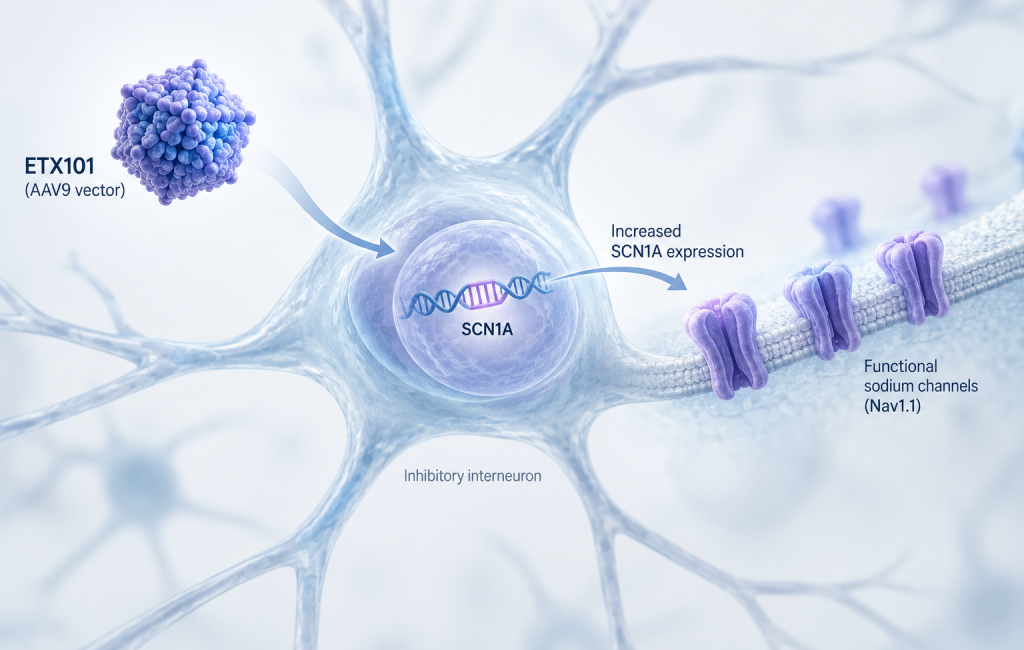
ETX101 is an investigational AAV9-based gene regulation therapy that increases expression of SCN1A, the gene responsible for the sodium channel α1 subunit that is deficient in most cases of Dravet syndrome.
Rather than replacing the gene, ETX101 increases SCN1A expression in inhibitory interneurons to restore sodium channel function. The therapy is administered as a one-time intracerebroventricular (ICV) injection and is being developed as a disease-modifying treatment for seizures as well as cognitive, behavioral, communication and motor impairments.
Dravet syndrome is a severe developmental and epileptic encephalopathy in which persistent seizures are accompanied by significant neurodevelopmental impairment. Existing treatments can reduce seizures but do not directly correct the underlying SCN1A-related mechanism.
Safety Remains Favorable with Long-Term Follow-Up
ETX101 remained generally well tolerated across all four dose levels, with follow-up extending to 117 weeks. No treatment- or procedure-related serious adverse events were reported.
Treatment-related adverse events included transaminase elevations in 7 of 21 participants and thrombocytopenia in 3 of 21. All were clinically asymptomatic and resolved.
All efficacy and safety analyses used data available through the August 3, 2026 cutoff.
Phase 3 Development Continues
The POLARIS program includes multiple Phase 1-3 studies. ENDEAVOR Part 1 (NCT05419492), EXPEDITION (NCT06283212) and WAYFINDER (NCT06112275 )are evaluating ETX101 in children aged 6 months to 7 years, while ENDEAVOR Part 1B is enrolling patients aged 4 to 18 years.
The pivotal ENDEAVOR Part 2 study is evaluating seizure and neurodevelopmental outcomes in children aged 6 months to 4 years.
ETX101 has received FDA Breakthrough Therapy, RMAT, Fast Track, Rare Pediatric Disease and Orphan Drug designations, as well as EMA Orphan designation. It was also selected for the FDA’s CMC Development and Readiness Pilot program.
The emerging data strengthen the clinical rationale for advancing ETX101 through pivotal development, although randomized controlled evidence will be needed to establish its efficacy and determine whether the developmental changes represent a durable disease-modifying effect.
Reference
Encoded Therapeutics Presents Updated Data from POLARIS Phase 1/2 Trials of ETX101 Gene Therapy in Dravet Syndrome at the 16th European Epilepsy Congress, Encoded Therapeutics, 08 September 2026

About the Writer
Creola Gonsalves (Linkedin) is an M.S. Biotechnology postgraduate with a strong interest in clinical research, evidence interpretation, and healthcare writing, with a focus on translating life-science knowledge into meaningful real-world insights.
She is trained in Good Clinical Practice (GCP), clinical research principles, and critical interpretation of randomized clinical trials, with certifications from NIH and Stanford University.
Her research background in biotechnological applications and microbial research strengthens her ability to understand scientific evidence and develop clear, accurate, and research-driven healthcare content.