
INBRX-106 plus pembrolizumab improved response rates and 6-month PFS in Phase 2 HNSCC, with strongest results in HPV-positive disease.
Written By: Khushi Patel, PharmD
Reviewed By: Pharmacally Editorial Team
Inhibrx Biosciences reported positive primary endpoint results from the randomized Phase 2 portion of the HexAgon study (NCT06295731), showing that INBRX-106 combined with pembrolizumab produced deeper and more durable responses than pembrolizumab alone in treatment-naïve, PD-L1-positive metastatic or unresectable recurrent head and neck squamous cell carcinoma (HNSCC). Confirmed objective response rate (cORR) reached 48.3% with the combination versus 26.5% with pembrolizumab monotherapy, while six-month progression-free survival (PFS) was 72.4% versus 42.8%.
OX40 agonism strengthens T-cell costimulation
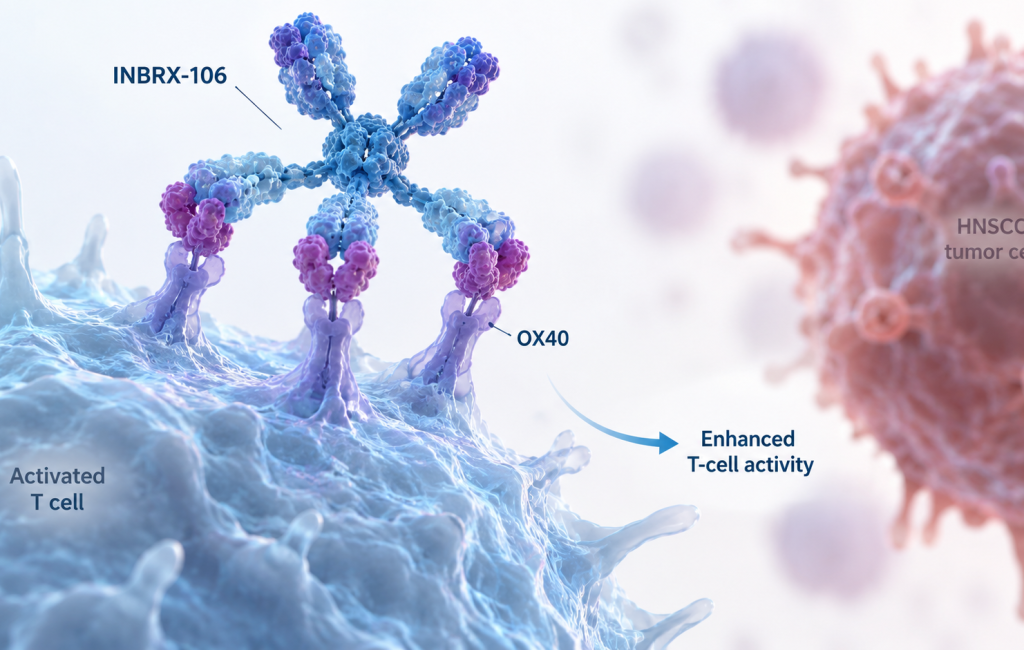
INBRX-106 is a hexavalent OX40 agonist that activates OX40, a costimulatory receptor expressed on activated T cells. OX40 signaling can enhance T-cell proliferation, survival and antitumor immune activity, providing a complementary mechanism to PD-1 blockade.
The findings are particularly notable in HPV-positive HNSCC, where viral tumor antigens can generate an immunologically active tumor environment. In this subgroup, the combination produced an 80.0% cORR versus 33.3% with pembrolizumab alone. Complete responses occurred in 30.0% of HPV-positive patients receiving INBRX-106 plus pembrolizumab, compared with none in the control arm.
Phase 2 data show a marked PFS advantage
The randomized Phase 2 portion enrolled 68 patients, with 63 evaluable for the primary endpoint. Twenty-nine evaluable patients received the combination, including 10 with HPV-positive disease, while 34 received pembrolizumab alone, including nine HPV-positive patients. Baseline prognostic factors were largely balanced, and the study is being conducted at more than 80 sites across the United States, Europe and Asia.
Median PFS reached 9.6 months with INBRX-106 plus pembrolizumab compared with 4.9 months for pembrolizumab alone. Four patients in the combination arm achieved complete responses, representing a 13.8% complete response rate, while no complete responses occurred with pembrolizumab alone.
Among HPV-positive patients, median PFS had not yet been reached with the combination versus 4.6 months with pembrolizumab. Six-month PFS was 90.0% versus 33.0%.
The combination was generally manageable. The most common treatment-related adverse events were rash, fatigue and diarrhea, predominantly at low grades.
HPV-positive disease becomes the next development focus
Mark Lappe, Inhibrx co-founder and CEO, highlighted the depth and durability of responses in HPV-positive disease as evidence supporting further development of OX40-mediated T-cell costimulation.
The company plans to add approximately 50 HPV-positive oropharyngeal squamous cell carcinoma (OPSCC) patients with PD-L1 CPS ≥1 to the randomized Phase 2 study. Following the expansion, Inhibrx plans to discuss the development framework with the FDA, with a potential accelerated approval pathway and a subsequent Phase 3 confirmatory trial.
The program is also moving beyond HNSCC. A Phase 1/2 study is evaluating INBRX-106 in the perioperative setting for non-small cell lung cancer, with initial results expected by mid-2027. The company also plans to investigate combinations with therapeutic cancer vaccines, leveraging OX40-mediated T-cell activation to potentially amplify antigen-specific immune responses.
If the HPV-positive signal is sustained in the expanded cohort, the program could provide a clinically important test of OX40 agonism as a complement to PD-1 blockade in immunogenic solid tumors.
Reference
Inhibrx’s INBRX-106 Nearly Doubles Response Rate and Achieves Interim Median PFS of 9.6 months in Phase 2 HNSCC Study, INHIBRX, 08 September 2026

About the Writer
Khushi Patel is a PharmD (Linkedin) professional with a strong foundation in clinical pharmacy, patient-centered care, regulatory affairs, and pharmacovigilance, with published work on Brugada syndrome.
Her interests include regulatory affairs, pharmacovigilance, guideline integration, multimodal therapy, pharmacogenomics, and antibiogram utilization, with a focus on evidence-based clinical decision-making and medication safety.
As a Pharmacally healthcare writer, she translates clinical and scientific evidence into clear, accurate, and clinically relevant healthcare content, while continuously developing her expertise in evolving pharmacy practice.