
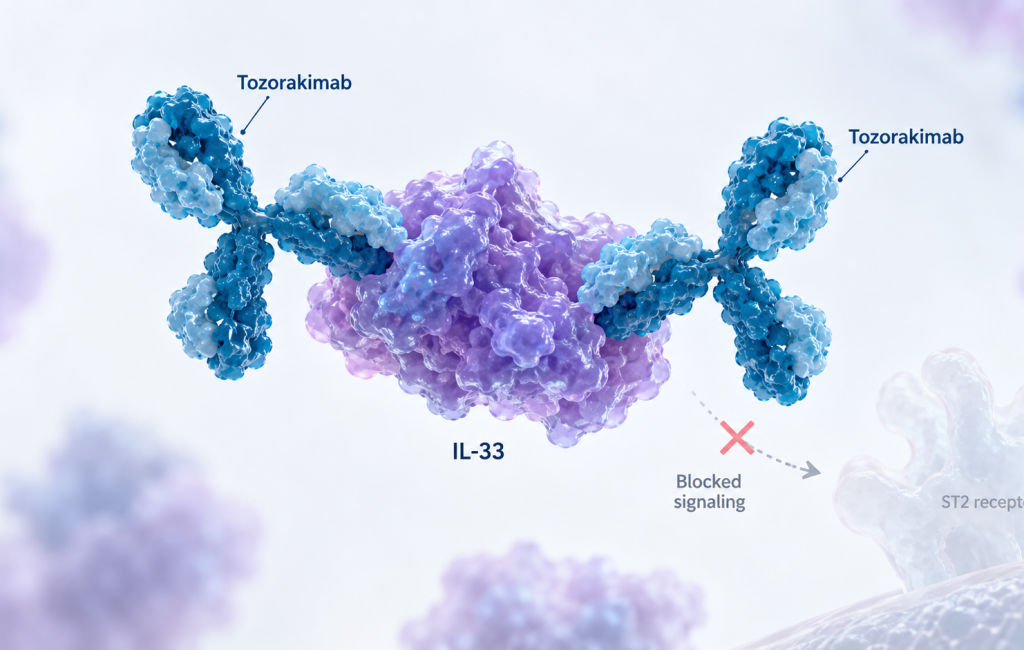
AstraZeneca’s tozorakimab reduced moderate-to-severe COPD exacerbations across blood eosinophil levels in Phase 3 OBERON and TITANIA trials.
Written By: Mayuri Vaja, PharmD
Reviewed By: Pharmacally Editorial Team
AstraZeneca’s investigational IL-33 antibody tozorakimab significantly reduced moderate-to-severe COPD exacerbations across a broad patient population in the Phase 3 OBERON (NCT05166889) and TITANIA (NCT05158387) trials, including patients with low blood eosinophil counts. The full results, published in the New England Journal of Medicine and presented at the 2026 European Respiratory Society Congress, strengthen the case for a biologic approach that does not depend on eosinophil status.
Broad efficacy across COPD populations
Tozorakimab 300 mg, administered subcutaneously every four weeks on top of inhaled standard-of-care therapy, reduced moderate-to-severe exacerbations by 29% in former smokers in OBERON and 34% in TITANIA, the primary population for both trials.
Across current and former smokers, exacerbations fell by 30% and 29%, respectively. The pooled analysis also showed clinically meaningful reductions across all prespecified subgroups, including different blood eosinophil counts and levels of lung-function impairment.
The effect extended to patients with lower eosinophil levels. Those with baseline blood eosinophils below 150 cells/µL had a 23% reduction in moderate-to-severe exacerbations, compared with 34% among patients with counts of at least 150 cells/µL and 43% among those with counts of at least 300 cells/µL.
These findings are notable because blood eosinophil counts are commonly used to help identify COPD patients most likely to benefit from certain anti-inflammatory biologics. The OBERON and TITANIA results indicate that targeting IL-33 could provide benefit beyond an eosinophil-defined population.
Targeting IL-33 and mucus dysfunction
Tozorakimab is a human monoclonal antibody that targets interleukin-33 (IL-33), an upstream mediator involved in airway inflammation. The antibody inhibits signaling from both reduced and oxidized forms of IL-33.
The approach is intended to address two components of COPD worsening: inflammatory signaling and mucus dysfunction. In a separate integrated analysis of OBERON and TITANIA, treatment also reduced mucus plug scores, supporting a potential effect on airway mucus obstruction.
Mucus plugging has been associated with worse outcomes in COPD, making the finding clinically relevant beyond exacerbation reduction.
Phase 3 design and safety
OBERON and TITANIA were replicate, double-blind, placebo-controlled Phase 3 trials enrolling adults with symptomatic COPD who had experienced at least two moderate exacerbations or one severe exacerbation during the previous year. Together, the studies randomized 2,306 patients, including current and former smokers across blood eosinophil levels and lung-function severities.
Patients received tozorakimab 300 mg every four weeks or placebo for 52 weeks alongside inhaled maintenance therapy. The primary endpoint was the annualized rate of moderate-to-severe exacerbations among former smokers, while a key secondary endpoint assessed the same outcome in the overall population.
Tozorakimab was generally well tolerated. Injection-site reaction was the only reported adverse drug reaction highlighted in the results.
Regulatory path
The FDA has accepted AstraZeneca’s Biologics License Application for tozorakimab 300 mg under Priority Review as an add-on maintenance treatment for adults with COPD. The Prescription Drug User Fee Act action date is expected in the first quarter of 2027, following use of a Priority Review voucher.
Regulatory reviews are also underway in the European Union and China. Beyond COPD, AstraZeneca is evaluating tozorakimab in a Phase 2 trial in severe asthma and a Phase 3 study in severe viral lower respiratory tract disease.
If approved, tozorakimab could establish an IL-33-directed treatment option for COPD patients who continue to experience exacerbations despite inhaled therapy, including those whose blood eosinophil counts fall below thresholds typically associated with biologic treatment.
Reference
Tozorakimab demonstrated statistically significant and highly clinically meaningful reduction in COPD exacerbations in OBERON and TITANIA Phase III trials, Astra Zeneca, 08 September 2026

About the Writer
Mayuri Vaja (Linkedin) is a Pharm.D professional with a strong interest in clinical research, pharmacovigilance, and medical writing, supported by certifications in pharmacovigilance and academic projects exploring AI in healthcare and drug safety.
With a growing focus on evidence-based healthcare and scientific communication, she is developing expertise in clinical research and translating healthcare evidence into clear, meaningful content.
As a Pharmacally healthcare writer, Mayuri is committed to creating accurate, research-driven, and clinically relevant healthcare content while continuously strengthening her professional skills.