
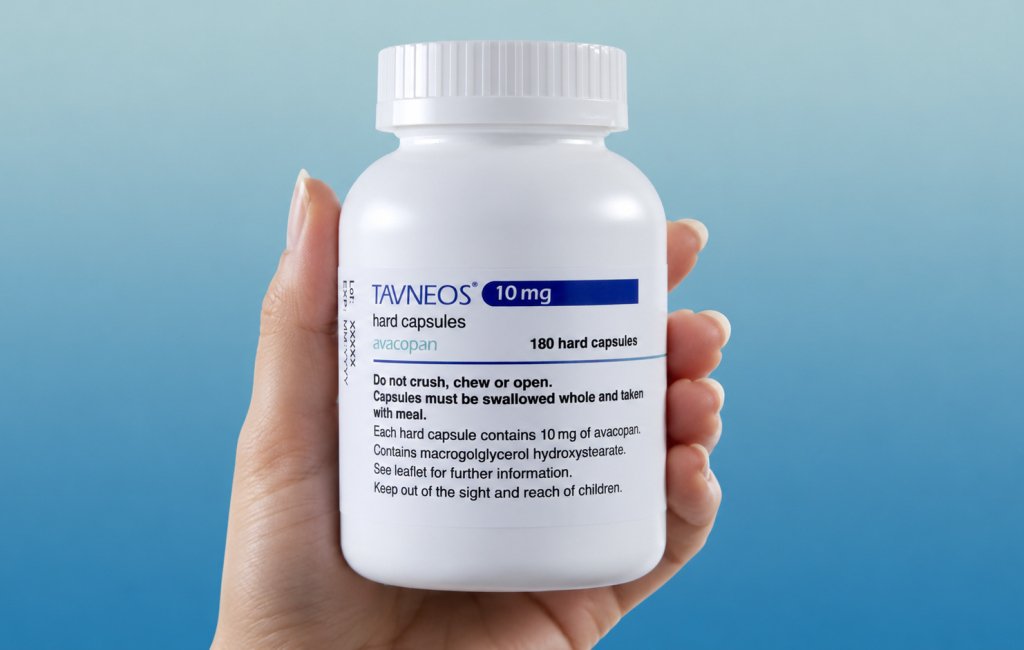
The MHRA has suspended Avacopan Vifor for new patients after concluding pivotal clinical data can no longer reliably support its efficacy.
Written By: Kalyani Boharapi,
M.Pharm (Reg. Affair)
Reviewed By: Pharmacally Editorial Team
The UK Medicines and Healthcare products Regulatory Agency (MHRA) has suspended the use, supply, and sale of Avacopan Vifor, previously known as Tavneos, for new patients after concluding that evidence supporting its efficacy is no longer sufficiently reliable to establish a positive benefit-risk balance.
The decision follows an investigation into the integrity and reliability of data from the pivotal clinical study that supported the medicine’s UK authorisation. After reviewing the available evidence and receiving advice from the Commission on Human Medicines (CHM), as well as representations from patients and healthcare professionals, the MHRA determined that the pivotal study can no longer be relied upon to demonstrate avacopan’s efficacy.
Regulatory Action Follows Data Integrity Concerns
Avacopan Vifor is approved in the UK in combination with a rituximab- or cyclophosphamide-based regimen for adults with severe, active granulomatosis with polyangiitis (GPA) or microscopic polyangiitis (MPA). Both are rare autoimmune diseases in which inflammation damages small blood vessels and can affect multiple organs.
The MHRA’s action took effect on September 1, 2026, under Regulations 69 and 71 of the Human Medicines Regulations 2012. Healthcare professionals must not initiate treatment in new patients.
The regulator intends to revoke the UK marketing authorisation on March 1, 2027, following a six-month managed withdrawal period. During this transition, the medicine will remain available only to patients already receiving treatment, with the marketing authorisation holder guaranteeing supply throughout the period.
Existing Patients Require Specialist Review
The MHRA has advised clinicians to review patients currently receiving Avacopan Vifor as soon as possible and consider appropriate alternative treatments. Patients should not discontinue therapy without first consulting their specialist healthcare professional.
Existing safety and risk-minimisation measures remain in effect. These include liver-function monitoring, with testing frequency recently increased, as well as monitoring white blood cell counts and assessing patients for serious infections. Suspected adverse reactions should continue to be reported through the MHRA Yellow Card scheme.
Clinical Significance of Avacopan
Avacopan is an oral complement 5a receptor (C5aR1) antagonist. By blocking C5aR1 signalling, the drug targets a pathway involved in neutrophil activation and inflammatory injury associated with ANCA-associated vasculitis, the disease group that includes GPA and MPA.
Its regulatory withdrawal represents a significant change for UK treatment of these rare vasculitides because the medicine had provided a targeted alternative to conventional glucocorticoid-based approaches when used alongside standard immunosuppressive regimens.
However, the MHRA concluded that the integrity concerns surrounding the pivotal evidence undermine the ability to establish avacopan’s efficacy, making the overall benefit-risk balance no longer positive.
Regulatory Action Extends Beyond the UK
The UK decision follows similar regulatory action in the US FDA and European Union over the same underlying concerns. In April 2026, the US Food and Drug Administration (FDA) proposed withdrawing approval of Tavneos after finding new evidence that unblinded study personnel had manipulated results from the pivotal Phase 3 ADVOCATE trial and that the original analysis did not support the drug’s efficacy. The FDA also cited serious postmarketing liver injury, including cases of vanishing bile duct syndrome (VBDS), as an additional safety concern.
In the EU, the European Medicines Agency’s Committee for Medicinal Products for Human Use (CHMP) recommended revocation of Tavneos’ marketing authorisation in June 2026 after concluding that the ADVOCATE data had been handled in breach of good clinical practice and could no longer reliably demonstrate efficacy. The European Commission subsequently issued its final decision to revoke the authorisation in August 2026.
Patient Safety Drives Managed Withdrawal
“Patient safety is our highest priority,” said Julian Beach, MHRA Executive Director of Healthcare Quality and Access. He said the regulator concluded that the efficacy data were no longer sufficiently reliable to support a positive benefit-risk balance.
The managed withdrawal gives clinicians time to reassess existing patients and transition them to alternative therapies rather than triggering an abrupt treatment interruption.
The immediate regulatory restriction applies specifically to new patients from September 1, 2026. Existing patients can continue receiving Avacopan Vifor during the six-month transition, with the MHRA currently intending to revoke the UK authorisation on March 1, 2027.
Reference
MHRA concludes review of Avacopan Vifor following reassessment of benefit-risk balance – GOV.UK

About the Writer
Kalyani Boharapi (LinkedIn) is a pharmacy professional and healthcare writer currently pursuing an M.Pharm in Regulatory Affairs at Dr. D. Y. Patil College of Pharmacy, with interests in pharmaceutical regulations, drug development, and healthcare innovation. She has academic exposure to dossier preparation, scientific writing, and regulatory documentation. Kalyani has also completed certification courses in Generative AI, AI in Pharma, and Bioinformatics, and actively participates in pharmaceutical conferences to stay updated with emerging trends and advancements in the healthcare and pharmaceutical industry.