
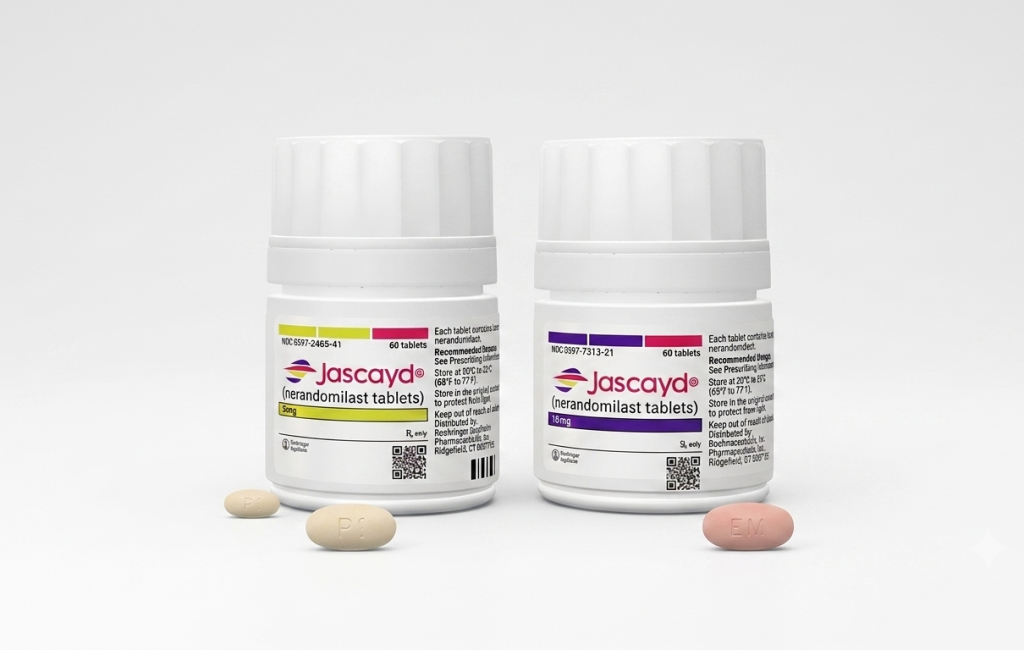
Boehringer Ingelheim has announced a Phase 3 trial of nerandomilast in adults with active idiopathic inflammatory myopathies, enrolling about 270 participants.
Written By: Saniya Katakdhond, PharmD
Reviewed By: Pharmacally Editorial Team
Boehringer Ingelheim has announced the VERANDA™-IIM Phase 3 trial (NCT07789015) evaluating nerandomilast, an oral preferential PDE4B inhibitor, in adults with active idiopathic inflammatory myopathies (IIM). The randomized, placebo-controlled study is designed to evaluate the efficacy and safety of nerandomilast added to standard background therapy over 52 weeks.
Phase 3 Trial Plans to Enroll 270 Adults
VERANDA™-IIM is an interventional, randomized, parallel-group, double-blind, placebo-controlled, quadruple-masked Phase 3 study sponsored by Boehringer Ingelheim. The trial plans to enroll approximately 270 adults aged 18 years and older with active IIM.
Participants will receive either nerandomilast or matching placebo twice daily for 52 weeks alongside permitted background therapy. The study is scheduled to begin in November 2026, with primary and overall study completion anticipated in March 2030.
Total Improvement Score Is the Primary Endpoint
The primary endpoint is the Total Improvement Score (TIS) at Week 52. TIS is a composite measure incorporating Manual Muscle Testing-8 (MMT-8), extramuscular disease activity assessed via the Myositis Disease Activity Assessment Tool (MDAAT), Patient Global Assessment, Physician Global Activity, Health Assessment Questionnaire-Disability Index (HAQ-DI), and serum muscle enzyme levels. The score ranges from 0 to 100, with higher scores indicating greater overall improvement.
Secondary endpoints include TIS-40 and TIS-60 response rates, corticosteroid tapering, changes in muscle strength and physical function, patient- and physician-reported disease activity, extramuscular disease activity, muscle enzyme levels, and cutaneous disease activity. Participants with relevant skin involvement will also be assessed using the Cutaneous Dermatomyositis Disease Area and Severity Index (CDASI) activity score and 5-D itch score.
Study Targets Selected IIM Subpopulations
The trial is designed for adults with definite or probable IIM according to the 2017 ACR/EULAR classification criteria and predefined disease-activity requirements. Selected IIM subtypes include dermatomyositis, antisynthetase syndrome, and overlap myositis.
Immune-mediated necrotizing myositis (IMNM), inclusion body myositis (IBM), and non-inflammatory myopathies are excluded, as are participants meeting specified criteria for advanced interstitial lung disease (ILD).
Nerandomilast will be evaluated as an add-on treatment rather than replacing existing IIM therapy. Permitted background treatments include specified corticosteroid regimens and selected immunosuppressive or immunomodulatory therapies.
Nerandomilast Enters IIM Development Following Positive Fibrosis Data
The Phase 3 IIM program expands the clinical development of nerandomilast into a new indication following positive results from the FIBRONEER program in pulmonary fibrosis.
In the Phase 3 FIBRONEER-IPF study, nerandomilast significantly reduced the decline in forced vital capacity (FVC) at Week 52 compared with placebo in patients with idiopathic pulmonary fibrosis (IPF). Positive Phase 3 findings were also reported in FIBRONEER-ILD, where nerandomilast reduced FVC decline in patients with progressive pulmonary fibrosis (PPF).
These findings provide rationale for evaluating nerandomilast in IIM, though pulmonary fibrosis outcomes do not establish efficacy in myositis. VERANDA™-IIM will determine whether the therapy can improve disease activity and related outcomes when added to background treatment in selected patients with active IIM.
Status
VERANDA™-IIM is currently listed as not yet recruiting, and no efficacy or safety results from this study are currently available.
Reference

About the Writer
Saniya Sanjay Katakdhond (Linkedin) is a Doctor of Pharmacy professional with hands-on experience in patient case review, clinical documentation, medical record analysis, and patient care.
Her hospital experience has strengthened her understanding of clinical conditions, treatment approaches, and multidisciplinary healthcare practices.
With ICH-GCP certification and a research-oriented approach, she brings clinical insight and attention to detail to healthcare content development.
As a healthcare writer, Saniya focuses on translating clinical knowledge and patient-care experience into clear, accurate, and evidence-informed medical content.