
Plozasiran cut triglycerides by up to 81% and reduced acute pancreatitis events in Phase 3 SHASTA-3 and SHASTA-4 trials.
Written By: Anshu Gupta, PharmD
Reviewed By: Pharmacally Editorial Team
Severe hypertriglyceridemia (SHTG) remains a major risk factor for acute pancreatitis, with limited therapeutic options capable of producing sustained triglyceride control. Data presented at the 2026 European Society of Cardiology (ESC) Congress demonstrate that Arrowhead Pharmaceuticals’ plozasiran delivered deep triglyceride reductions and significantly lowered acute pancreatitis events across the Phase 3 SHASTA-3 (NCT06347003) and SHASTA-4 (NCT06347016) studies.
Durable Triglyceride and Atherogenic Lipid Control
In the global, double-blind, placebo-controlled Phase 3 trials involving 757 adults with severe hypertriglyceridemia, plozasiran (25 mg administered subcutaneously once every three months) reduced median triglyceride levels from baseline by 79% in SHASTA-3 and 81% in SHASTA-4 at Month 12 ( vs. placebo).
Key lipid parameters and biomarker reductions include:
- Target Threshold Achievement: At Month 12, 91% of treated patients in SHASTA-3 and 93% in SHASTA-4 achieved triglyceride levels below 500 mg/dL (compared to 51% and 50% for placebo, respectively). More than half of all plozasiran-treated patients dropped below 150 mg/dL.
- High-Baseline Subgroup: Among patients with baseline triglycerides 880 mg/dL, median reductions reached 85% in both studies.
- Broader Lipid Impact: Plozasiran also lowered key atherogenic markers, including apolipoprotein C-III (APOC3), remnant cholesterol, and non-HDL cholesterol.
Significant Reduction in Acute Pancreatitis Risk
Beyond biomarker lowering, plozasiran demonstrated clear clinical benefit in acute pancreatitis outcomes:
- All Acute Pancreatitis Events: Reduced overall event rates by 78% versus placebo (RR 0.22; 95% CI: 0.07–0.67; ), representing a 4.1% absolute risk reduction and a 1-year Number Needed to Treat (NNT) of 24.
- First Event Prevention: Reduced the risk of a first pancreatitis event by 74% (HR 0.26; 95% CI: 0.09–0.78; ).
- High-Risk Subgroup: In patients with baseline triglycerides mg/dL and a prior history of pancreatitis, event rates fell 91% versus placebo, yielding an absolute risk reduction of 34% and a 1-year NNT of 3.
Mechanism of Action
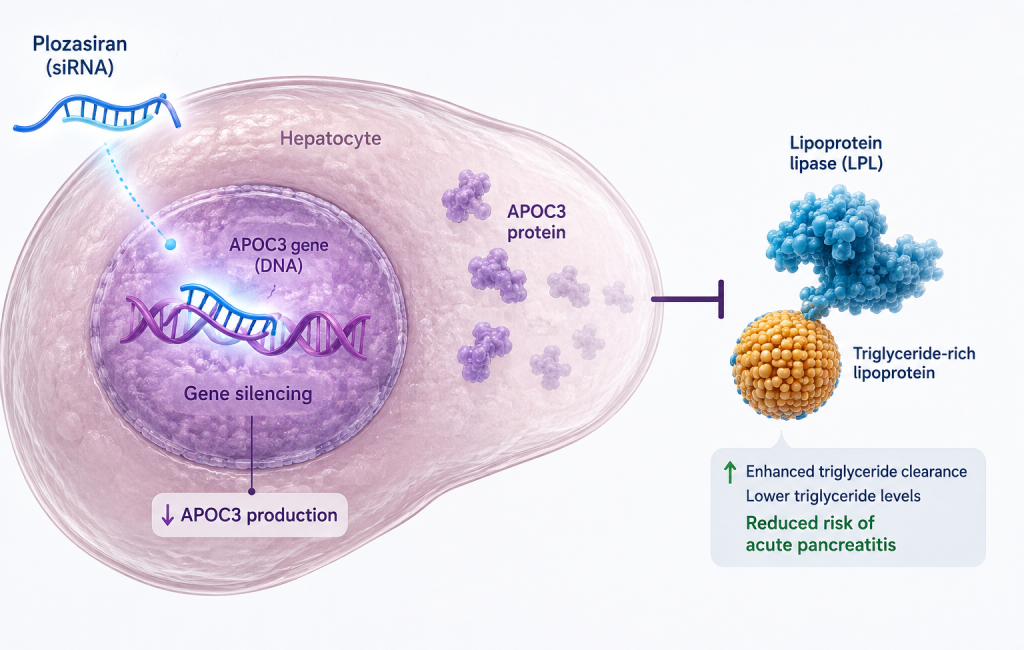
Plozasiran is an RNA interference (siRNA) therapeutic that silences the hepatic gene responsible for producing APOC3 a key inhibitor of lipoprotein lipase and hepatic uptake of triglyceride-rich lipoproteins. By suppressing APOC3, plozasiran restores clearance pathways, enabling sustained triglyceride reduction with quarterly subcutaneous dosing.
Safety Profile
Plozasiran was generally well tolerated across the pooled cohort:
- Overall Events: Treatment-emergent adverse events occurred in 73% of both the plozasiran and placebo groups.
- Serious Adverse Events: Reported in 8.3% of plozasiran patients versus 10.0% with placebo. Discontinuations due to adverse events remained low (1.4% vs. 0.8%, respectively).
- Glycemic Control: Worsening glycemic control was observed in 14.3% of plozasiran patients compared to 8.7% on placebo, though mean HbA1c showed minimal absolute change without worsening over time.
- Local & Systemic Safety: Injection-site reactions occurred in 3.2% (vs. 2.0% placebo). There were no reports of anaphylaxis, systemic hypersensitivity, clinically meaningful platelet drops, or treatment-related liver enzyme signals.
Regulatory Status and Path Forward
Arrowhead plans to combine data from SHASTA-3, SHASTA-4, and MUIR-3 (NCT06347133) to submit a supplemental New Drug Application (sNDA) to the U.S. FDA before the end of 2026, utilizing a Priority Review Voucher to accelerate review.
Plozasiran is currently approved in select markets under the brand name REDEMPLO for familial chylomicronemia syndrome (FCS). The SHASTA data position the APOC3-targeted siRNA to expand beyond rare genetic indications into the significantly larger SHTG population.
Reference

About the Writer
Anshu Gupta (LinkedIn) is a PharmD professional and healthcare writer with interests in clinical research, pharmacovigilance, regulatory affairs, and medical writing. She has presented research at academic conferences and completed certifications in Good Clinical Practice (GCP), ICH-GCP, and drug safety. Passionate about clinical trials and evidence-based medicine, she is committed to translating scientific evidence into accurate, reliable, and accessible healthcare content.