
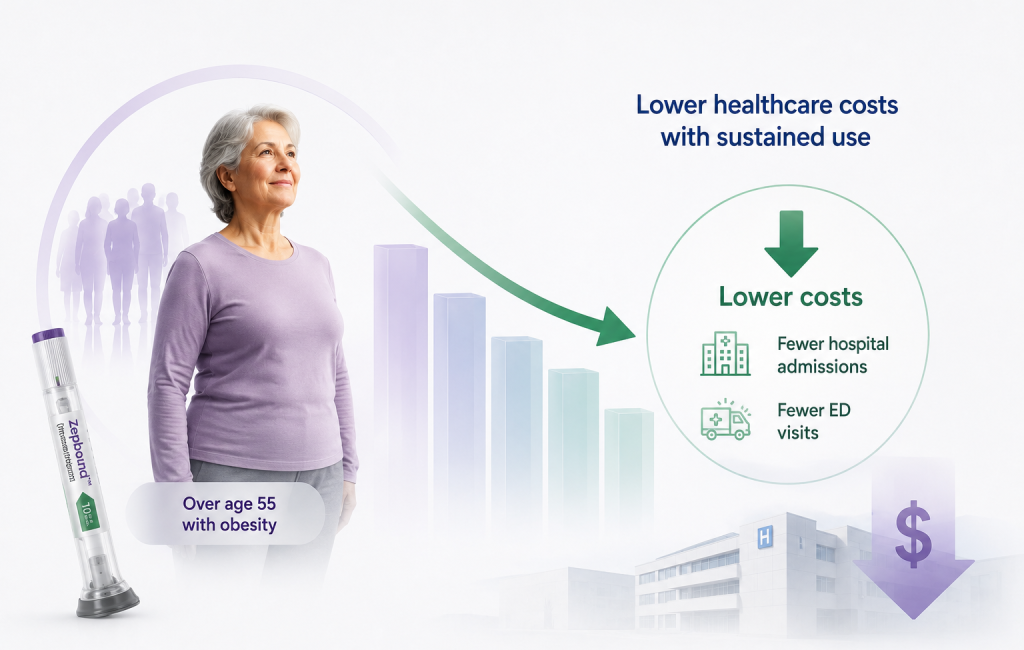
Real-world data found lower healthcare costs and fewer hospital and ED visits among adults over 55 using Zepbound, excluding drug costs.
Written By: Siddhi Bhadekar, M. Pharm (QA)
Reviewed By: Pharmacally Editorial Team
New real-world evidence from Eli Lilly and Company suggests that sustained Zepbound (tirzepatide) use was associated with lower healthcare costs among adults over age 55 with obesity or overweight, compared with similar adults who did not receive GLP-1 or GIP/GLP-1 receptor agonist treatment.
The retrospective observational study, announced by Lilly on August 26, 2026, found that healthcare cost differences increased over time and were accompanied by fewer hospital admissions and emergency department (ED) visits among adults treated with Zepbound.
The analysis excluded the cost of Zepbound itself. The findings therefore represent potential healthcare cost savings that could offset treatment costs rather than demonstrating an overall net cost saving.
Study Population and Design
Researchers analyzed de-identified claims data from Komodo Health’s Healthcare Map, which includes information from more than 330 million individuals enrolled in U.S. healthcare plans.
The study included 15,843 adults older than 55 years, with a mean age of 64.5 years, who had obesity or overweight with at least one obesity-related complication. Participants initiated Zepbound between November 2023 and September 2025.
Each Zepbound user was matched 1:1 with a control who met the same eligibility criteria but did not initiate a GLP-1 or GIP/GLP-1 receptor agonist. Matching considered baseline demographics, clinical characteristics, obesity-related complications and healthcare utilization patterns. All participants had at least 12 months of continuous enrollment before entering the study.
Because this was an observational claims analysis, the findings demonstrate an association rather than establishing that Zepbound directly caused the observed cost differences.
Lower Healthcare Costs with Sustained Zepbound Use
Researchers used two complementary approaches to account for differences in follow-up duration: Inverse Probability of Censoring Weighting (IPCW), the primary analysis, and a secondary pairwise comparison.
Both approaches showed lower monthly healthcare costs with sustained Zepbound use versus no treatment.
At six months, the primary IPCW analysis showed an estimated $145 lower healthcare cost per patient per month, representing a 12% lower increase in costs. The secondary pairwise analysis showed a $181 per-patient-per-month difference, or a 15% lower increase in costs.
At 12 months, the IPCW analysis estimated a $319 lower cost per patient per month, representing 25% lower costs on average. The secondary pairwise analysis estimated a larger difference of $607 per patient per month, corresponding to 38% lower costs.
Hospital and Emergency Department Utilization
In the primary IPCW analysis, adults treated with Zepbound had lower rates of hospital admissions and ED visits across every follow-up period.
Routine outpatient and office visits were numerically higher among Zepbound-treated adults, a pattern Lilly said was consistent with greater engagement in routine care.
Potential Relevance to Medicare
The findings may be particularly relevant to older adults receiving obesity treatment through Medicare’s GLP-1 Bridge program.
Lilly reported that estimated healthcare cost savings beginning at six months nearly covered the program’s $195 per-patient monthly treatment cost. Beginning at 12 months, estimated healthcare cost savings exceeded that monthly treatment cost.
However, because the study did not capture Zepbound’s net price, it cannot establish the overall net financial impact of treatment for Medicare or other payers. Instead, the findings indicate that lower costs elsewhere in healthcare could potentially offset treatment expenses.
About Zepbound
Zepbound (tirzepatide) is a dual GIP and GLP-1 receptor agonist indicated for adults with obesity, or some adults with overweight who have at least one weight-related medical condition, to help them lose weight and maintain weight loss.
Zepbound is also FDA-approved for adults with moderate-to-severe obstructive sleep apnea and obesity. It is intended to be used alongside a reduced-calorie diet and increased physical activity.
Overall, the findings add real-world evidence that sustained Zepbound use among older adults is associated with lower healthcare costs and reduced acute-care utilization, while highlighting the need to account for the medicine’s own cost when assessing its overall economic impact.
Reference

About the Writer
Siddhi Rajendra Bhadekar (Linkedin) is an M.Pharm professional with expertise in medical and scientific writing, literature review, publication writing, and evidence synthesis, supported by four peer-reviewed publications.
She brings working knowledge of ICH-GCP, MedDRA, pharmacovigilance, ADR/AE reporting, clinical data management, and regulatory documentation.
With experience across pharmaceutical R&D, Quality Control, and Quality Assurance, she combines scientific research skills with strong attention to accuracy and detail.
Her background in manuscript development, publication planning, and scientific communication enables her to translate complex healthcare information into clear, reliable content.