
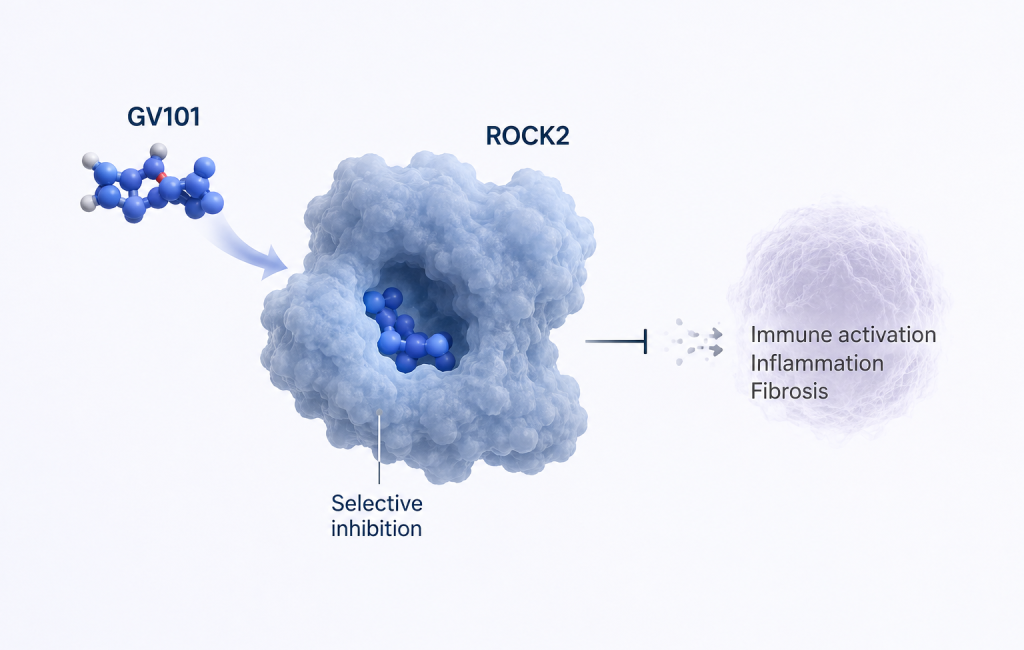
GV101 achieved 86.2% 24-week response at 400 mg in chronic graft-versus-host disease, with favorable safety and Phase III development planned.
Written By: Mayuresh Salvi, PharmD
Reviewed By: Pharmacally Editorial Team
Graviton BioScience has reported peer-reviewed data from a multicenter Phase Ib/II trial (NCT06169722) evaluating GV101, a highly selective Rho-associated coiled-coil containing protein kinase 2 (ROCK2) inhibitor, in patients with moderate to severe chronic graft-versus-host disease (cGvHD). The findings, published in Signal Transduction and Targeted Therapy, a Springer Nature Portfolio journal, provide efficacy and safety data from 60 enrolled patients who had received one to five prior systemic therapies for cGvHD. At 24 weeks, GV101 produced a best overall response rate (bORR) of 86.2% at 400 mg and 67.9% at 200 mg.
Strong responses in heavily pretreated cGvHD
At 24 weeks, bORR reached 86.2% (95% CI, 68.3-96.1) with GV101 400 mg and 67.9% (95% CI, 47.6-84.1) with 200 mg. Failure-free survival (FFS) was 89.4% and 78.6%, respectively. Median FFS and median duration of response had not been reached at the time of analysis.
The company reported that the 24-week bORR and FFS probabilities exceeded published six-month outcomes for currently approved therapies used in steroid-refractory cGvHD. Cross-trial comparisons should be interpreted cautiously because patient populations, treatment histories and study designs can differ.
Responses emerged relatively quickly. Median time to first response was 30 days at 400 mg and 44.5 days at 200 mg.
Complete responses were observed across all organ systems except the lower gastrointestinal tract, where only one participant had involvement. At 24 weeks, organ-specific response rates included 52.6% in the liver, 50.0% in the esophagus and 50.0% in the upper gastrointestinal tract. The pulmonary response rate, assessed using the 2014 NIH Consensus Criteria lung symptom score, was 23.7% (95% CI, 11.4-40.2).
ROCK2 inhibition targets inflammation and fibrosis
cGvHD is a serious and potentially fatal complication of allogeneic stem cell transplantation in which donor-derived immune cells attack recipient tissues. Persistent immune dysregulation, inflammation and fibrosis can affect multiple organs and substantially impair quality of life.
ROCK2 regulates signaling pathways involved in immune activation, inflammation and fibrosis. GV101 is being developed as a selective ROCK2 inhibitor, with the therapeutic rationale centered on modulating these disease-driving processes while preserving broader immune function.
Safety profile supports continued development
The most frequent adverse events were transient bilirubin elevation, reported in 81.7% of patients, and headache, reported in 23.3%. The bilirubin abnormalities were generally transient and were not accompanied by transaminase elevations.
The company attributed these laboratory findings to reversible inhibition of UGT1A1 and OATP1B3 by GV101. Grade ≥3 treatment-related adverse events occurring in at least 5% of patients were limited to bilirubin laboratory abnormalities.
No grade ≥3 leukopenia, thrombocytopenia or anemia occurred, while one grade 3 neutropenia was reported. No cytomegalovirus infections occurred.
Overall survival at 24 weeks was 96.6% at 400 mg and 100% at 200 mg. One participant died from COVID-19 pneumonia.
Phase III planning moves forward
Graviton is planning a Phase III randomized controlled trial of GV101 in cGvHD and intends to advance the 400 mg dose.
The peer-reviewed Phase Ib/II findings support continued evaluation of selective ROCK2 inhibition in cGvHD, particularly in patients whose disease remains inadequately controlled after multiple systemic therapies. The planned randomized study will be important for determining whether GV101 can reproduce these response and failure-free survival outcomes in a controlled setting.
Reference
Graviton BioScience – Innovating for Equilibrium | Graviton Bioscience
About the Writer
Mayuresh Sunil Salvi (Linkedin) is a PharmD professional and healthcare writer with a strong interest in pharmacovigilance, drug safety, and emerging medical research. He is passionate about exploring new drug discoveries, clinical research, and advances in evidence-based medicine. His interests also include ward rounds, prescription audits, and treatment analysis to support rational pharmacotherapy and improved patient care.