
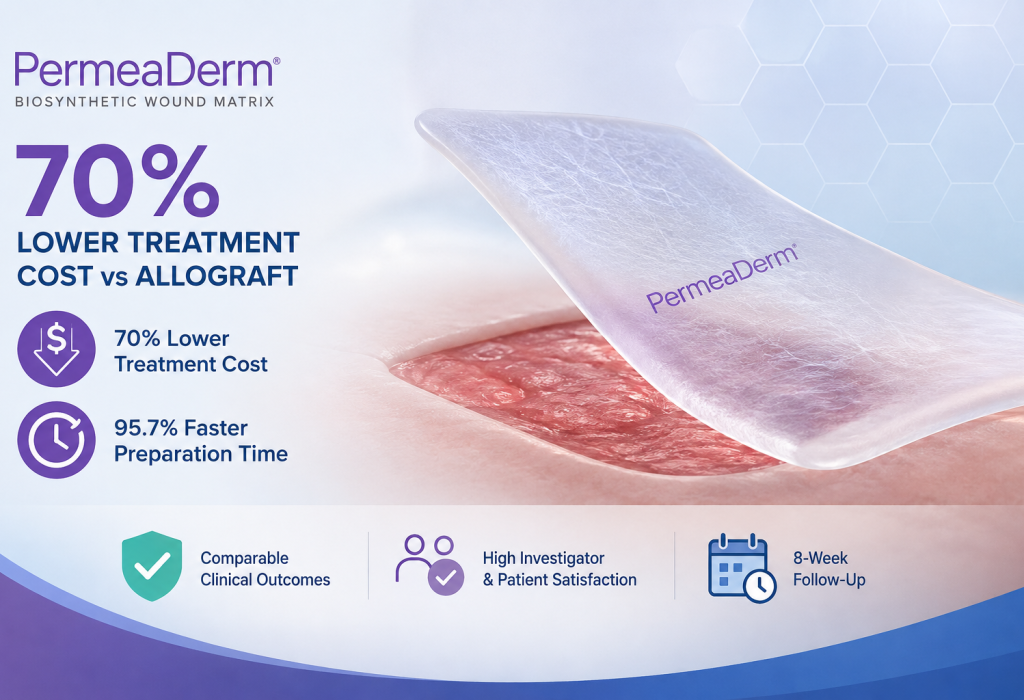
AVITA Medical reports PermeaDerm-I results showing 70% lower treatment cost and 95.7% faster preparation than allograft, with comparable clinical outcomes.
Written by: Nakum Mansi, PharmD
Reviewed By: Pharmacally Editorial Team
AVITA Medical has reported positive results from its multicenter, randomized controlled PermeaDerm-I clinical study, demonstrating that PermeaDerm, a biosynthetic wound matrix, delivered clinically comparable outcomes to cadaveric allograft while reducing treatment cost by approximately 70%. The study met its primary endpoint, demonstrating statistically significant superiority (p < 0.001) for mean treatment cost per percent total body surface area (%TBSA) treated.
PermeaDerm Demonstrates 70% Lower Treatment Cost
Mean treatment cost was $148.70 for every 1% TBSA treated with PermeaDerm compared with $497.10 for allograft, representing savings of approximately $348 per %TBSA.
The study enrolled 40 patients across 11 U.S. burn centers with wounds involving up to 30% TBSA. Following surgical excision, patients were randomized to receive either PermeaDerm or cadaveric allograft during the temporization period (to stabilize the wound bed while awaiting definitive skin grafting) before definitive split-thickness skin grafting.
Off-the-Shelf Product Reduces Preparation Time
As an off-the-shelf product, PermeaDerm reduced preparation time by 95.7% compared with allograft by eliminating tissue tracking, thawing, and meshing, while maintaining comparable application time in the operating room.
PermeaDerm is a transparent bilayer biosynthetic wound matrix designed to provide temporary wound coverage between surgical excision and definitive closure. Its transparency allows clinicians to visualize the wound bed without removing the product.
Comparable Clinical Outcomes Across Treatment Groups
Clinical outcomes were comparable between the treatment groups. Approximately 94% of patients treated with PermeaDerm achieved at least 95% graft take one week following autografting, comparable to allograft. All patients in both treatment groups achieved 95% or greater wound healing by eight weeks.
No adverse events were attributed to PermeaDerm during the study. At final follow-up, all responding investigators and patients reported satisfaction, with responses rated as satisfied or very satisfied.
PermeaDerm-I Study Design
PermeaDerm-I (NCT06750809) is a post-market, multicenter, randomized controlled clinical trial evaluating PermeaDerm against cadaveric allograft in patients with acute wounds requiring temporary coverage before definitive skin grafting.
The primary endpoint evaluated treatment cost per percent TBSA treated. Secondary endpoints included preparation time, application time, graft take, wound healing, inflammatory profile, adverse events, and surgeon and patient satisfaction. Patients were followed for eight weeks following definitive closure.
Integration Across the Continuum of Care
The PermeaDerm-I findings provide strong clinical and economic evidence for PermeaDerm as an off-the-shelf alternative to cadaveric allograft for temporary wound coverage following surgical excision and before definitive skin grafting.
PermeaDerm strengthens AVITA Medical’s therapeutic portfolio by addressing the initial phase of full-thickness acute wound management across a complete continuum of care:
- Temporary Coverage (PermeaDerm®): Acts as an off-the-shelf biosynthetic matrix to temporarily stabilize, protect, and visualize the excised wound bed during the temporization phase.
- Dermal Matrix Integration (Cohealyx®): Facilitates cellular infiltration and revascularization to rebuild a robust dermal foundation prior to grafting.
- Definitive Autologous Closure (RECELL®): Delivers autologous Spray-On Skin™ Cells to achieve permanent wound closure, minimizing donor site requirements and improving functional outcomes.
Reference

About the Writer
Mansi Nakum (Linkedin) is a Pharm.D professional with a strong foundation in clinical pharmacy, evidence-based healthcare writing, and clinical data interpretation.
She has published work on Brugada syndrome and has a keen interest in guideline integration, multimodal therapy, pharmacogenomics, and antibiogram utilization.
As a healthcare writer, she focuses on translating clinical evidence into clear, accurate, and clinically relevant content, while continuously developing her expertise in evolving pharmacy practice.