
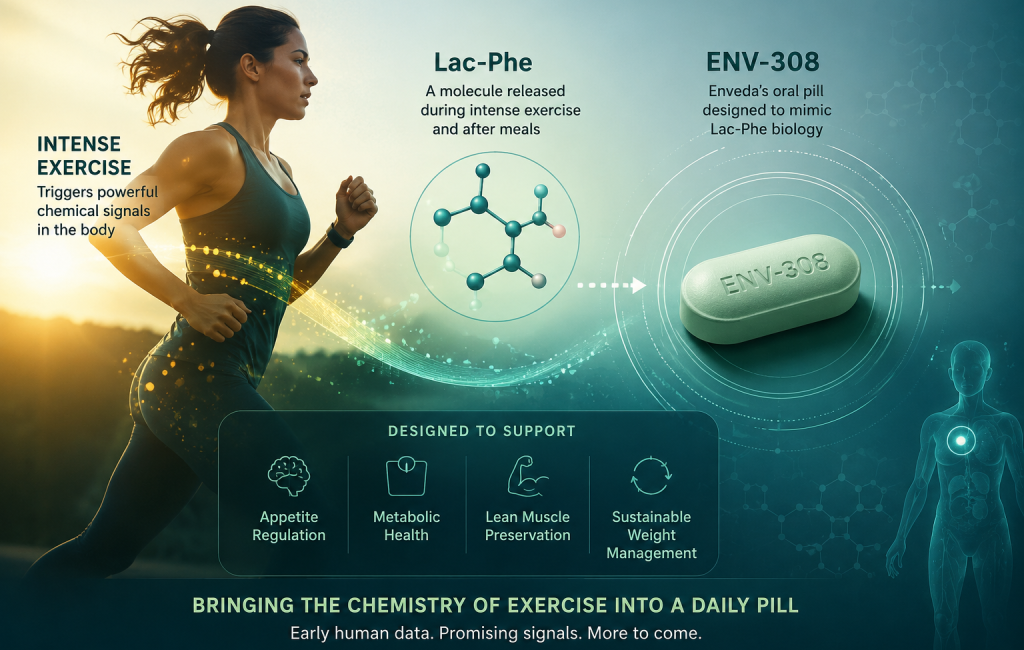
Enveda’s ENV-308, an oral Lac-Phe mimetic inspired by exercise chemistry, showed favorable Phase 1 safety in 88 healthy volunteers.
Written By: Saniya Katakdhond, PharmD
Reviewed By: Pharmacally Editorial Team
Enveda reported positive Phase 1 results for ENV-308 in 88 healthy adult volunteers, supporting continued clinical development of the investigational daily oral therapy for metabolic health. The trial evaluated safety, tolerability, and how ENV-308 behaved in the body across the studied dose range.
ENV-308 was well tolerated, with no serious adverse events, treatment discontinuations, or dose interruptions reported. The study also showed a favorable gastrointestinal safety profile. This finding is clinically relevant because nausea, vomiting, and other gastrointestinal effects are among the common tolerability concerns associated with GLP-1 medicines.
The Phase 1 study was conducted in healthy volunteers and was not designed to evaluate body weight, body composition, or other clinical efficacy outcomes. Therefore, the findings do not establish that ENV-308 causes weight loss or prevents weight regain in humans.
ENV-308 targets the biology of Lac-Phe
ENV-308 is an investigational oral small molecule engineered to mimic the biological effects of N-lactoyl-phenylalanine, or Lac-Phe, a signaling molecule released by the body during intense exercise and after meals.
Lac-Phe has been investigated for its role in appetite and metabolic regulation. Preclinical research has linked the molecule to appetite suppression and reduced obesity in animal models. However, naturally occurring Lac-Phe is cleared rapidly from the body, limiting its potential as a conventional medicine.
Enveda used its proprietary PRISM AI-enabled discovery platform to identify and develop ENV-308 as an orally administered molecule intended to reproduce relevant Lac-Phe activity while supporting daily administration.
Leptin reduction provides an early pharmacodynamic signal
The Phase 1 study also evaluated circulating leptin, a hormone produced by adipose tissue that contributes to appetite and energy regulation.
ENV-308 reduced circulating leptin levels, with the largest reductions observed among participants who had the highest baseline leptin levels relative to their sex. Enveda considers the finding an early pharmacodynamic signal that ENV-308 may be engaging biological processes relevant to metabolic health.
However, the clinical significance of the leptin reduction remains uncertain. Additional studies will be needed to determine whether the change reflects meaningful effects on leptin biology or translates into improvements in body weight and metabolic health.
Preclinical studies support weight-maintenance strategy
Animal studies provide the initial rationale for evaluating ENV-308 after weight-loss treatment. According to Enveda, ENV-308 preserved lean muscle mass during weight loss and maintained weight reduction after weight-loss therapy was withdrawn, with no observed rebound in the reported models.
Preclinical studies also suggested potential for combination use with GLP-1 therapies. Enveda reported that combination treatment could potentially allow less frequent GLP-1 dosing and improve certain tolerability effects associated with GLP-1 treatment.
These findings remain preclinical and have not been established in humans.
Phase 2 will test ENV-308 after GLP-1 discontinuation
Maintaining weight loss after discontinuing anti-obesity pharmacotherapy remains a key clinical challenge. Enveda plans to evaluate ENV-308 in people who have discontinued or are preparing to discontinue GLP-1 therapy.
A planned Phase 2 study will assess whether ENV-308 can help maintain weight loss and other metabolic benefits following GLP-1 treatment. Future clinical studies are expected to examine body weight, body composition, metabolic markers, leptin biology, safety, and tolerability.
The company is also evaluating ENV-308 in other conditions in which exercise may provide therapeutic benefits, including migraine, inflammatory bowel disease, and polyendocrine metabolic ovarian syndrome, formerly known as polycystic ovary syndrome.
Early findings support continued development
The Phase 1 results provide early human evidence supporting further development of ENV-308, particularly its observed safety and tolerability profile and the reduction in circulating leptin.
The critical next step will be determining whether these biological signals translate into clinically meaningful benefits. Phase 2 studies will establish whether ENV-308 can help sustain weight loss and metabolic health after GLP-1 therapy is stopped, while also clarifying its effects on body composition and other metabolic measures.
ENV-308 remains investigational, and its safety and efficacy for the treatment or prevention of disease have not been established.
Reference

About the Writer
Saniya Sanjay Katakdhond (Linkedin) is a Doctor of Pharmacy professional with hands-on experience in patient case review, clinical documentation, medical record analysis, and patient care.
Her hospital experience has strengthened her understanding of clinical conditions, treatment approaches, and multidisciplinary healthcare practices.
With ICH-GCP certification and a research-oriented approach, she brings clinical insight and attention to detail to healthcare content development.
As a healthcare writer, Saniya focuses on translating clinical knowledge and patient-care experience into clear, accurate, and evidence-informed medical content.