
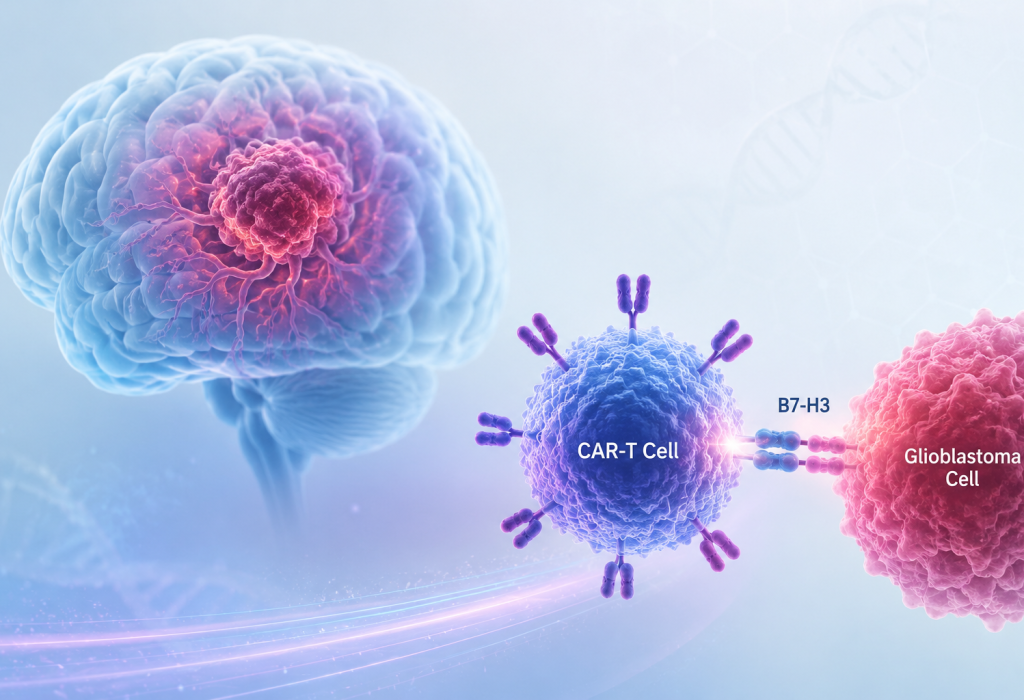
Phase 1 results suggest B7-H3-targeted CAR-T therapy TX103 may offer a new treatment approach for recurrent glioblastoma, with early tumor control.
Written By: Shaik Yasmeen, PharmD
Reviewed By: Pharmacally Editorial Team
A Phase 1 clinical trial has provided encouraging early evidence for TX103, an investigational autologous chimeric antigen receptor T-cell (CAR-T) therapy targeting B7-H3 a protein highly expressed in glioblastoma. Led by researchers from Beijing Tiantan Hospital, Yale School of Medicine, Capital Medical University, Fujian Medical University, and Tcelltech Biological Science and Technology, the clinical study was centered at Beijing Tiantan Hospital.
Published in Nature Medicine on August 6, 2026, the study found that intracranial administration of TX103 was generally tolerable and produced preliminary evidence of antitumor activity. Among patients with measurable disease, several achieved disease control, including one patient who experienced a sustained complete response.
B7-H3 Emerges as a Target in Recurrent Glioblastoma
Glioblastoma is an aggressive primary brain cancer that frequently returns after initial treatment and can become resistant to available therapies. Recurrent disease has limited treatment options, creating a significant need for new therapeutic approaches.
CAR-T therapy involves collecting a patient’s own T cells and genetically modifying them to express a chimeric antigen receptor. The engineered cells can then recognize a specific protein on cancer cells and initiate an immune-mediated attack.
For TX103, researchers selected B7-H3, also known as CD276, as the target. B7-H3 is highly expressed in glioblastoma and has been investigated as a potential target for several forms of cancer therapy.
Before enrollment, patients underwent tumor testing to confirm B7-H3 expression. The study required at least 30% B7-H3 expression in tumor tissue, allowing investigators to select patients whose tumors expressed the target.
Phase 1 Trial Evaluates TX103 in B7-H3-Positive Tumors
Phase 1 study (NCT05241392) was an open-label, 3+3 dose-escalation Phase 1 trial involving 15 patients aged 18 to 75 years with B7-H3-positive recurrent glioblastoma.
The primary objectives were to evaluate the safety and tolerability of TX103, identify dose-limiting toxicities and determine an appropriate dose for subsequent clinical development.
Investigators evaluated three dose levels:
- 2 × 10⁷ cells per infusion
- 6 × 10⁷ cells per infusion
- 1.5 × 10⁸ cells per infusion
No dose-limiting toxicities or maximum tolerated dose were identified during the study. Based on the overall safety findings, the 6 × 10⁷ cells-per-infusion dose, corresponding to dose level 2, was selected as the recommended Phase 2 dose.
Intracranial Administration Enables Direct Tumor Delivery
Unlike conventional systemic administration, TX103 was delivered intracranially, allowing the engineered T cells to be administered directly within the brain.
Across the study, patients received a total of 72 intracranial infusions, with 13 of the 15 patients receiving repeated infusions.
The approach was designed to place CAR-T cells closer to the tumor and within the central nervous system, addressing one of the major challenges associated with treating brain tumors with cellular therapies.
The researchers also observed evidence of CAR-T cell activity within the cerebrospinal fluid, supporting the biological activity of the locally administered cells.
TX103 Shows Preliminary Antitumor Activity
Although the primary purpose of the Phase 1 study was safety and dose selection, investigators observed preliminary evidence of clinical activity.
Among the 14 patients with measurable disease, 8 achieved disease control, defined as stable disease or better. One patient achieved a complete response, which remained sustained at the latest follow-up reported by the investigators.
The findings are notable because the participants had recurrent glioblastoma that had progressed despite available treatment options. However, the efficacy findings remain preliminary because the study involved only 15 patients and was not designed as a controlled efficacy trial.
Safety Findings Support Further Clinical Development
TX103 was generally tolerated, although treatment-related adverse events were observed.
The most frequently reported treatment-related adverse events included low-grade cytokine release syndrome in 86.7% of patients, sinus tachycardia in 53.3%, vomiting in 53.3%, hypertension in 53.3%, and elevated intracranial pressure in 46.7%.
Three grade 3 treatment-related serious adverse events were reported: elevated intracranial pressure, epilepsy and depressed consciousness. Two of these events occurred at the highest dose level.
The absence of dose-limiting toxicities or a maximum tolerated dose supported selection of the second dose level as the recommended Phase 2 dose.
Overall Survival Findings Add to the Early Clinical Signal
The investigators also reported encouraging survival findings during follow-up.
The 12-month overall survival rate was 66.7%, while the median overall survival was 19.1 months from the first TX103 infusion. These findings provide additional clinical context for the disease-control observations seen during the study.
However, survival outcomes from a small, uncontrolled Phase 1 study cannot establish that TX103 improves survival compared with existing treatments. Larger prospective studies will be required to determine whether these early findings can be reproduced.
Phase 2 Evaluation to Further Assess TX103
The selection of 6 × 10⁷ cells per infusion as the recommended Phase 2 dose provides a basis for further clinical evaluation of TX103.
Future studies will need to determine whether the antitumor activity observed in the Phase 1 trial can be reproduced in a larger patient population and whether treatment can provide durable disease control.
Researchers will also need to better understand the persistence and activity of engineered T cells within the brain, mechanisms of treatment resistance, and biological factors that may influence response to B7-H3-targeted therapy.
Clinical Significance of B7-H3-Targeted CAR-T Therapy
The Phase 1 findings do not establish TX103 as an effective treatment for recurrent glioblastoma. The study was small, early-stage and primarily designed to evaluate safety and identify an appropriate dose.
However, the results provide a clinically relevant signal for a novel treatment strategy in a disease with substantial unmet need. The combination of B7-H3 targeting, autologous CAR-T cell engineering and intracranial delivery represents a distinct approach to bringing cellular immunotherapy into the treatment of recurrent brain cancer.
Disease control in 8 of 14 patients with measurable disease, together with one sustained complete response and the reported survival findings, provides a rationale for continued clinical investigation.
The next stages of development will determine whether these early observations can translate into durable and reproducible benefit for patients with recurrent glioblastoma.
References
T Cell Therapy Shows Promise in Treating Aggressive Brain Cancer | Yale School of Medicine

About the Writer
Shaik Yasmeen (LinkedIn) is a Pharm.D graduate with interests in clinical pharmacy, pharmacovigilance, and medical writing. She has gained experience through hospital clinical postings, patient case reviews, case presentations, and literature evaluation. Passionate about evidence-based healthcare, she is committed to creating accurate and engaging medical content while continuously expanding her professional knowledge.