
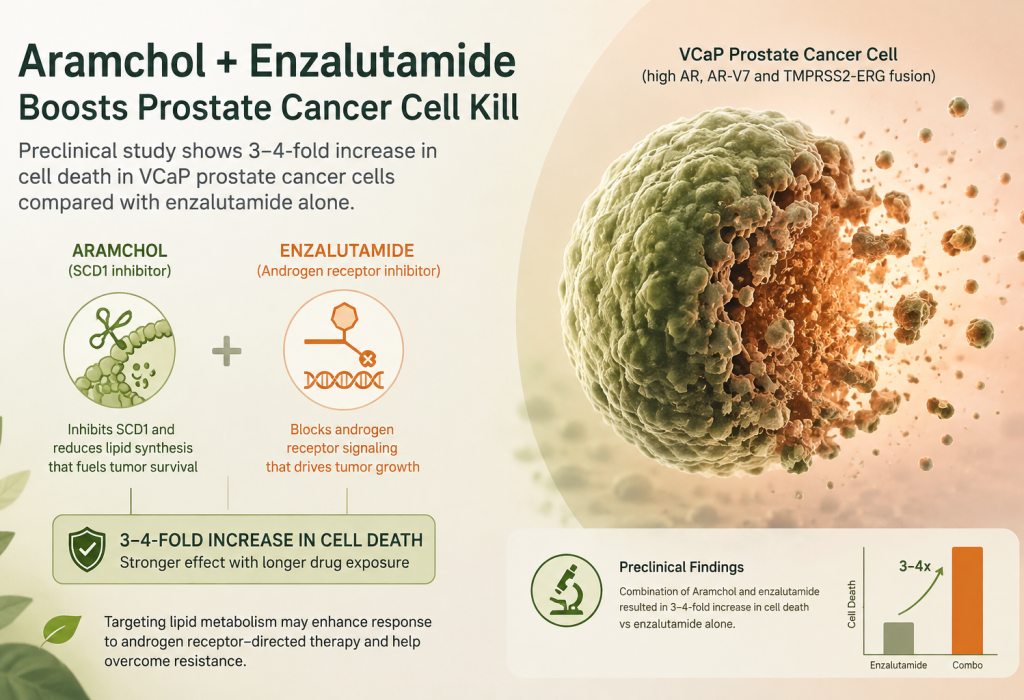
Galmed reports a 3–4-fold increase in prostate cancer cell death with Aramchol plus enzalutamide in a preclinical VCaP cell model, supporting further clinical investigation.
Written By: Meghana Jinka, PharmD
Reviewed By: Pharmacally Editorial Team
Galmed Pharmaceuticals reported preclinical data demonstrating that Aramchol, its investigational stearoyl-CoA desaturase 1 (SCD1) inhibitor, enhanced the cell-killing activity of enzalutamide in prostate cancer cells. In the VCaP model, combining Aramchol with enzalutamide produced a 3–4-fold increase in cell death compared with enzalutamide alone, supporting further investigation of lipid metabolism disruption as a strategy to improve androgen receptor (AR)-directed therapy.
Targeting Lipid Metabolism Alongside Androgen Signaling
AR signaling is a central driver of prostate cancer progression, making AR-axis therapies like enzalutamide (Xtandi) a standard of care in multiple settings, including metastatic and nonmetastatic castration-sensitive prostate cancer with high risk of metastasis.
Prostate tumors frequently adapt to AR blockade through metabolic changes that support continued survival and contribute to treatment resistance. Galmed’s strategy leverages Aramchol to downregulate SCD1—a key enzyme in monounsaturated fatty acid synthesis—thereby depriving cancer cells of essential lipid resources while enzalutamide blocks AR signaling.
Preclinical Synergy in the VCaP Model
The study utilized VCaP cells, a model derived from a vertebral metastasis of a patient with metastatic castration-sensitive prostate cancer. VCaP cells express high levels of wild-type AR, the clinically relevant AR-V7 splice variant, and the TMPRSS2-ERG gene fusion.
Galmed reported that the Aramchol–enzalutamide combination produced 3–4 times greater cell death than enzalutamide alone, with interaction strength increasing over extended drug exposure. While these results highlight potential combination benefit, they remain strictly in vitro preclinical findings. They do not establish clinical efficacy, human oncology dosing, or the ability to overcome or delay enzalutamide resistance in patients.
Clinical Transition: Dose, Safety, and Formulation Questions
Aramchol brings extensive human exposure data from its liver-disease development program, where approximately 600 adults (including MASH patients) received Aramchol free acid across six trials with a favorable safety profile.
However, this history does not establish the therapeutic window, target exposure, or combination tolerability required in oncology, where patient comorbidities, toxicities, and concomitant medications differ significantly. Additionally, Galmed’s Phase 1 AM-001 study showed that an updated Aramchol meglumine formulation delivers substantially higher bioavailability than the original free acid, supporting a once-daily regimen that will need specific validation in cancer trials.
Commercial Context and Xtandi Lifecycle Management
The combination carries a potential commercial rationale. Xtandi was selected for the second round of the U.S. Medicare Drug Price Negotiation Program under the Inflation Reduction Act, with negotiated Maximum Fair Prices taking effect January 1, 2027.
Concurrently, enzalutamide faces a shifting U.S. patent landscape. Primary composition-of-matter protection (US7709517) extends into August 2027, while secondary method and formulation patents (such as US8183274 and US9126941) expire in 2026. Galmed’s recently submitted patent application covering the Aramchol–enzalutamide combination offers a potential lifecycle-management strategy, though its ultimate commercial value will depend on IP scope, enforceability, and clinical validation.
Path Forward
Building on earlier preclinical data showing greater-than-additive tumor cell killing with Aramchol plus docetaxel, Galmed plans to evaluate Aramchol alongside approved prostate cancer therapies—including enzalutamide (with or without a GnRH analogue) and chemotherapy upon anti-androgen progression. The immediate priority is clinical translation: determining whether preclinical synergies reproduce at tolerable human exposures. Galmed intends to engage potential pharmaceutical partners to advance the combination program.
References

About the Writer
Meghana Jinka (LinkedIn) is a Pharm.D graduate with a strong interest in clinical pharmacy, clinical research, pharmacovigilance, and medical writing. She has developed expertise in evaluating scientific literature, interpreting clinical data, and communicating complex medical information in a clear and accessible manner. Through clinical training, patient counseling, and healthcare awareness activities, she has gained practical experience in evidence-based medicine and patient-centered care. Passionate about healthcare communication, Meghana is committed to developing accurate, engaging, and evidence-based healthcare documents that support healthcare professionals and the wider community.