
EyePoint reports mixed Phase 3 LUGANO results for DURAVYU in wet AMD: the primary endpoint was not met, while treatment burden fell 42% versus aflibercept.
Written By: Mansi Nakum, PharmD
Reviewed By: Pharmacally Editorial Team
EyePoint reported topline results from the pivotal Phase 3 LUGANO trial (NCT06668064) of investigational DURAVYU (vorolanib intravitreal insert) in wet age-related macular degeneration (wet AMD), showing a substantial reduction in treatment burden and high rates of freedom from supplemental anti-VEGF injections. However, the trial did not meet its primary visual acuity endpoint in the full analysis population, with the result affected by an asymmetric subgroup of patients who experienced vision loss unrelated to wet AMD.
Primary Endpoint Affected by Asymmetric Vision Loss
LUGANO evaluated the change from baseline in best-corrected visual acuity (BCVA) at Weeks 52 and 56 against on-label aflibercept, the current standard-of-care comparator. DURAVYU was not non-inferior to aflibercept in the full dataset. An ad hoc analysis excluding nine of 211 patients who experienced vision loss of at least 15 letters unrelated to wet AMD showed non-inferiority, with a nominal p-value of 0.0096. No comparable cases occurred in the aflibercept arm.
Despite the primary endpoint result, several prespecified secondary outcomes favored the sustained-delivery therapy. The findings are particularly relevant because treatment burden remains a major challenge in wet AMD, where anti-VEGF therapy often requires administration approximately every two months under treat-and-extend regimens.
Treatment Burden Fell by 42%
DURAVYU reduced treatment burden by 42% versus on-label aflibercept, achieving statistical superiority with a nominal p-value below 0.0001. The reduction corresponded to an average of two fewer injections through Week 56.
The durability of disease control was also reflected in supplemental injection requirements. Seventy-six percent of DURAVYU-treated patients remained supplement-free through Week 32, while 94% received zero or one supplemental injection during that period. By Week 56, 54% remained supplement-free and 79% had received no more than one supplemental injection. Among supplement-free patients, a prespecified BCVA analysis demonstrated non-inferiority to aflibercept, with a nominal p-value of 0.0035.
Sustained Retinal Control with Repeat Dosing
DURAVYU also maintained anatomical control through Week 56. The mean difference in central subfield thickness was four microns versus aflibercept, narrowing to three microns among eyes that remained supplement-free through Week 56.
The safety profile remained favorable with repeat dosing. EyePoint reported no differences between treatment groups in cataracts, elevated intraocular pressure, or intraocular inflammation. No cases of insert migration, anterior chamber opacities, free-floating drug particles, retinal vasculitis, or severe intraocular inflammation were observed.
Six-Month Dosing Targets Treatment Burden
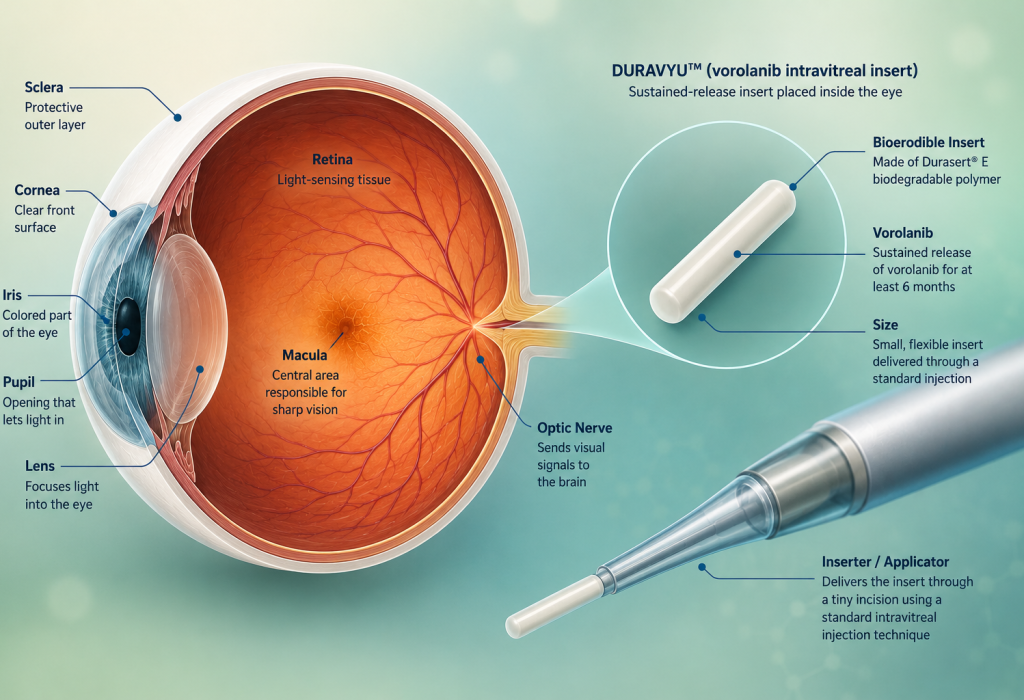
DURAVYU contains the selective tyrosine kinase inhibitor vorolanib in EyePoint’s bioerodible Durasert E delivery system. The insert is administered through a standard intravitreal injection and provides sustained drug release for at least six months. Vorolanib inhibits VEGF receptors and PDGFR while also affecting IL-6/JAK1 signaling, providing a mechanism distinct from conventional anti-VEGF ligand blockade.
LUGANO and the second pivotal Phase 3 trial, LUCIA (NCT06683742), are randomized, double-masked, aflibercept-controlled studies enrolling treatment-naive and previously treated wet AMD patients. Both use a six-month DURAVYU 2.7 mg dosing regimen.
LUCIA Data Will Determine Next Regulatory Step
EyePoint expects topline LUCIA results in the fourth quarter of 2026 and plans a potential FDA New Drug Application submission in the first half of 2027, contingent on those results. The company will present additional LUGANO analyses at upcoming retina meetings, beginning with the Retina Society’s annual meeting in September 2026.
DURAVYU is also being evaluated in diabetic macular edema, with the Phase 3 COMO and CAPRI trials fully enrolled and topline results expected in the fourth quarter of 2027.
Reference

About the Writer
Mansi Nakum (Linkedin) is a Pharm.D professional with a strong foundation in clinical pharmacy, evidence-based healthcare writing, and clinical data interpretation.
She has published work on Brugada syndrome and has a keen interest in guideline integration, multimodal therapy, pharmacogenomics, and antibiogram utilization.
As a healthcare writer, she focuses on translating clinical evidence into clear, accurate, and clinically relevant content, while continuously developing her expertise in evolving pharmacy practice.