
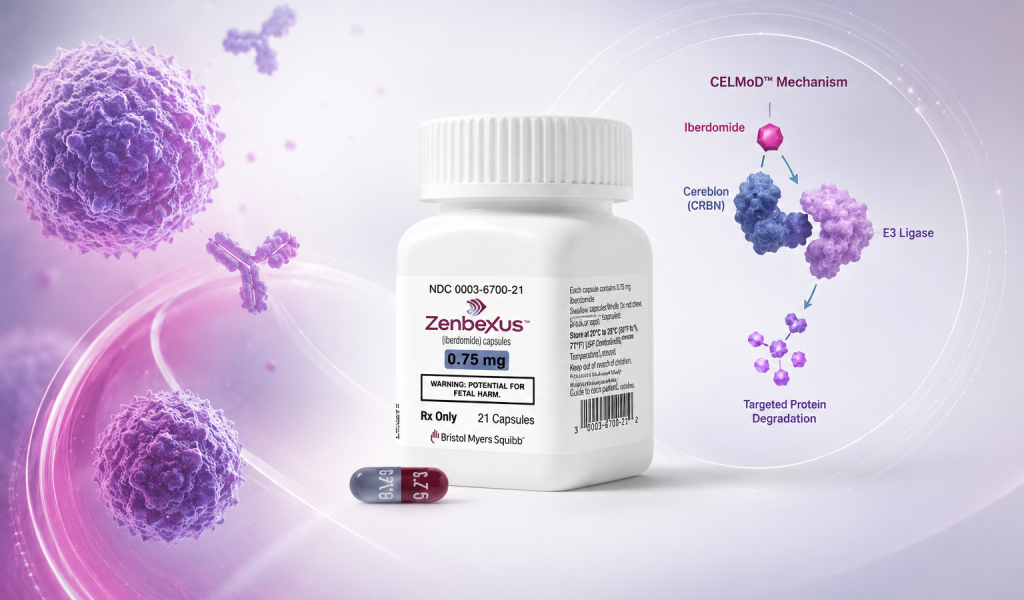
FDA approved ZENBEXUS (iberdomide) with daratumumab and dexamethasone for relapsed multiple myeloma after significant MRD-negative response in Phase 3.
Written By: Anshu Gupta, PharmD
Reviewed By: Pharmacally Editorial Team
The U.S. Food and Drug Administration has granted accelerated approval to Bristol Myers Squibb’s ZENBEXUS™ (iberdomide) in combination with daratumumab and hyaluronidase-fihj plus dexamethasone (ZDd) for adults with multiple myeloma who have received at least one prior line of therapy containing a proteasome inhibitor and an immunomodulatory agent.
The approval makes iberdomide the first FDA-approved cereblon E3 ligase modulator (CELMoD), a newer class of targeted protein degraders being developed to extend the therapeutic potential of cereblon-directed treatment in multiple myeloma.
Full approval remains contingent on verification and description of clinical benefit in confirmatory trial data.
EXCALIBER-RRMM Shows Deeper Responses
The regulatory decision was supported by the Phase 3 EXCALIBER-RRMM trial (NCT04975997), a randomized, open-label study evaluating ZDd against daratumumab, bortezomib and dexamethasone (DVd) in patients with relapsed or refractory multiple myeloma.
Among the first 420 randomized patients included in the primary minimal residual disease (MRD) efficacy population, 207 received ZDd and 213 received DVd. At a median follow-up of 16 months, 41% of patients receiving ZDd achieved MRD-negative complete response compared with 21% receiving DVd. The difference was statistically significant (p<0.0001).
MRD negativity represents one of the deepest measures of treatment response in multiple myeloma and has been associated with improved progression-free survival. The FDA decision marks the first approval in relapsed or refractory multiple myeloma based on MRD-negative complete response.
The trial continues to evaluate progression-free survival (PFS), the second dual primary endpoint. Overall survival, overall response rate and sustained MRD negativity are also being assessed.
CELMoD Mechanism Expands Cereblon Targeting
Iberdomide belongs to the CELMoD class, which enhances cereblon-mediated protein degradation to alter the activity and survival of malignant plasma cells. The approach builds on the therapeutic biology established by immunomodulatory drugs while introducing a distinct strategy for targeted protein degradation.
The development is significant because multiple myeloma remains a relapsing disease in which treatment resistance accumulates across successive lines of therapy.
Safety Remains a Key Consideration
The ZDd safety profile included substantial rates of hematologic and infectious adverse events. Neutropenia occurred in 90.2% of patients and infections in 78.9%, although discontinuation rates attributed to these events were 1% and 1.5%, respectively.
Pneumonia occurred in 34% of patients, while upper respiratory tract infection and fatigue occurred in 54% and 36%, respectively. Serious adverse reactions included pneumonia, upper respiratory tract infection, second primary malignancies, neutropenia, febrile neutropenia, COVID-19 and sepsis.
Fatal adverse reactions occurred in 4.9% of patients receiving ZDd. The prescribing information carries boxed warnings for embryo-fetal toxicity and venous and arterial thromboembolism, and ZENBEXUS is contraindicated during pregnancy.
PFS Data Will Determine the Next Milestone
ZENBEXUS received Breakthrough Therapy designation and accelerated approval under the FDA’s Project Orbis initiative. The EXCALIBER-RRMM study remains ongoing, with full results expected in 2026.
The regulatory review also comes as another CELMoD advances toward potential approval. Bristol Myers Squibb’s investigational mezigdomide, combined with carfilzomib and dexamethasone, is under FDA review with a PDUFA target date of May 13, 2027.
The ongoing PFS analysis will therefore be central to confirming whether the MRD response advantage observed with iberdomide translates into longer disease control and supports conversion of the accelerated approval to full approval.
Reference

About the Writer
Anshu Gupta (LinkedIn) is a PharmD professional and healthcare writer with interests in clinical research, pharmacovigilance, regulatory affairs, and medical writing. She has presented research at academic conferences and completed certifications in Good Clinical Practice (GCP), ICH-GCP, and drug safety. Passionate about clinical trials and evidence-based medicine, she is committed to translating scientific evidence into accurate, reliable, and accessible healthcare content.