
Caribou Biosciences reports mature vispa-cel and CB-011 CAR-T data, including durable responses in LBCL and multiple myeloma and FDA alignment for ANTLER-3
Written By: Mayuresh Salvi, PharmD
Reviewed By: Pharmacally Editorial Team
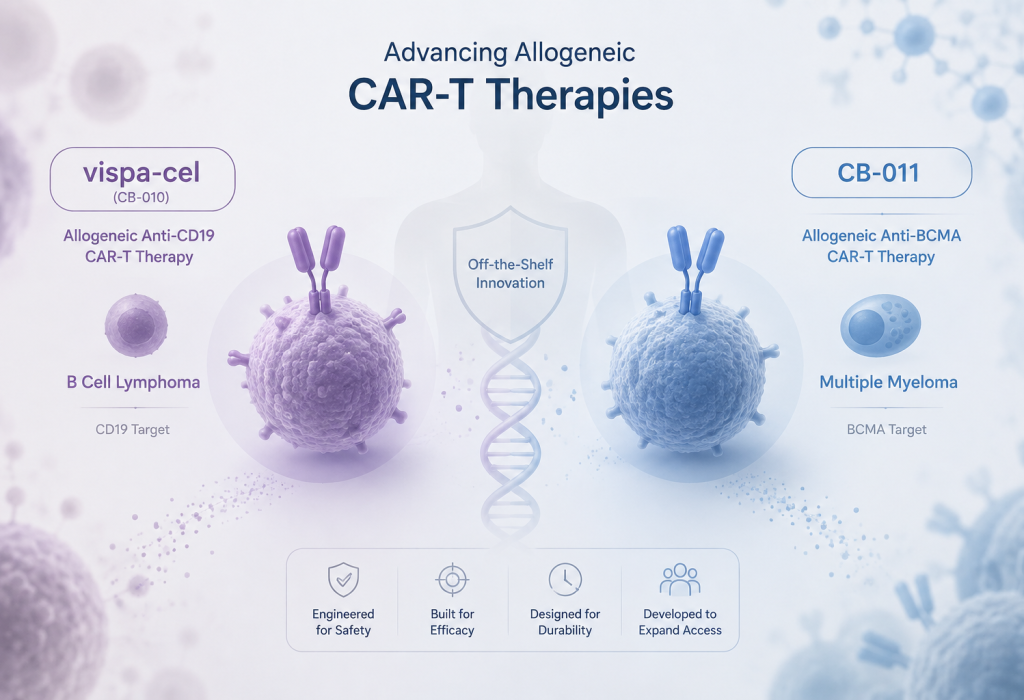
Caribou Biosciences’ latest clinical update adds longer-term evidence supporting the durability of its two allogeneic CAR-T cell programs, while moving vispacabtagene regedleucel (vispa-cel; formerly CB-010) closer to pivotal testing in second-line large B-cell lymphoma (LBCL). In the updated ANTLER phase 1 dataset (NCT04637763), a single 80-million-cell dose produced an 82% overall response rate (ORR), 67% complete response (CR) rate, and 17.1-month median progression-free survival (PFS) in 27 patients with optimized vispa-cel.
For CB-011, longer follow-up from the CaMMouflage phase 1 trial (NCT05722418) showed an 83% CR or stringent CR rate and 50% of patients remaining in at least CR at 15 months.
Vispa-cel advances with mature ANTLER data
Vispa-cel is an allogeneic anti-CD19 CAR-T therapy being developed for relapsed or refractory B-cell non-Hodgkin lymphoma. The product incorporates a PD-1 knockout intended to reduce premature CAR-T cell exhaustion. Its off-the-shelf manufacturing model could also avoid the production delays associated with individualized autologous CAR-T therapies.
The updated analysis focuses on 27 patients with second-line LBCL who received a single 80-million-cell dose of optimized vispa-cel. The optimized product used cells from donors younger than 30 years with at least two matched human leukocyte antigen (HLA) alleles.
The cohort produced an 82% ORR and 67% CR rate, with a median PFS of 17.1 months. The PFS result represents an important maturity milestone compared with the November 2025 dataset, when median PFS had not yet been reached in the 35-patient optimized cohort. At that time, the cohort showed an 86% ORR, 63% CR rate and 53% PFS at 12 months.
Longer follow-up provides a clearer safety picture
The longer follow-up also adds clinically important safety information. Caribou continues to report no graft-versus-host disease and no grade 3 or higher immune effector cell-associated neurotoxicity syndrome in the optimized population.
However, the mature dataset identified additional serious events, including one vispa-cel-related death from immune effector cell-associated hemophagocytic syndrome and one possibly related death from progressive multifocal leukoencephalopathy. These events warrant consideration alongside the generally manageable safety profile reported by the company.
The findings therefore strengthen the durability case for vispa-cel while providing a more complete assessment of risks with longer observation.
FDA alignment clears path for ANTLER-3
The clinical update also reflects progress toward pivotal development. Caribou has reached alignment with the U.S. Food and Drug Administration on the design of ANTLER-3, a planned randomized, controlled phase 3 trial expected to enroll approximately 250 CD19-naïve patients with second-line LBCL who are not eligible for transplant and are not candidates for autologous CAR-T because of medical or access-related factors.
This population directly addresses one of the potential advantages of an off-the-shelf CAR-T product: treatment availability without the individualized manufacturing process required for autologous therapies. Caribou previously reported ongoing FDA discussions in late 2025 and confirmed regulatory alignment in May 2026.
CB-011 shows sustained responses in multiple myeloma
The CaMMouflage phase 1 program is evaluating CB-011, an allogeneic anti-BCMA CAR-T therapy in patients with relapsed or refractory multiple myeloma after at least three prior lines of therapy. CB-011 incorporates B2M knockout and insertion of a B2M-HLA-E-peptide fusion protein to reduce immune-mediated rejection.
In the 12-patient BCMA-naïve cohort treated at the 450-million-cell recommended dose for expansion, ORR remained 92% and MRD negativity remained 91% among evaluable patients. The CR or stringent CR rate increased from 75% in the November 2025 dataset to 83% with longer follow-up. Importantly, 50% of patients remained in at least CR at 15 months.
Caribou also reported a case involving a 71-year-old patient who had received eight previous treatment lines, including ciltacabtagene autoleucel. After a single 450-million-cell dose of CB-011, the patient achieved a CR by day 28 that remained ongoing at the May 2026 data cutoff.
Dose expansion remains the next major milestone
Caribou expects initial dose-expansion data for CB-011 in both BCMA-naïve and BCMA-exposed patients during the second half of 2026. The company expects more than 15 patients to have at least three months of follow-up in the initial dataset.
As of June 30, 2026, Caribou held $113.8 million in cash, cash equivalents and marketable securities. The company expects those resources to support CB-011 dose expansion and certain ANTLER-3 startup activities through the end of 2027, while it evaluates financing options to fully fund the planned phase 3 trial.
The updated datasets therefore provide the clearest evidence to date that both programs can generate durable responses after a single dose, while the next clinical readouts will determine whether these early allogeneic CAR-T findings translate into broader efficacy across BCMA-exposed multiple myeloma and a pivotal second-line LBCL population.
Reference

About the Writer
Mayuresh Sunil Salvi (Linkedin) is a PharmD professional and healthcare writer with a strong interest in pharmacovigilance, drug safety, and emerging medical research. He is passionate about exploring new drug discoveries, clinical research, and advances in evidence-based medicine. His interests also include ward rounds, prescription audits, and treatment analysis to support rational pharmacotherapy and improved patient care.