
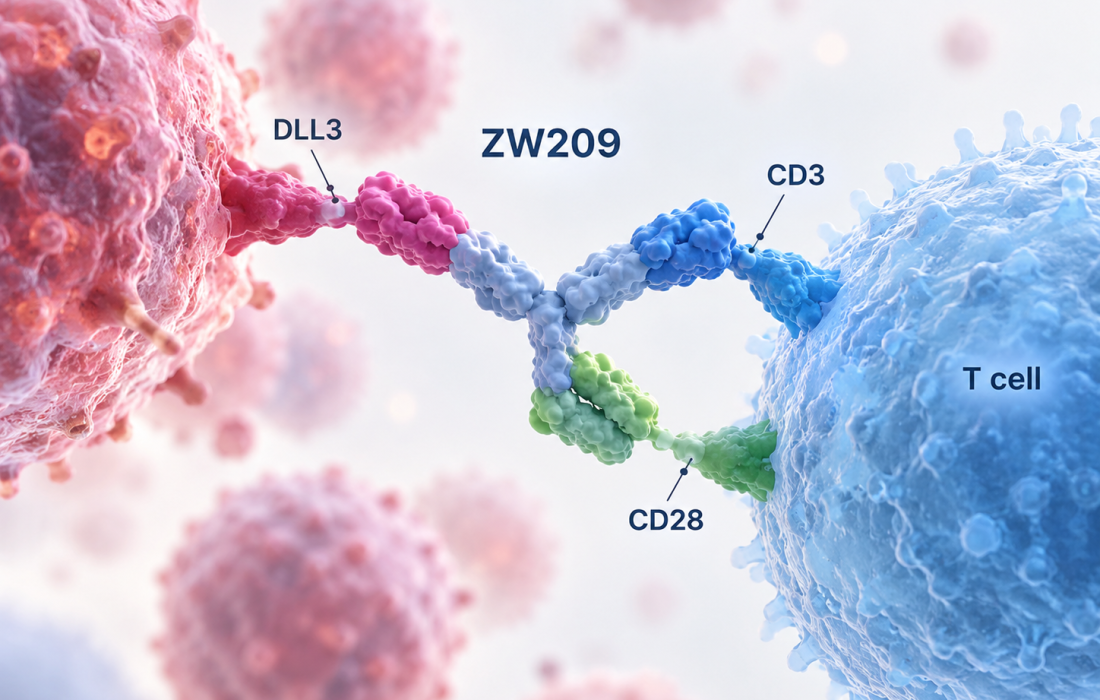
Zymeworks grants Roche global rights to DLL3-targeting T-cell engager ZW209 in a deal worth up to $813 million, plus tiered royalties on future sales.
Written By: Rishabh Sonawane, BPharm
Reviewed By: Pharmacally Editorial Team
Zymeworks announced on October 23, 2026, an exclusive global license and collaboration agreement with Roche for ZW209, an investigational trispecific T-cell engager (TriTCE) targeting DLL3-expressing cancers. The agreement combines Zymeworks’ multispecific antibody-engineering capabilities with Roche’s global oncology development, manufacturing and commercialization infrastructure.
The deal provides Zymeworks with a $55 million upfront payment, a further $40 million upon initiation of the Phase 1b trial, and up to $718 million in additional development, commercial and sales-based milestone payments. The company is also eligible for tiered royalties on future global net sales of approved medicines arising from the collaboration.
The transaction remains subject to the expiration or termination of the applicable waiting period under the Hart-Scott-Rodino Antitrust Improvements Act of 1976, other customary closing conditions and any required regulatory approvals.
ZW209 Integrates DLL3 Targeting with Conditional T-Cell Costimulation
ZW209 is designed to recognize DLL3 on tumour cells while simultaneously engaging T cells through CD3 and CD28. The candidate was developed using Zymeworks’ TriTCE Co-Stim platform alongside its Azymetric and EFECT technologies.
Its design incorporates obligate cis-T-cell binding and conditional CD28 engagement, intended to promote tumour-directed immune activity while limiting unintended T-cell activation. CD3 engagement supports T-cell-mediated tumour-cell killing, while CD28 provides a costimulatory signal intended to strengthen T-cell proliferation and persistence.
In preclinical experiments, ZW209 demonstrated enhanced long-term cytotoxicity in vitro, alongside increased T-cell proliferation and survival. These findings provide a rationale for clinical investigation, but they do not establish clinical efficacy, safety or improved patient outcomes.
The approach is relevant to DLL3-expressing malignancies, including small-cell lung cancer and other neuroendocrine tumours. However, its potential clinical advantage over existing DLL3-targeting therapies will require evaluation in human studies.
Phase 1 Development to Assess Safety and Preliminary Activity
Following US Food and Drug Administration (FDA) clearance of its Investigational New Drug (IND) application, a global, open-label, multicentre Phase 1 study of ZW209 has been initiated. The study is designed to evaluate safety, tolerability, pharmacokinetics and preliminary antitumour activity in adults with selected advanced solid tumours, including small-cell lung cancer and other DLL3-expressing neuroendocrine tumours.
Under the agreement, Zymeworks will conduct the Phase 1a monotherapy trial in collaboration with Roche, which will fund the study. Roche will subsequently assume responsibility for global development and commercialization. Additional regulatory applications are planned to support the opening of clinical study sites outside the United States.
This arrangement allows Zymeworks to advance the candidate through initial clinical development while sharing development risk with a partner equipped to support broader global trials and commercialization, subject to the programme’s progress.
Up to $813 Million in Payments Plus Royalties
The agreement’s stated financial components comprise:
- $55 million upfront: Payable under the licensing agreement.
- $40 million Phase 1b payment: Triggered by initiation of the Phase 1b trial.
- Up to $718 million in additional milestones: Linked to development, commercial and sales-based achievements.
- Tiered royalties: High-single-digit to mid-teen percentages on future global net sales, subject to the agreement’s terms.
The maximum stated upfront and milestone payments total $813 million, excluding royalties. This represents potential contractual value rather than guaranteed revenue, as the additional payments depend on future development and commercial milestones.
Patent protection extending into the 2040s could support the duration of Zymeworks’ potential commercial participation, although actual returns will depend on development outcomes, regulatory approvals, commercial performance and the applicable agreement terms.
Commercial Significance and Next Steps
For Zymeworks, the collaboration provides upfront funding, potential milestone income and continuing royalty participation while transferring responsibility for subsequent global development and commercialization to Roche. For Roche, the agreement secures exclusive global rights to an investigational DLL3-targeting candidate designed to integrate T-cell engagement with conditional costimulation.
The immediate priority is to generate clinical evidence on ZW209’s safety, tolerability, pharmacokinetics and preliminary antitumour activity. The preclinical findings support further investigation, but whether the trispecific design translates into durable clinical responses remains uncertain.
No marketing authorization or commercial launch date has been announced. The programme’s future value will depend on clinical results, regulatory progress and the ability to establish a meaningful therapeutic role in DLL3-expressing cancers.
Reference
Zymeworks Enters into an Exclusive Global License and Collaboration Agreement with Roche for ZW209, a Trispecific T cell Engager Targeting DLL3, Zymeworks, 23 October 2026

About the Writer
Rishabha Sonawane, B.Pharm (LinkedIn) is healthcare writer with a strong interest in medical writing, regulatory affairs, clinical research, and AI-driven drug discovery. He has completed specialized training from the NIH and ICMR in clinical pharmacology, clinical research, and scientific writing. Passionate about evidence-based healthcare communication, he focuses on translating complex scientific research into clear, accurate, and engaging medical content.