
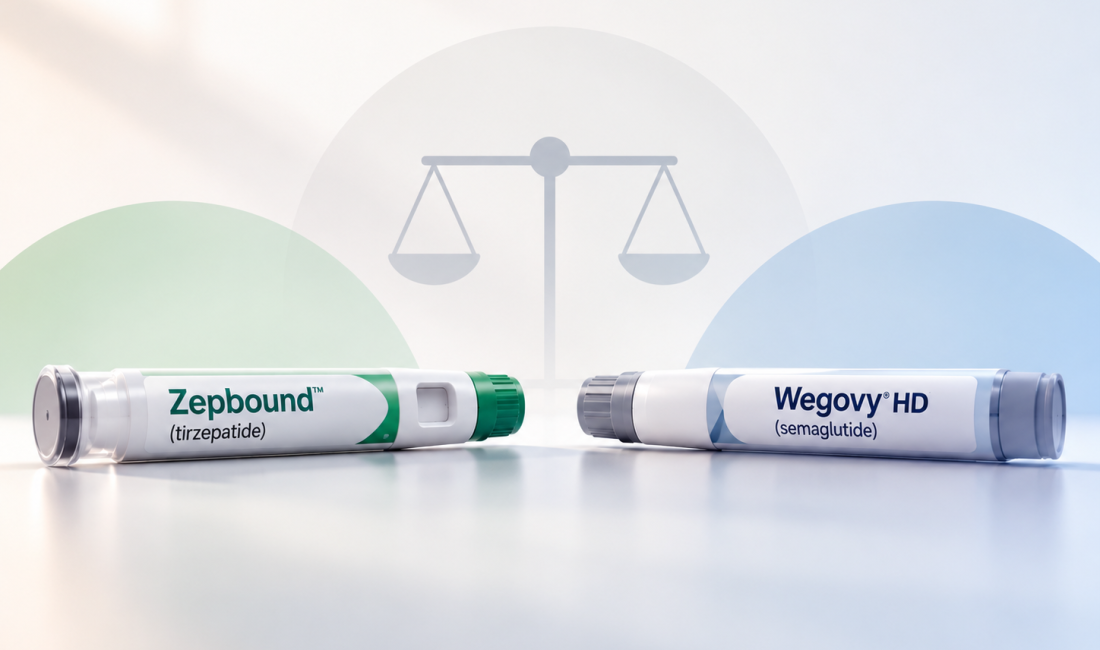
Zepbound 10 mg and 15 mg were associated with greater weight loss than Wegovy HD 7.2 mg in an indirect treatment comparison at 72 weeks.
Written By: Neha Vishwakarma, PharmD
Reviewed By: Pharmacally Editorial Team
Eli Lilly and Company has announced results from a new indirect treatment comparison of Zepbound (tirzepatide) 10 mg and 15 mg versus Wegovy HD (semaglutide injection 7.2 mg) in adults with obesity. The analysis drew on data from the SURMOUNT-1 and STEP UP trials and was presented at the 62nd Annual Meeting of the European Association for the Study of Diabetes (EASD) in Milan, Italy. No head-to-head trial has yet compared tirzepatide 15 mg with semaglutide 7.2 mg.
Weight Loss Results at 72 Weeks
The analysis was adjusted for gender, age, baseline weight and baseline A1C and used a multilevel network meta-regression (ML-NMR) approach to account for differences between the underlying trials. Using the treatment-regimen estimand, which reflects the average treatment effect regardless of treatment discontinuation, Zepbound was associated with greater weight loss than Wegovy HD at 72 weeks.
Zepbound 15 mg was associated with a 4.5-percentage-point greater reduction in body weight on average (95% CrI: -6.3 to -2.8), while Zepbound 10 mg was associated with a 3.2-percentage-point greater reduction (95% CrI: -5.0 to -1.4).
Using the efficacy estimand, which reflects efficacy before discontinuation of study drug, the differences were smaller and did not reach statistical significance. Zepbound 15 mg was associated with 1.8% greater mean weight reduction (95% CrI: -3.8 to 0.1), while Zepbound 10 mg was associated with 0.7% greater reduction (95% CrI: -2.6 to 1.3).
Odds of Achieving 20% or Greater Weight Reduction
Participants taking Zepbound 15 mg had higher odds of achieving at least 20% body-weight reduction than those receiving Wegovy HD. With the efficacy estimand, the odds ratio was 4.15 (95% CrI: 1.02 to 15.64), while the treatment-regimen estimand produced an odds ratio of 3.54 (95% CrI: 1.05 to 11.05).
For Zepbound 10 mg, the odds of reaching at least 20% weight loss were more than two times higher, but the results were not statistically significant. The odds ratios were 2.8 (95% CrI: 0.7 to 10.8) with the efficacy estimand and 2.46 (95% CrI: 0.7 to 7.8) with the treatment-regimen estimand.
HbA1c and Tolerability
The indirect comparison found no statistically significant difference in HbA1c reduction between tirzepatide 10 mg or 15 mg and semaglutide 7.2 mg.
Treatment discontinuation due to adverse events was also comparable between Zepbound 10 mg or 15 mg and Wegovy HD. Severe gastrointestinal adverse events could not be reliably compared because they occurred too infrequently across the treatment groups.
Background: SURMOUNT-1, STEP UP and SURMOUNT-5
SURMOUNT-1 (NCT04184622) was a randomized, double-blind, placebo-controlled trial of tirzepatide 5 mg, 10 mg and 15 mg in 2,539 adults with obesity, or overweight with at least one weight-related comorbidity, without type 2 diabetes. Participants were randomized 1:1:1:1 across the three tirzepatide doses and placebo, with co-primary endpoints assessed at 72 weeks.
The semaglutide 7.2 mg data came from STEP UP, a randomized, controlled Phase 3b trial published in The Lancet Diabetes & Endocrinology.
The analysis adds to earlier direct evidence from SURMOUNT-5 (NCT05822830), a 72-week, open-label Phase 3b trial that randomized 751 adults in the U.S. and Puerto Rico to the maximum tolerated dose of Zepbound (10 mg or 15 mg) or Wegovy (1.7 mg or 2.4 mg). Zepbound produced an average weight reduction of 20.2% versus 13.7% with Wegovy using the treatment-regimen estimand, corresponding to a 47% greater relative weight loss. Average weight reduction was 50.3 lb (22.8 kg) versus 33.1 lb (15.0 kg). However, SURMOUNT-5 did not include the 7.2 mg semaglutide dose evaluated in the current indirect comparison.
Expert Perspective
John Wilding, D.M., professor of medicine at the University of Liverpool, said clinicians increasingly want evidence on how available obesity treatments compare. He noted that in the absence of a head-to-head trial of tirzepatide 15 mg against semaglutide 7.2 mg, the indirect comparison provides additional evidence for clinicians.
Thomas Seck, M.D., senior vice president of product development at Lilly Cardiometabolic Health, said the analysis suggests that the Zepbound doses that demonstrated greater weight loss than Wegovy 1.7 mg and 2.4 mg in a head-to-head Phase 3 trial may also produce greater weight loss than Wegovy HD.
Interpretation and Limitations
The findings should be interpreted as an indirect treatment comparison rather than evidence from a head-to-head randomized trial. The analysis used ML-NMR to adjust for differences between the underlying studies, but only two trials were available and residual cross-trial confounding cannot be excluded.
The estimated treatment difference also depended on the estimand. The advantage for both Zepbound doses was statistically significant under the treatment-regimen estimand, whereas the weight-loss differences were not statistically significant under the efficacy estimand.
The credible intervals for the 20% weight-loss odds ratios were also wide, particularly for Zepbound 15 mg, indicating uncertainty around the precise size of the estimated treatment effect. The analysis was presented by Lilly, the manufacturer of Zepbound.
Regulatory Note
Zepbound is an injectable dual GIP and GLP-1 receptor agonist. It is indicated with a reduced-calorie diet and increased physical activity for adults with obesity, or some adults with overweight and a weight-related condition, and for adults with moderate-to-severe obstructive sleep apnea and obesity. It is approved in 2.5 mg, 5 mg, 7.5 mg, 10 mg, 12.5 mg and 15 mg doses.
The findings described here come from an indirect analysis and do not constitute a head-to-head clinical trial of tirzepatide 10 mg or 15 mg versus semaglutide 7.2 mg.
Reference
Lilly’s Zepbound (tirzepatide 10 mg and 15 mg) was associated with more weight loss than Wegovy HD (semaglutide injection 7.2 mg) in a new indirect treatment comparison, Eli Lilly, 29 September 2026
A Study of Tirzepatide (LY3298176) in Participants with Obesity or Overweight (SURMOUNT-1), ClinicalTrials.gov ID NCT04184622
A Study of Tirzepatide (LY3298176) in Participants with Obesity or Overweight with Weight Related Comorbidities (SURMOUNT-5), ClinicalTrials.gov ID NCT05822830
A Research Study to See How Semaglutide Helps People with Excess Weight, Lose Weight (STEP UP) (STEP UP), ClinicalTrials.gov ID NCT05646706
Wharton S, et al, Once-weekly semaglutide 7·2 mg in adults with obesity (STEP UP): a randomised, controlled, phase 3b trial. Lancet Diabetes Endocrinol. 2025 Nov;13(11):949-963. https://doi.org/10.1016/s2213-8587(25)00226-8

About the Writer
Neha Vishwakarma (Linkedin) is a Pharm.D professional with experience in clinical pharmacy, pharmacovigilance, and clinical research. She has hands-on experience in ADR assessment, ICSR processing, medication safety, and clinical data evaluation. Her research background in surgical site infections and antibiotic use supports her focus on evidence-based healthcare writing.