
CytoSorb real-world data showed a 37% reduction in severe bleeding during urgent CABG after ticagrelor exposure, supporting a new FDA De Novo filing.
Written By: Khushi Patel, PharmD
Reviewed By: Pharmacally Editorial Team
CytoSorbents has reported new real-world evidence demonstrating a 37% relative reduction in severe bleeding among patients undergoing urgent coronary artery bypass grafting (CABG) following recent exposure to ticagrelor. The patient-level matched analysis presented at ESC Congress 2026 also showed lower 24-hour chest tube drainage and reduced red blood cell transfusion requirements, with no serious device-related adverse events reported.
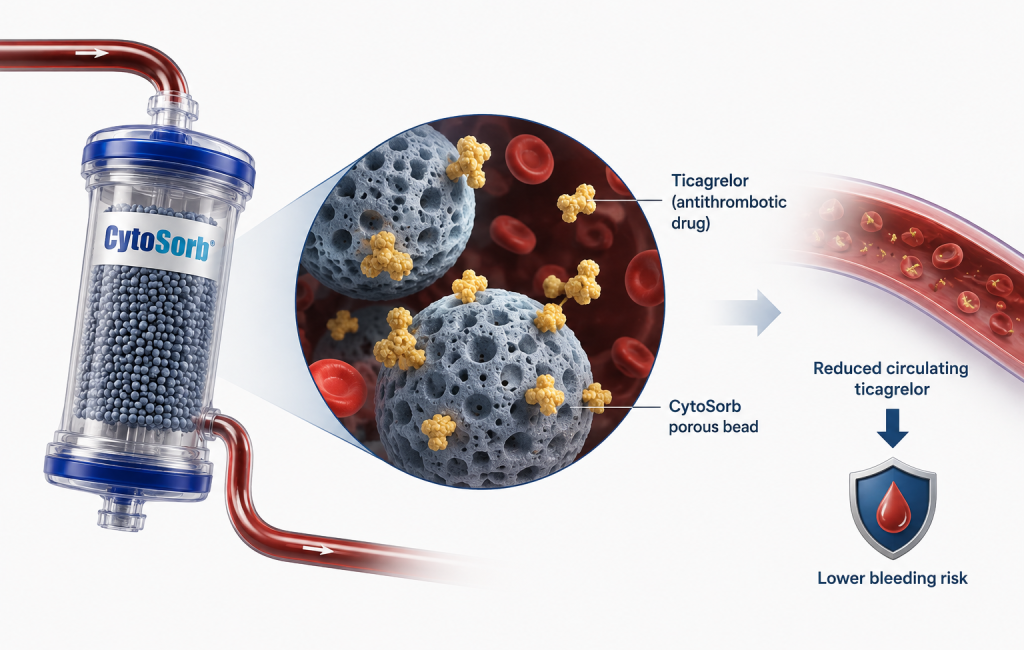
CytoSorb is an extracorporeal blood-purification device using highly porous polymer beads to adsorb selected substances directly from whole blood. Connected to the cardiopulmonary bypass circuit during surgery, the cartridge removes circulating antithrombotic medications like ticagrelor, blunting their antiplatelet effect and decreasing surgical bleeding risks.
Real-World Evidence Key Outcomes
The analysis evaluated 587 patients undergoing urgent CABG after recent ticagrelor exposure, comparing 198 patients treated intraoperatively with CytoSorb (from the STAR-T Registry) against 389 matched historical controls from a published individual patient data meta-analysis.
Clinical Metric | CytoSorb Group (n=198) | Control Group (n=389) | Statistical Significance |
Severe Bleeding (BARC-4) | 21.8% | 34.5% | P=0.002 (NNT=8 ) |
24-Hour Chest Tube Drainage | Statistically Reduced | Baseline | P=0.039 |
RBC Transfusion Need | Statistically Reduced | Baseline | P=0.003 |
Device Safety | 0 Serious Adverse Events | N/A | Safe profile maintained |
Addressing the Ticagrelor Challenge
Ticagrelor is a potent inhibitor routinely prescribed for acute coronary syndromes. Because its persistent antiplatelet activity creates severe surgical bleeding risks, conventional practice requires delaying urgent CABG for several days to allow drug clearance. Intraoperative blood purification offers an immediate alternative, eliminating the wait time by actively removing ticagrelor during cardiopulmonary bypass.
- European Union: Approved and commercially available under the CE mark for this indication.
- United States: CytoSorb and its dedicated U.S. counterpart, DrugSorb-ATR, remain investigational devices and are not yet FDA approved or cleared.
Alignment with STAR-T Trial & FDA Roadmap
According to Prof. Uwe Zeymer, Co-Principal Investigator of the STAR-T Registry, the robust statistical adjustment in this matched real-world study confirms the severe bleeding reductions previously observed in controlled settings. The findings align closely with the randomized, double-blind STAR-T trial, which demonstrated a number needed to treat (NNT) of six for major bleeding prevention.
CytoSorbents intends to utilize this real-world dataset as a foundational component of its upcoming FDA De Novo submission for DrugSorb-ATR under its Breakthrough Device designation:
- Expanded Cohort: Incorporating real-world evidence expands the total evaluated patient cohort supporting the primary ticagrelor application to approximately 250 treated patients.
- Ticagrelor Regulatory Timeline: Following Pre-Submission meetings covering mechanistic and evaluation models, the company plans to submit its De Novo application in early 2027.
- DOAC Expansion: Parallel FDA discussions are underway for DrugSorb-ATR in patients receiving direct oral anticoagulants (DOACs) such as apixaban and rivaroxaban, with a separate De Novo submission path planned.
Reference

About the Writer
Khushi Patel is a Pharm.D (Linkedin) professional with a strong foundation in clinical pharmacy, patient-centered care, regulatory affairs, and pharmacovigilance, with published work on Brugada syndrome.
Her interests include regulatory affairs, pharmacovigilance, guideline integration, multimodal therapy, pharmacogenomics, and antibiogram utilization, with a focus on evidence-based clinical decision-making and medication safety.
As a Pharmacally healthcare writer, she translates clinical and scientific evidence into clear, accurate, and clinically relevant healthcare content, while continuously developing her expertise in evolving pharmacy practice.