
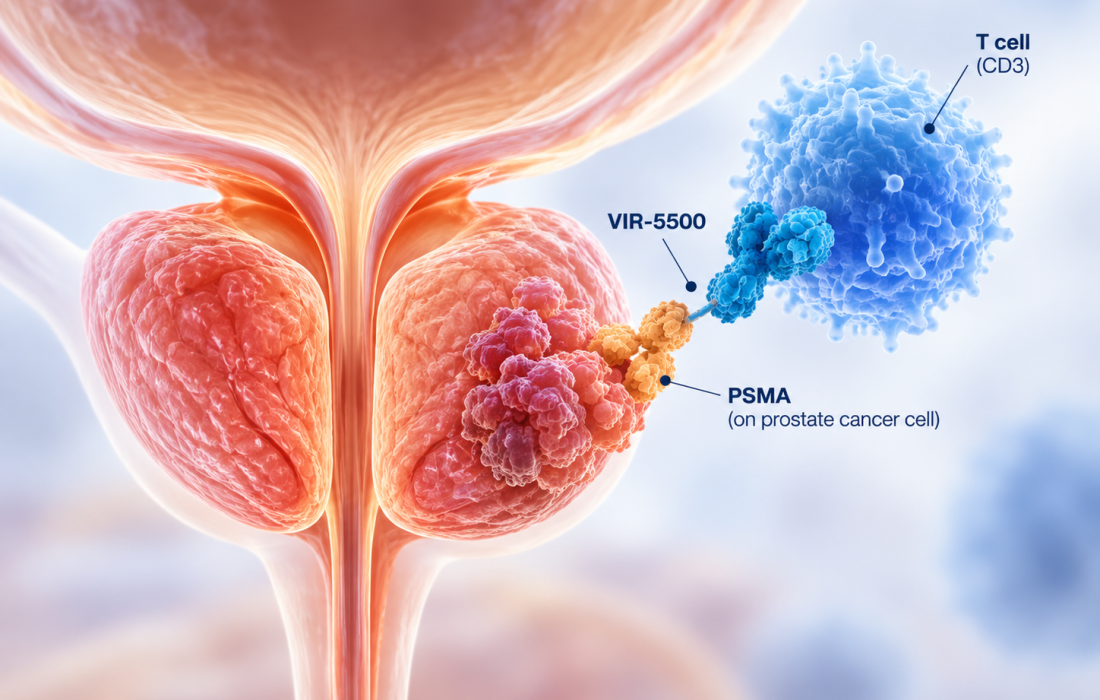
Vir Biotechnology’s VIR-5500 receives FDA Fast Track designation for advanced prostate cancer, following preliminary Phase 1 efficacy and safety findings.
Written By: Creola Gonsalves, MS Biotech
Reviewed By: Pharmacally Editorial Team
Vir Biotechnology announced on October 8, 2026, that the U.S. Food and Drug Administration (FDA) granted Fast Track designation to VIR-5500, an investigational PSMA-targeted, PRO-XTEN® dual-masked T-cell engager, for late-line metastatic castration-resistant prostate cancer (mCRPC).
VIR-5500 is being co-developed by Vir Biotechnology and Astellas Pharma under a global strategic collaboration. The companies anticipate initiating pivotal Phase 3 trials in 2027, subject to ongoing clinical development.
Fast Track designation is intended to facilitate the development and review of therapies for serious conditions with unmet medical needs. It can enable more frequent FDA interactions and access to certain expedited regulatory pathways when eligibility criteria are met. It does not constitute marketing approval or establish clinical benefit.
Clinical Evaluation of VIR-5500
VIR-5500 is being evaluated in an open-label, non-randomized Phase 1 study (NCT05997615) designed to assess safety, pharmacokinetics and preliminary efficacy. The dose-expansion program includes six cohorts spanning monotherapy and combination treatment.
The monotherapy cohorts include patients with taxane-naïve mCRPC, radioligand therapy-naïve mCRPC, and radioligand therapy-exposed mCRPC. Combination cohorts are evaluating VIR-5500 with enzalutamide in early-line mCRPC, docetaxel in early-line mCRPC, and darolutamide in metastatic hormone-sensitive prostate cancer (mHSPC).
Phase 1 Results Show Preliminary Antitumor Activity
In an update published on February 23, 2026, Vir reported monotherapy safety findings from 58 patients. No dose-limiting toxicities had been observed at the data cut-off. Grade 3 or higher treatment-related adverse events occurred in 7 of 58 patients (12%), while cytokine release syndrome (CRS) occurred in 29 of 58 patients (50%), generally at Grade 1.
In the higher-dose cohorts receiving at least 3,000 µg/kg every three weeks, PSA declines of at least 50% occurred in 14 of 17 evaluable patients (82%), while declines of at least 90% occurred in 9 of 17 (53%). Among 11 patients evaluable for radiographic response under RECIST criteria, 5 had an objective response (45%). Four responses were confirmed, and one was awaiting confirmation at the time of the update.
The reported population was heavily pretreated, with a median of four prior lines of therapy. These early findings support further investigation but do not establish clinical benefit. Larger studies and longer follow-up are needed to characterize response durability, efficacy and safety.
Need for More Treatment Options in Advanced Prostate Cancer
Some patients with metastatic prostate cancer eventually develop mCRPC, in which the disease progresses despite testosterone suppression. Late-line disease remains difficult to treat after multiple therapies, highlighting the need for treatments that sustain antitumor activity while limiting toxicity. VIR-5500 is being investigated as one potential approach to this challenge.
How VIR-5500 Works
VIR-5500 is a bispecific T-cell engager that binds prostate-specific membrane antigen (PSMA), expressed on many prostate cancer cells, and CD3, a component of the T-cell receptor complex. This interaction is designed to bring T cells into proximity with cancer cells and promote tumor-cell killing.
The candidate incorporates PRO-XTEN® dual-masking technology, which is designed to keep the molecule less active during circulation. Proteases in the tumor microenvironment are intended to remove the masking components, allowing the engager to become active near the tumor. The approach aims to limit activity in healthy tissues and improve the therapeutic window, although its potential safety and efficacy advantages remain to be established clinically.
Development Outlook
Marianne De Backer, President and Chief Executive Officer of Vir Biotechnology, said the Fast Track designation reflects the potential of VIR-5500 to address unmet medical needs in late-line mCRPC and the progress made with Astellas toward planned Phase 3 development in 2027.
The anticipated Phase 3 start remains a development goal, not a completed milestone. Further clinical findings and regulatory discussions will help determine the next steps for VIR-5500.
Reference
Vir Biotechnology Announces PSMA-targeted PRO-XTEN® Dual-masked T-cell Engager VIR-5500 Received FDA Fast Track Designation for the Treatment of Prostate Cancer, Vir Biotechnology, 08 October 2026
Safety, Pharmacokinetics, and Preliminary Efficacy of VIR-5500 (AMX-500) in Prostate Cancer, ClinicalTrials.gov ID NCT05997615

About the Writer
Creola Gonsalves (Linkedin) is an M.S. Biotechnology postgraduate with a strong interest in clinical research, evidence interpretation, and healthcare writing, with a focus on translating life-science knowledge into meaningful real-world insights.
She is trained in Good Clinical Practice (GCP), clinical research principles, and critical interpretation of randomized clinical trials, with certifications from NIH and Stanford University.
Her research background in biotechnological applications and microbial research strengthens her ability to understand scientific evidence and develop clear, accurate, and research-driven healthcare content.