
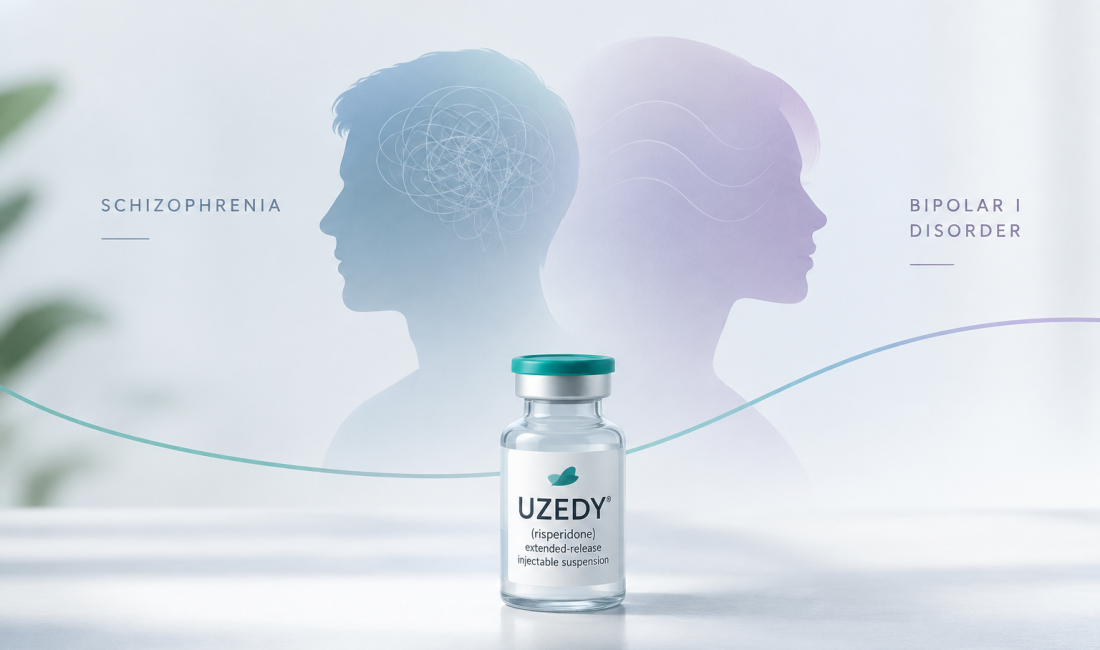
Teva’s UZEDY real-world data show greater treatment continuity, fewer emergency visits and lower healthcare costs in schizophrenia and bipolar I disorder.
Written By: Kalyani Boharapi,
M.Pharm (Reg. Affairs)
Reviewed By: Pharmacally Editorial Team
Teva presented new real-world evidence showing that UZEDY (risperidone) extended-release injectable suspension was associated with greater treatment continuity and lower emergency care use in adults with schizophrenia, while patients with bipolar I disorder (BD-I) who switched from oral antipsychotics experienced less treatment failure.
Real-World Evidence from Psych Congress
The findings, presented at Psych Congress in New Orleans from September 15–19, 2026, evaluated treatment persistence, healthcare resource utilization and clinical outcomes among adults receiving UZEDY for schizophrenia or BD-I.
In schizophrenia, matched real-world analyses compared once-monthly UZEDY with other long-acting injectable (LAI) antipsychotics. A separate analysis assessed healthcare utilization and costs against once-monthly paliperidone palmitate (PP1m).
Lower Emergency Care and Healthcare Costs in Schizophrenia
The PP1m analysis included 1,166 matched patients, with 583 in each treatment group. The analysis found lower emergency care use and direct healthcare costs among patients receiving UZEDY.
Key findings versus PP1m:
- Emergency department visits: 22.0% of UZEDY-treated patients had an ED visit versus 27.8% with PP1m.
- All-cause ED visit rate: 40% lower with UZEDY.
- Inpatient hospitalization: 11.1% with UZEDY versus 14.8% with PP1m.
- Mean monthly direct healthcare costs: $4,688.10 with UZEDY versus $5,724.80 with PP1m.
- Adjusted monthly savings: $1,036.70 per patient with UZEDY.
The cost difference reflects direct healthcare costs captured in the analysis and should not be interpreted as a measure of total economic benefit.
Treatment Continuity Across Long-Acting Injectables
Another matched analysis compared once-monthly UZEDY with risperidone microspheres administered every two weeks, once-monthly aripiprazole and once-monthly haloperidol decanoate.
Risperidone microspheres require administration every two weeks, whereas UZEDY is available in once-monthly and once-every-two-month dosing options, providing a longer administration interval.
The largest differences in treatment continuity were observed between UZEDY and risperidone microspheres.
Key findings across the LAI comparisons
- Adherence versus risperidone microspheres: UZEDY was associated with 3.6-fold higher odds of adherence.
- Treatment discontinuation: UZEDY was associated with an 80% lower likelihood of discontinuation versus risperidone microspheres.
- Emergency and inpatient care: UZEDY patients had lower rates of ED visits and hospitalizations versus risperidone microspheres.
- Haloperidol decanoate: UZEDY was associated with lower ED visit rates.
- Aripiprazole: Outcomes were generally comparable between the treatments.
Because these analyses used observational, matched real-world data rather than randomized treatment assignment, the reported associations do not establish that UZEDY itself caused the differences in treatment continuity or healthcare utilization.
Findings in Bipolar I Disorder
Teva also reported real-world data from 358 matched adults with BD-I who switched from an oral antipsychotic to either UZEDY or another oral antipsychotic.
The analysis included 179 patients in each group. Treatment failure occurred in 47% of patients switched to UZEDY compared with 63% of those switched to another oral antipsychotic.
Patients receiving UZEDY were also more likely to remain on treatment without BD-I or mania-related hospitalization, ED visits or discontinuation because of inadequate effectiveness.
Clinical Context and UZEDY’s Role
UZEDY is a subcutaneous extended-release formulation of risperidone that uses Medincell’s copolymer technology to provide rapid absorption followed by sustained drug release. It is available in one- and two-month dosing intervals.
UZEDY is indicated for the treatment of schizophrenia in adults and for maintenance treatment of bipolar I disorder in adults, either as monotherapy or as adjunctive therapy with lithium or valproate.
The new real-world analyses add evidence on treatment continuity, acute-care utilization and healthcare costs in routine clinical practice. These outcomes are particularly relevant in schizophrenia and BD-I, where treatment interruption and relapse can lead to emergency care and hospitalization.
Expanding Evidence for UZEDY
The Psych Congress data expand the real-world evidence base for UZEDY across schizophrenia and BD-I. The analyses associate UZEDY with greater treatment continuity, fewer emergency-care encounters and lower direct healthcare costs in the populations studied.
Further real-world and comparative research will help clarify how these findings translate across broader patient populations and different treatment settings.
Reference
Teva Highlights New Real-World Data Showing UZEDY® (risperidone) Outperforms Other Long-Acting Injectables in Keeping Schizophrenia Patients on Treatment, While Reducing Emergency Care and Healthcare Costs, Teva, 18 September 2026

About the Writer
Kalyani Boharapi (LinkedIn) is a pharmacy professional and healthcare writer currently pursuing an M.Pharm in Regulatory Affairs at Dr. D. Y. Patil College of Pharmacy, with interests in pharmaceutical regulations, drug development, and healthcare innovation. She has academic exposure to dossier preparation, scientific writing, and regulatory documentation. Kalyani has also completed certification courses in Generative AI, AI in Pharma, and Bioinformatics, and actively participates in pharmaceutical conferences to stay updated with emerging trends and advancements in the healthcare and pharmaceutical industry.