
Trastuzumab botidotin (A166) improved PFS versus T-DM1 in HER2-positive advanced breast cancer, with higher response rates in a Phase III trial.
Written By: Creola Gonsalves, MS Biotech
Reviewed By: Pharmacally Editorial Team
Sichuan Kelun-Biotech Biopharmaceutical’s trastuzumab botidotin (A166) significantly prolonged progression-free survival versus trastuzumab emtansine (T-DM1) in patients with previously treated HER2-positive unresectable or metastatic breast cancer. The Phase III results, now published in Journal of Clinical Oncology, also showed higher response rates and longer response duration, strengthening the clinical evidence supporting the ADC in later-line HER2-positive disease.
Phase III Trial Shows 61% Reduction in Progression or Death
The randomized, open-label, multicenter KL166-III-06 Phase III trial enrolled 365 patients with HER2-positive unresectable or metastatic breast cancer who had previously received trastuzumab and a taxane-containing regimen. Patients were randomized 1:1 to trastuzumab botidotin or T-DM1.
At the April 26, 2025 data cutoff, after a median follow-up of 14.9 months, blinded independent central review showed median progression-free survival of 11.1 months with trastuzumab botidotin versus 4.4 months with T-DM1. The hazard ratio was 0.39, corresponding to a 61% reduction in the risk of disease progression or death. The PFS benefit was consistent across all prespecified subgroups.
Tumor responses were also more frequent and durable with A166. The objective response rate was 76.9% versus 53.0%, while median duration of response reached 12.2 months versus 5.7 months for T-DM1.
Overall survival remained immature at the data cutoff. However, the analysis showed a favorable trend for trastuzumab botidotin, with a reported 38% reduction in the risk of death. This finding remains exploratory until the OS analysis matures.
HER2 Targeting Delivers a Tubulin-Inhibiting Payload
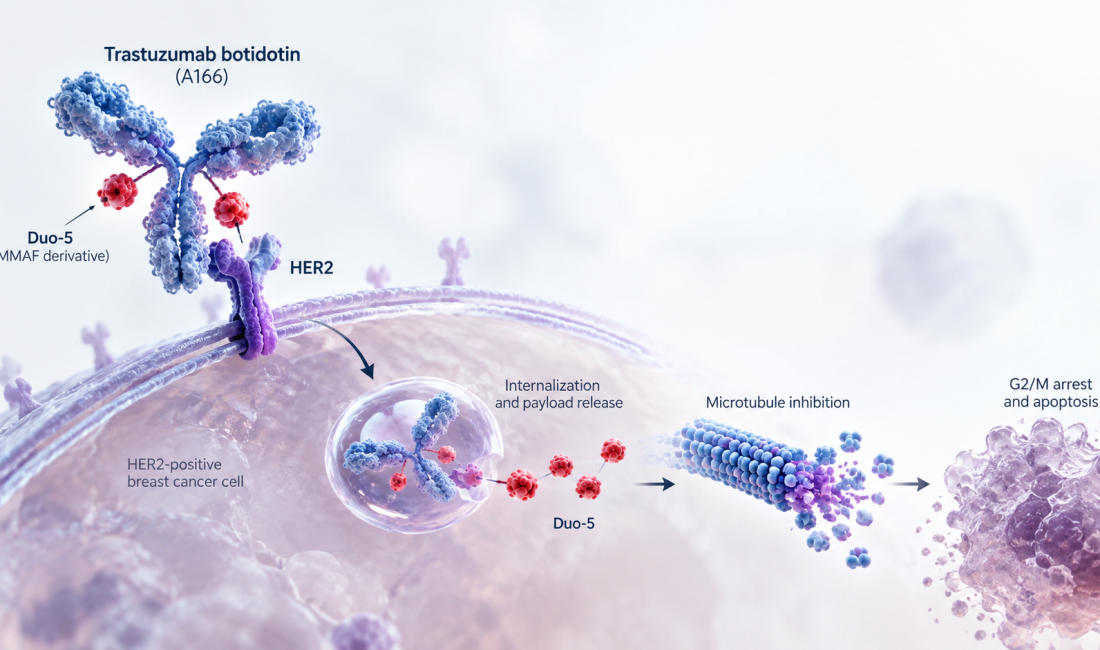
Trastuzumab botidotin is a HER2-directed antibody-drug conjugate that links a HER2 monoclonal antibody to Duo-5, a monomethyl auristatin F (MMAF) derivative that inhibits tubulin function.
The ADC uses a stable, enzyme-cleavable linker and has a drug-to-antibody ratio of 2. After binding to HER2 on tumor cells, the conjugate is internalized and releases Duo-5, which disrupts microtubule function, induces G2/M cell-cycle arrest and promotes apoptosis.
The antibody component also retains HER2 signaling inhibition and antibody-dependent cell-mediated cytotoxicity, giving the molecule activity beyond payload delivery.
Ocular Events Remain the Key Toxicity to Monitor
The safety profile showed lower rates of hematologic, hepatic and gastrointestinal toxicities, serious adverse events and treatment discontinuations compared with T-DM1. The incidence of interstitial lung disease was also low.
Ocular adverse events were the most common treatment-related toxicities. Earlier clinical characterization of A166 has identified corneal epitheliopathy, blurred vision and dry-eye symptoms as prominent manifestations. These events have generally been managed with ophthalmic monitoring and supportive measures, while treatment interruption or dose reduction can be used for more significant toxicity.
This toxicity profile makes proactive eye assessment and management an important component of treatment with trastuzumab botidotin rather than an incidental safety consideration.
NMPA Approval Established a Domestic HER2-ADC Milestone
The Phase III findings were previously presented as a Late-Breaking Abstract at the 2025 ESMO Congress. The JCO publication now provides peer-reviewed clinical evidence from the pivotal head-to-head comparison with T-DM1.
The NMPA approved trastuzumab botidotin on October 17, 2025 for adults with unresectable or metastatic HER2-positive breast cancer who have received one or more prior anti-HER2 therapies. The approval made A166 the first domestically developed HER2 ADC approved in China for this treatment setting.
Kelun-Biotech has since initiated a multicenter Phase II study evaluating trastuzumab botidotin in HER2-positive unresectable or metastatic breast cancer previously treated with an ADC carrying a topoisomerase inhibitor payload. That study will provide clinical evidence on A166’s activity following exposure to another major class of HER2-directed ADCs and could help define its role across later lines of therapy.
Reference
Results from Phase III Study of Trastuzumab Botidotin versus T-DM1 in HER2-Positive Breast Cancer Published in JCO, Sichuan Kelun-Biotech Biopharmaceutical, 14 September 2026
A Study of A166 Versus Trastuzumab Emtansine (T-DM1) in Patients With HER2-Positive Unresectable or Metastatic Breast Cancer Previously Treated With Trastuzumab and Taxane Therapy (A166), ClinicalTrials.gov ID NCT06968585

About the Writer
Creola Gonsalves (Linkedin) is an M.S. Biotechnology postgraduate with a strong interest in clinical research, evidence interpretation, and healthcare writing, with a focus on translating life-science knowledge into meaningful real-world insights.
She is trained in Good Clinical Practice (GCP), clinical research principles, and critical interpretation of randomized clinical trials, with certifications from NIH and Stanford University.
Her research background in biotechnological applications and microbial research strengthens her ability to understand scientific evidence and develop clear, accurate, and research-driven healthcare content.