
Tezspire (tezepelumab) showed significant and sustained improvements in histologic remission and dysphagia in the Phase III CROSSING trial in eosinophilic esophagitis.
Written By: Anamika Koshti, PharmD
Reviewed By: Pharmacally Editorial Team
AstraZeneca and Amgen’s Tezspire (tezepelumab) met both co-primary endpoints in the Phase III CROSSING trial in patients with symptomatic and uncontrolled eosinophilic esophagitis (EoE), delivering statistically significant and clinically meaningful improvements in histologic remission and dysphagia versus placebo. The benefits observed at week 24 were sustained through week 52 across both doses tested.
Tezspire improves disease activity and dysphagia
CROSSING was a randomised, double-blind, placebo-controlled Phase III trial (NCT05583227) evaluating subcutaneous Tezspire every four weeks in patients aged 12 to 80 years with symptomatic and histologically active EoE. A total of 368 patients were randomised 1:1:1 to receive a low dose, high dose or placebo while continuing stable background EoE therapy where applicable.
At week 24, the first co-primary endpoint assessed histologic remission, defined as a peak esophageal eosinophil count of six or fewer eosinophils per high-power field. The second assessed the frequency and severity of dysphagia through mean change from baseline in the patient-reported Dysphagia Symptom Questionnaire (DSQ).
Tezspire produced statistically significant and clinically meaningful improvements versus placebo across both co-primary endpoints. The treatment also improved all key secondary endpoints, with benefits maintained through week 52. The companies have not disclosed the numerical remission rates, mean DSQ changes, treatment differences or p-values in the topline release. Full efficacy data are expected at an upcoming medical meeting.
Key secondary assessments included histologic remission and dysphagia at week 52, changes in endoscopic disease features and histologic severity and extent at weeks 24 and 52, and endoscopic response, inflammatory remission and total endoscopic remission at week 52.
Targeting an upstream epithelial cytokine
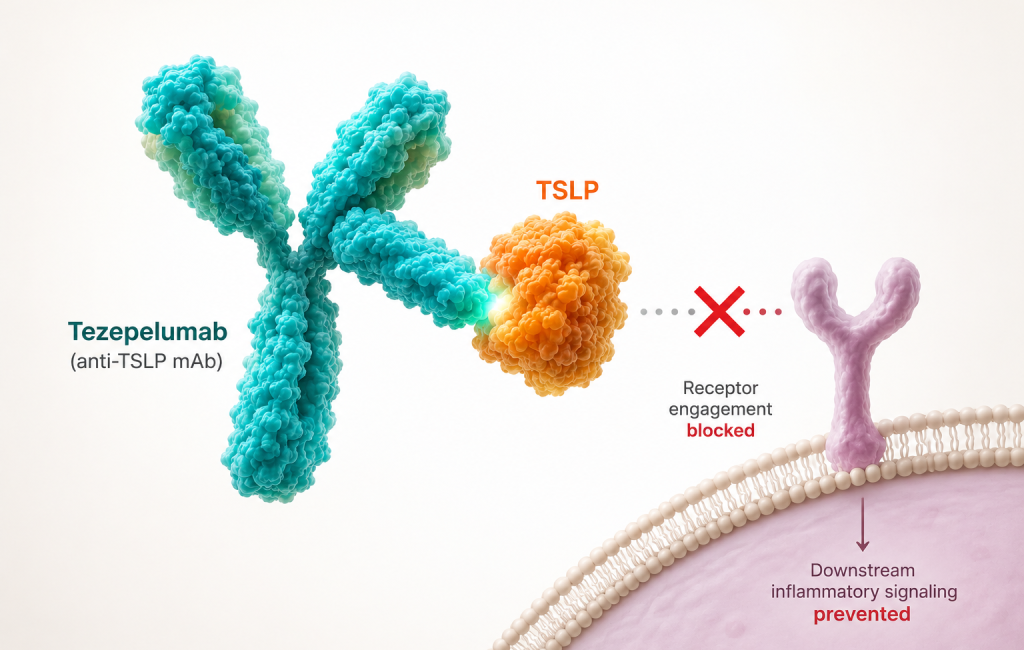
Tezepelumab is a human monoclonal antibody that blocks thymic stromal lymphopoietin (TSLP), an epithelial cytokine positioned upstream of multiple inflammatory pathways. TSLP is involved in the initiation and persistence of allergic, eosinophilic and other forms of epithelial-driven inflammation.
EoE is a chronic, progressive inflammatory disorder of the esophagus characterised by epithelial dysfunction, inflammation and tissue remodelling. The disease can cause dysphagia, food impaction and esophageal narrowing, while also affecting daily activities, work, school and quality of life.
More than 470,000 people in the US are affected by EoE, according to the company, with prevalence reported to have increased five-fold since 2009. Current management includes dietary restriction, proton pump inhibitors and swallowed topical corticosteroids, but nearly half of patients do not achieve adequate disease control with first-line treatment or dietary intervention.
Safety data remain limited at topline stage
The safety profile of Tezspire in CROSSING was generally consistent with its established profile in approved indications. However, the topline announcement does not provide specific rates for treatment-emergent adverse events, serious adverse events or treatment discontinuations.
Those detailed safety data, along with the full efficacy dataset, will be important for assessing the overall benefit-risk profile of tezepelumab in EoE.
The release also identifies the CROSSING regimens only as low- and high-dose Tezspire administered every four weeks. The exact dose levels were not disclosed in the topline announcement and therefore cannot be specified reliably at this stage.
Clinical and development significance
Arjan Bredenoord, MD, professor at Amsterdam University Medical Center and primary investigator of CROSSING, said the sustained 52-week findings highlight the potential of tezepelumab to address persistent disease and swallowing-related burden in patients who remain symptomatic despite existing treatment.
Sharon Barr, AstraZeneca’s executive vice president of BioPharmaceuticals R&D, said the results reinforce the companies’ confidence in TSLP inhibition and extend the clinical evidence for Tezspire into a third epithelial-driven inflammatory disease.
Tezspire is already approved for severe asthma in the US, EU, China, Japan and more than 70 countries, and for chronic rhinosinusitis with nasal polyps in the US, EU, China and Japan. Phase III JOURNEY and EMBARK trials are also evaluating the drug in COPD.
Regulatory path ahead
The FDA granted tezepelumab Orphan Drug Designation for EoE in October 2021.
AstraZeneca and Amgen said they will present the full CROSSING results at an upcoming medical meeting and share the data with regulatory authorities. The next key milestones will therefore be the disclosure of the complete numerical efficacy and safety dataset and subsequent regulatory discussions for EoE.
For now, the topline findings establish that Tezspire met both co-primary endpoints and sustained its reported clinical benefit through 52 weeks, while the magnitude of that benefit and detailed safety profile remain to be defined by the forthcoming full dataset.
References

About the Writer
Anamika Koshti (LinkedIn) is a PharmD professional and healthcare writer with interests in clinical research, pharmacovigilance, and evidence-based medicine. She has authored peer-reviewed publications on Alzheimer’s disease and PCOS, presented research at national conferences, and gained hands-on experience in medical content development and clinical data interpretation. She is committed to translating complex medical research into accurate, accessible content for healthcare professionals and patients.