
The FDA has approved AbbVie’s tavapadon (Juvmo) for Parkinson’s disease, supported by Phase 3 TEMPO studies showing improved motor function and ON time.
Written By: Kirti Kumbhar, M. Pharm (QA)
Reviewed By: Pharmacally Editorial Team
The U.S. Food and Drug Administration (FDA) has approved tavapadon, marketed by AbbVie as Juvmo (tavapadon), for the treatment of Parkinson’s disease in adults. The approval is listed in the FDA’s 2026 novel drug approvals database.
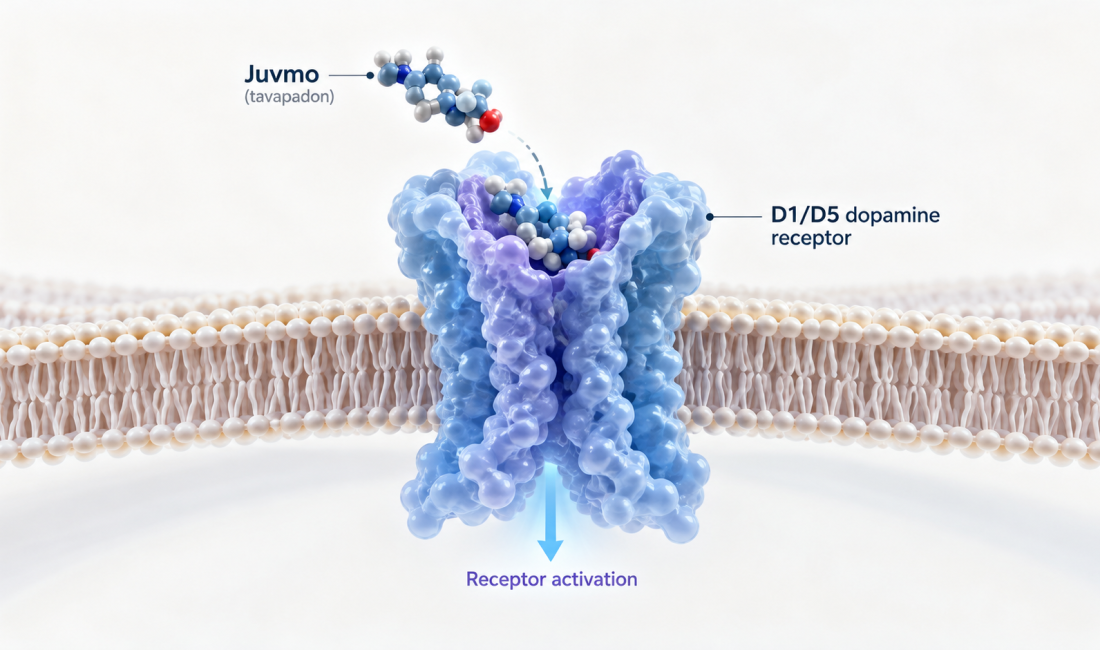
Tavapadon is a once-daily oral selective dopamine D1/D5 receptor partial agonist. Unlike dopamine agonists that primarily target D2/D3 receptors, tavapadon activates D1 and D5 receptors belonging to the D1-like dopamine receptor family. Its development program evaluated the drug both as monotherapy in early Parkinson’s disease and as adjunctive treatment to levodopa in patients with motor fluctuations.
Phase 3 Studies Demonstrated Motor Improvement
The approval was supported by the Phase 3 TEMPO program, comprising TEMPO-1, TEMPO-2 and TEMPO-3.
TEMPO-1 (NCT04201093) evaluated fixed-dose tavapadon in adults with early Parkinson’s disease. At Week 26, tavapadon at 5 mg and 15 mg once daily significantly improved the combined Movement Disorder Society-Unified Parkinson’s Disease Rating Scale (MDS-UPDRS) Parts II and III score compared with placebo, with treatment differences of −11.5 and −12.1 points, respectively.
TEMPO-2 (NCT04223193) evaluated flexible-dose tavapadon at 5–15 mg once daily in early Parkinson’s disease. At Week 26, the MDS-UPDRS Parts II and III score improved by 9.1 points more than placebo (P<0.0001). Most adverse events were non-serious and mild to moderate, with nausea, headache and dizziness among the most frequently reported events.
Improved ON Time with Levodopa
TEMPO-3 (NCT04542499) evaluated tavapadon as adjunctive therapy to levodopa in patients experiencing motor fluctuations. Among 507 participants, tavapadon increased daily ON time without troublesome dyskinesia by 1.10 hours more than placebo at Week 26. It also reduced daily OFF time by 0.94 hours more than placebo.
The findings support tavapadon’s use in patients whose motor symptoms fluctuate despite levodopa treatment.
Once-Daily Treatment and Safety
The approved Juvmo prescribing information provides once-daily oral dosing with gradual titration. Tavapadon can be used as monotherapy or in combination with levodopa, with dosing adjusted according to clinical response and tolerability. AbbVie’s official prescribing-information repository now lists the complete U.S. Juvmo label.
The prescribing information includes warnings and precautions associated with dopaminergic therapy, including somnolence, hypotension and orthostatic hypotension, hallucinations and psychotic-like behavior, impulse-control disorders and dyskinesia. Dyskinesia was also monitored across the clinical studies, reflecting its established relevance in patients receiving dopaminergic treatment.
Clinical Significance
Tavapadon adds a D1/D5 receptor-targeted approach to the pharmacological treatment of Parkinson’s disease. Evidence from the TEMPO program demonstrated improvements in motor function in early disease and increased ON time while reducing OFF time when added to levodopa in patients with motor fluctuations.
The FDA approval establishes Juvmo as an additional once-daily oral treatment option for adults with Parkinson’s disease.
Reference
Novel Drug Approvals for 2026, Juvmo (tavapadon), 25 September 2026
US Prescribing information, JUVMO™ (tavapadon)
Fixed-Dose Trial in Early Parkinson’s Disease (PD) (TEMPO-1), ClinicalTrials.gov ID NCT04201093
Flexible-Dose Trial in Early Parkinson’s Disease (PD) (TEMPO-2), ClinicalTrials.gov ID NCT04223193
Flexible-Dose, Adjunctive Therapy Trial in Adults With Parkinson’s Disease With Motor Fluctuations (TEMPO-3), ClinicalTrials.gov ID NCT04542499

About the Writer
Kirti Kumbhar (LinkedIn) is an M.Pharm graduate with experience in Quality Assurance at Lupin Limited and a strong interest in clinical research, regulatory affairs, and Trial Master File (TMF) management. She has developed knowledge of regulatory documentation, quality systems, compliance, and healthcare research through her professional experience. Passionate about clinical development and continuous learning, Kirti is committed to supporting high-quality healthcare documentation, regulatory excellence, and research-driven healthcare advancements.