
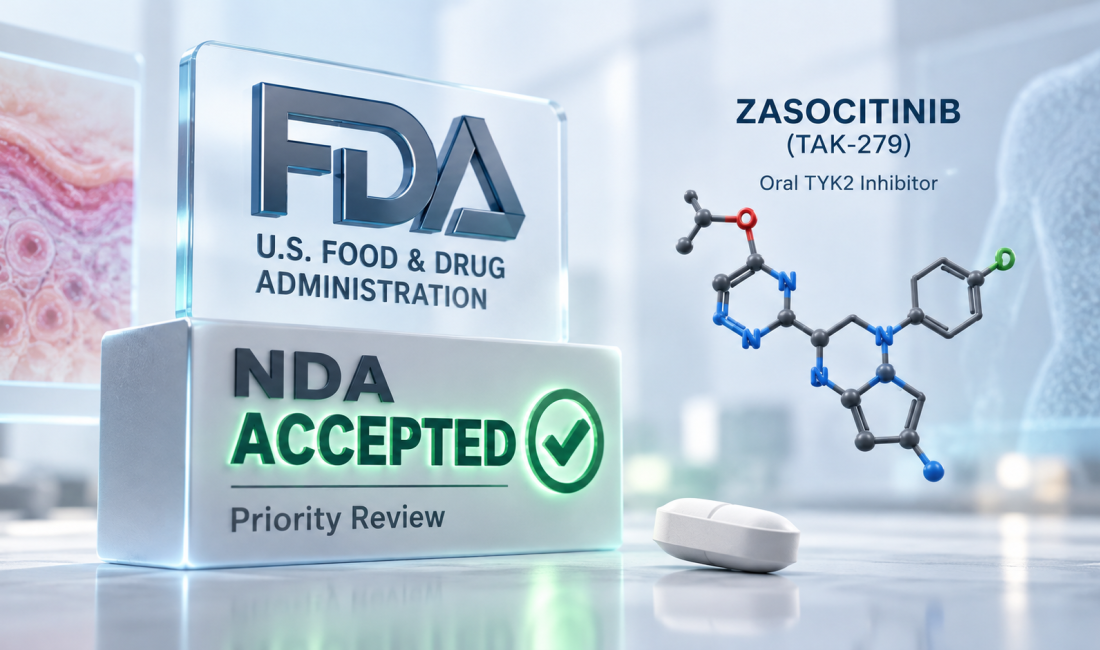
FDA grants Priority Review to Takeda’s zasocitinib NDA for moderate-to-severe plaque psoriasis after positive Phase 3 results showing strong skin clearance.
Written By: Umesh Hanumante,
M.Pharm (Reg. Affairs)
Reviewed By: Pharmacally Editorial Team
Takeda’s investigational oral TYK2 inhibitor produced rapid and durable skin clearance in Phase 3 trials, with about 70% of patients achieving clear or almost clear skin at week 16. The FDA is expected to decide on the application in the first quarter of 2027.
FDA Advances Zasocitinib Toward Potential Approval
The U.S. Food and Drug Administration has accepted Takeda’s New Drug Application (NDA) for zasocitinib (TAK-279), an investigational next-generation oral tyrosine kinase 2 (TYK2) inhibitor, for adults with moderate-to-severe plaque psoriasis. The FDA granted the application Priority Review, setting a PDUFA target action date in the first quarter of 2027.
The submission is supported by the pivotal Phase 3 LATITUDE PsO 3001 and 3002 studies, which met their co-primary endpoints and all 44 ranked secondary endpoints. The package also includes long-term data from LATITUDE PsO 3003.
Week 16 Trials Show Broad Skin Clearance
LATITUDE PsO 3001 enrolled 693 patients and 3002 enrolled 1,108 patients across 21 countries. Both were randomized, double-blind, placebo-controlled and active-comparator-controlled studies, with apremilast serving as the active comparator. The co-primary endpoints assessed the proportion of patients achieving static Physician Global Assessment (sPGA) 0/1 and at least 75% improvement in the Psoriasis Area and Severity Index (PASI 75) at week 16.
In LATITUDE PsO 3001, 71% of patients receiving zasocitinib achieved sPGA 0/1 at week 16, compared with 11% on placebo and 32% on apremilast. PASI 75 responses reached 76%, versus 12% and 37%, respectively. Results were consistent in 3002, where sPGA 0/1 and PASI 75 responses reached 69% and 71%. All reported comparisons with placebo were statistically significant at p<0.001.
Zasocitinib also produced deeper clearance. PASI 90 responses reached 61% and 52% across the two studies, while PASI 100 responses reached 33% and 25%. Responses extended to difficult-to-treat sites, including the scalp, nails, palms and soles. Scalp-specific sPGA 0/1 responses reached 77% and 74%.
Long-Term Assessment Extends Beyond the Pivotal Week 16 Window
The separate Phase 3 LATITUDE PsO 3003 study is evaluating the long-term safety, tolerability and efficacy of zasocitinib. Its de novo cohort received 30 mg once daily for up to 52 weeks, while eligible patients continuing from the pivotal studies could receive treatment for up to 156 weeks.
This distinction is important: the pivotal 3001 and 3002 studies established the key efficacy outcomes at week 16, whereas 3003 provides longer-term clinical and safety follow-up. Zasocitinib was generally well tolerated, with no new safety signals identified. Common adverse events included upper respiratory tract infection, nasopharyngitis and acne.
Selective TYK2 Inhibition
Zasocitinib provides 24-hour inhibition of TYK2-mediated inflammatory signaling, including the IL-23 pathway. Takeda reports more than 1-million-fold greater selectivity for TYK2 over other JAK enzymes based on in vitro data, potentially enabling TYK2 inhibition without directly affecting JAK1, JAK2 or JAK3 signaling.
Psoriasis affects an estimated 66.4 million people worldwide, with plaque psoriasis accounting for about 80% to 90% of cases. Disease affecting the scalp, nails, palms and soles can substantially impair quality of life.
Regulatory Path and Development Outlook
The European Medicines Agency has also accepted Takeda’s marketing authorization application for moderate-to-severe plaque psoriasis. The company plans additional global regulatory submissions.
If approved, zasocitinib would add a once-daily oral option for patients with moderate-to-severe plaque psoriasis. Takeda is also evaluating the drug in Phase 3 psoriatic arthritis studies and Phase 2 trials in Crohn’s disease, ulcerative colitis, vitiligo and hidradenitis suppurativa.
Reference
U.S. FDA Accepts New Drug Application Under Priority Review for Takeda’s Zasocitinib in Moderate-to-Severe Plaque Psoriasis, with Potential to Redefine Oral Treatment Expectations, Takeda, 14 September 2026
A Study About How Well TAK-279 Works and Its Safety in Participants With Moderate-to-severe Plaque Psoriasis During 52 Weeks of Treatment, ClinicalTrials.gov ID NCT06088043
A Study About How Well TAK-279 Works and Its Safety in Participants With Moderate-to-severe Plaque Psoriasis During 60 Weeks of Treatment With a Withdrawal and Retreatment Period, ClinicalTrials.gov ID NCT06108544

About the Writer
Umesh Hanumante (M.Pharm) (LinkedIn) is a pharmacy professional and healthcare writer with a background in Regulatory Affairs, pharmaceutical innovation, and clinical research. He has around two years of industry experience as an Executive PMT at Troikaa Pharmaceuticals Ltd and qualified GPAT 2024. His areas of interest include regulatory compliance, dossier preparation, clinical trials, emerging therapies, and advancements in the global pharmaceutical and healthcare sector.