
AstraZeneca’s Tagrisso cut the risk of death by 48% at eight years in EGFR-mutated NSCLC in the Phase III ADAURA trial, supporting adjuvant treatment after surgery.
Written By: Kalyani Boharapi,
M.Pharm (Reg. Affairs)
Reviewed By: Pharmacally Editorial Team
AstraZeneca’s Tagrisso (osimertinib) continued to reduce mortality eight years after complete tumor resection in patients with early-stage EGFR-mutated (EGFRm) non-small cell lung cancer (NSCLC), according to updated exploratory results from the global Phase III ADAURA trial.
At eight years, osimertinib reduced the risk of death by 47% in the primary Stage II-IIIA population (HR 0.53; 95% CI 0.38-0.75) and by 48% across the Stage IB-IIIA population (HR 0.52; 95% CI 0.39-0.71).
In the primary population, estimated eight-year overall survival was 74% with osimertinib versus 58% with placebo. Across all enrolled stages, survival was 79% versus 64%, respectively. The findings were presented at the IASLC 2026 World Conference on Lung Cancer in Seoul and simultaneously published in the Journal of Thoracic Oncology.
Long-term survival after surgery
ADAURA enrolled 682 patients with Stage IB, II or IIIA EGFRm NSCLC following complete tumor resection. Patients received oral osimertinib 80 mg once daily or placebo for up to three years, with adjuvant chemotherapy permitted at physician and patient discretion.
The primary endpoint was disease-free survival in Stage II-IIIA disease, while overall survival was a key secondary endpoint.
With follow-up extending to approximately eight years, the mortality benefit remained consistent across predefined subgroups. In the Stage II-IIIA population, median follow-up was 92 months for osimertinib and 68.5 months for placebo. In the overall population, median follow-up reached 93.3 and 79.6 months, respectively.
The analysis used survival data available through May 4, 2026. Final safety data from the planned OS analysis showed no new safety concerns, with osimertinib’s tolerability remaining consistent with its established safety profile.
Implications for EGFR-driven lung cancer
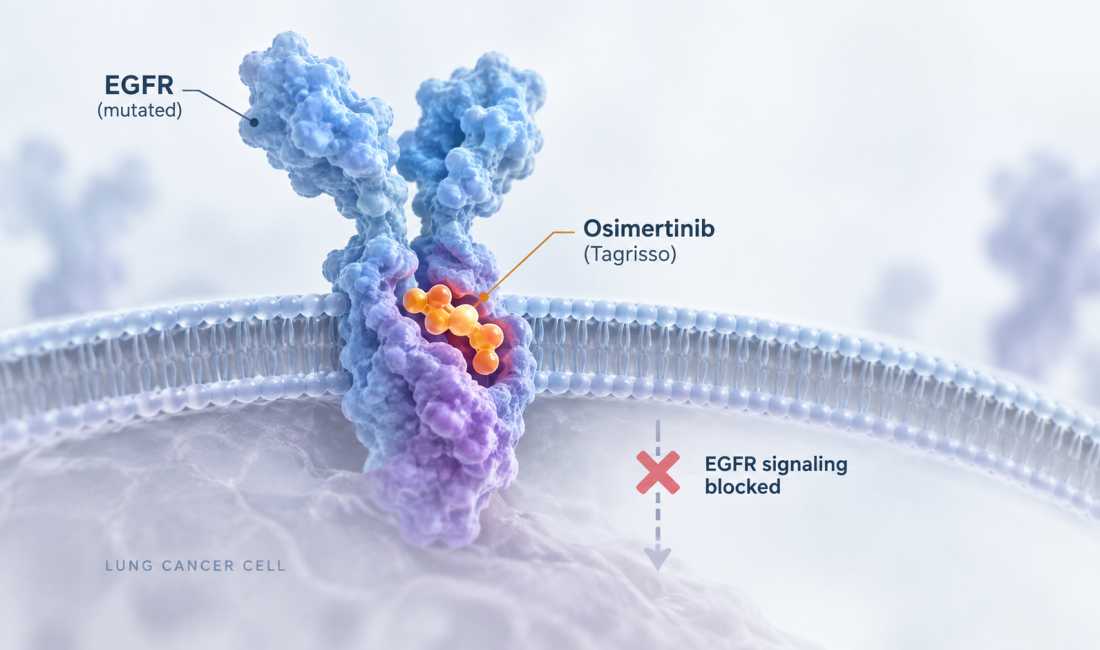
EGFR mutations occur in roughly 10%-15% of NSCLC cases in the US and Europe and 30%-40% of cases in Asia. These tumors depend on EGFR signaling, making EGFR tyrosine kinase inhibition a central treatment strategy.
Osimertinib is a third-generation, irreversible EGFR-TKI with activity against EGFR-driven disease, including central nervous system metastases. Its role now spans multiple stages of EGFRm NSCLC, from resected early-stage disease through locally advanced and metastatic settings.
Real-world evidence presented at WCLC 2026 further supported treatment persistence. In a retrospective US cohort, discontinuing osimertinib before completing the established three-year adjuvant course was associated with more than a twofold increase in the risk of recurrence or death.
Tagrisso remains central to AstraZeneca’s EGFR strategy
Roy Herbst, principal investigator of ADAURA, said the eight-year survival difference was particularly notable given substantial crossover to osimertinib after disease recurrence. He also emphasized the importance of EGFR testing at diagnosis to identify patients who could benefit from targeted treatment.
The company is extending osimertinib development across the disease spectrum. In advanced EGFRm NSCLC, updated FLAURA2 analyses continued to support osimertinib plus platinum-pemetrexed chemotherapy, while exploratory data suggested that progression-free and overall survival outcomes favored the combination regardless of baseline TP53 co-mutation status.
Additional Phase III programs are evaluating osimertinib in combination with savolitinib after progression and with datopotamab deruxtecan in advanced disease. In earlier disease, NeoADAURA and ADAURA2 are expanding investigation of osimertinib around surgery and neoadjuvant treatment, while the Phase III LAURA program supports its use in unresectable Stage III EGFRm NSCLC.
The eight-year ADAURA data therefore extend the survival evidence for adjuvant osimertinib and reinforce the clinical importance of identifying EGFR mutations before treatment decisions are made.
Reference
TAGRISSO® (osimertinib) demonstrated unprecedented eight-year landmark survival in early-stage EGFR-mutated lung cancer in ADAURA Phase III trial, Astra Zeneca, 14 September 2026
AZD9291 Versus Placebo in Patients With Stage IB-IIIA Non-small Cell Lung Carcinoma, Following Complete Tumour Resection With or Without Adjuvant Chemotherapy. (ADAURA), ClinicalTrials.gov ID NCT02511106
Yi-Long Wu et al, Adjuvant Osimertinib in Resected EGFR-Mutated Stage IB–IIIA Non-Small Cell Lung Cancer: Exploratory 8-year Overall Survival Landmark Update from the ADAURA Trial [161/175], Journal of Thoracic Oncology, September 13, 2026, https://doi.org/10.1016/j.jtho.2026.104179

About the Writer
Kalyani Boharapi (LinkedIn) is a pharmacy professional and healthcare writer currently pursuing an M.Pharm in Regulatory Affairs at Dr. D. Y. Patil College of Pharmacy, with interests in pharmaceutical regulations, drug development, and healthcare innovation. She has academic exposure to dossier preparation, scientific writing, and regulatory documentation. Kalyani has also completed certification courses in Generative AI, AI in Pharma, and Bioinformatics, and actively participates in pharmaceutical conferences to stay updated with emerging trends and advancements in the healthcare and pharmaceutical industry.