
SynAct’s post-hoc ADVANCE analysis found stronger ACR20 responses with resomelagon 40 mg plus methotrexate in treatment-naïve rheumatoid arthritis patients.
Written By: Siddhi Bhadekar,
M. Pharm (QA)
Reviewed By: Pharmacally Editorial Team
SynAct Pharma’s post-hoc analysis of the Phase 2b ADVANCE study found that resomelagon 40 mg once daily, given in combination with methotrexate (MTX), produced a stronger ACR20 response than placebo plus MTX in treatment-naïve patients with highly active rheumatoid arthritis (RA) after accounting for baseline fluctuations in inflammatory activity. The findings help explain the unexpectedly high placebo response and strengthen the rationale for advancing resomelagon into Phase 3 development.
Post-Hoc Analysis Clarifies the ADVANCE Placebo Response
The analysis examined why the placebo-plus-MTX arm in ADVANCE showed a higher-than-expected clinical response. Investigators identified regression to the mean (RTM) as an important contributor.
Patients with newly diagnosed RA may enter a clinical trial during a temporary disease flare, when pain, swelling, systemic inflammation and C-reactive protein (CRP) levels are unusually high. Baseline measurements may therefore capture a temporary peak rather than a patient’s typical disease activity. Subsequent measurements can improve as disease activity naturally moves back toward a more typical level, independent of treatment effect.
Approximately one in five ADVANCE participants appeared to have entered the study during such a flare-up. This subgroup accounted for the vast majority of the response variability in the placebo arm, indicating that baseline disease instability contributed substantially to the observed placebo response.
Among the remaining approximately four in five patients with more stable baseline high-sensitivity C-reactive protein (hsCRP) levels, the difference between resomelagon and placebo plus MTX was more pronounced.
Resomelagon 40 mg Showed Stronger Clinical Responses
In patients with stable baseline hsCRP, 79% receiving resomelagon 40 mg achieved an ACR20 response at Week 12, compared with 55% receiving placebo plus MTX. The difference was statistically significant (p<0.05).
Resomelagon also showed numerical differences across other efficacy measures. ACR50 response reached 38% with resomelagon versus 30% with placebo plus MTX, while Disease Activity Score 28-CRP (DAS28-CRP) decreased from baseline by 2.0 points with resomelagon compared with 1.5 points with placebo plus MTX. The source material does not provide p-values for ACR50 or DAS28-CRP, so these results are reported without assigning statistical significance.
The findings are consistent with the earlier Phase 2b EXPAND study in patients with hsCRP levels above the normal range and provide further support for resomelagon’s potential clinical benefit in active RA.
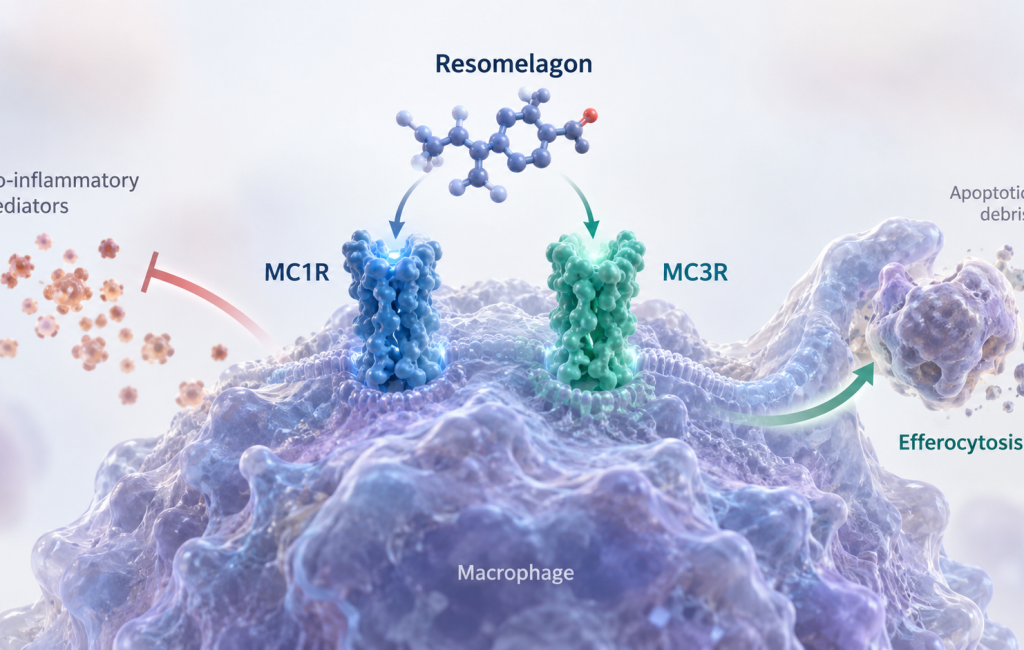
Resomelagon is an oral, biased agonist of the melanocortin receptors MC1R and MC3R, which are expressed on immune cells involved in inflammation and its resolution. The drug is being developed as a pro-resolution therapy that seeks to activate the body’s natural mechanisms for resolving inflammation rather than broadly suppressing inflammatory pathways.
Activation of MC1R and MC3R is intended to reduce the production of pro-inflammatory mediators while promoting macrophage efferocytosis, the process by which macrophages clear apoptotic cells and inflammatory debris. By combining suppression of inflammatory signaling with promotion of inflammation resolution, SynAct is investigating whether resomelagon can provide meaningful disease control in patients with early RA.
Phase 3 Planning Moves Toward FDA Review
The post-hoc findings will inform the planned Phase 3 program. SynAct intends to reduce the influence of baseline disease instability and prospectively power the confirmatory study for both ACR20 and ACR50 comparisons.
The proposed Phase 3 trial will continue evaluating resomelagon 40 mg once daily in treatment-naïve patients with early RA while extending treatment to 26 weeks. The longer treatment period will allow assessment of whether the strong ACR20 response observed at Week 12 translates into a more pronounced ACR50 response over time.
Thomas Jonassen, Chief Scientific Officer of SynAct, said the analysis provides a clearer basis for Phase 3 planning. The company intends to establish more stable inflammatory activity before randomization while maintaining its focus on patients with early RA.
SynAct plans to submit the proposed Phase 3 trial design and supporting toxicology program to the U.S. Food and Drug Administration (FDA) in early Q4 2026 for discussion at an FDA Type C meeting. Feedback is expected by the end of 2026 or early 2027.
Broader Development and Partnering Strategy
Beyond RA, SynAct is continuing development of resomelagon in host-directed therapies for infectious diseases, including dengue and respiratory viral infections. Upcoming milestones include data from Part 1 of the Phase 2 RESOVIR-2 dengue study, subject to local authority approval of a protocol amendment, completion and reporting of the full RESOVIR-2 dataset, and Phase 2 results from the RESPIRE study in patients with respiratory viral infections.
The company is also evaluating strategic options for resomelagon, including global or regional licensing agreements, an outright sale of the asset, or a potential sale of SynAct. These activities will run alongside clinical development as the company seeks to establish a clear Phase 3 pathway in RA and assess the broader potential of resomelagon across autoimmune and infectious diseases.
The immediate clinical milestone is the planned FDA interaction on the Phase 3 design. Regulatory feedback will help determine the next development step for resomelagon in RA, while additional data from the infectious disease programs could further define the asset’s broader development and partnering opportunities.
Reference
Further analysis of the Phase 2b ADVANCE study reinforces Phase 2b EXPAND results and supports Phase 3 development – FDA discussions on trial design planned for Q4 2026 – SynAct Pharma

About the Writer
Siddhi Rajendra Bhadekar (Linkedin) is an M.Pharm professional with expertise in medical and scientific writing, literature review, publication writing, and evidence synthesis, supported by four peer-reviewed publications.
She brings working knowledge of ICH-GCP, MedDRA, pharmacovigilance, ADR/AE reporting, clinical data management, and regulatory documentation.
With experience across pharmaceutical R&D, Quality Control, and Quality Assurance, she combines scientific research skills with strong attention to accuracy and detail.
Her background in manuscript development, publication planning, and scientific communication enables her to translate complex healthcare information into clear, reliable content.