
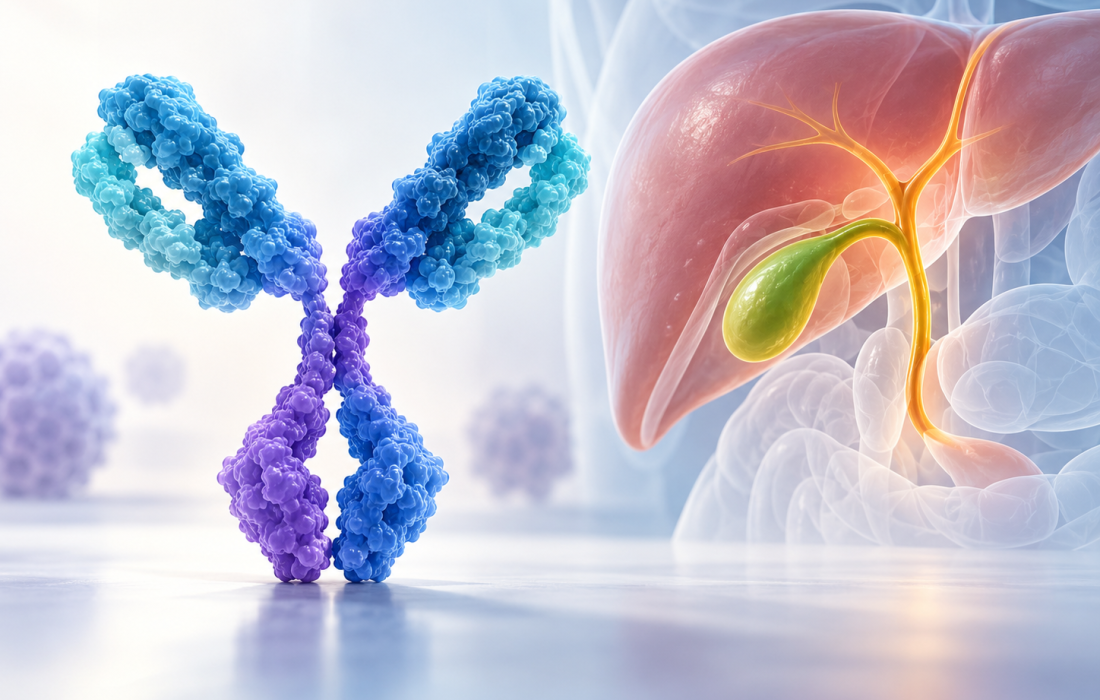
Summit Therapeutics and ECOG-ACRIN launch plans for a Phase II/III trial testing ivonescimab plus chemotherapy against immunotherapy-based regimens in advanced biliary tract cancer.
Written By: Rishabh Sonawane, BPharm
Reviewed By: Pharmacally Editorial Team
Summit Therapeutics is collaborating with the ECOG-ACRIN Cancer Research Group to evaluate ivonescimab, an investigational bispecific antibody, as a first-line treatment for advanced biliary tract cancer (BTC). The registration-enabling Phase II/III EA2251 study (NCT07765433) will compare ivonescimab plus chemotherapy with pembrolizumab or durvalumab plus chemotherapy, with overall survival as the primary endpoint. Clinical trial site activations in the United States are expected to begin in the fourth quarter of 2026.
Trial Design and Treatment Arms
EA2251 is an open-label, randomized Phase II/III study that will enroll patients in the United States with advanced BTC. Participants will receive either ivonescimab combined with gemcitabine and cisplatin or an established immunotherapy-based regimen comprising pembrolizumab or durvalumab with the same chemotherapy backbone.
The study’s primary endpoint is overall survival (OS), which will assess whether the investigational combination extends survival compared with current first-line treatment options. The announcement did not disclose the planned enrollment target, secondary endpoints, or detailed eligibility criteria.
The collaboration brings Summit’s drug development program together with ECOG-ACRIN’s cooperative oncology research network. The registration-enabling designation indicates that the study is intended to contribute evidence supporting potential regulatory approval, although the outcome will depend on the trial’s results and subsequent regulatory review.
Ivonescimab Combines PD-1 and VEGF Targeting
Ivonescimab is an investigational bispecific antibody that combines programmed cell death protein 1 (PD-1) blockade with inhibition of vascular endothelial growth factor (VEGF). PD-1 blockade helps restore antitumor immune activity, while VEGF inhibition targets signaling involved in tumor blood vessel formation.
By engaging both targets within a single molecule, ivonescimab seeks to combine immune checkpoint inhibition with anti-angiogenic activity. Its engineered tetravalent structure and cooperative target binding are intended to enhance binding in the tumor microenvironment. Whether these properties translate into improved clinical outcomes in BTC remains to be established through clinical studies.
Biliary tract cancer includes intrahepatic, perihilar and distal cholangiocarcinoma, as well as gallbladder cancer. Many patients receive their diagnosis after the disease has advanced, when curative surgery is no longer feasible. Although immunotherapy-based combinations have expanded first-line treatment options, outcomes remain poor for many patients, creating a need for additional effective regimens.
HARMONi-GI1 Results Provide Additional Context
EA2251 is the second Phase III ivonescimab study in BTC. The first, HARMONi-GI1, is a China-based Phase III trial sponsored by Akeso that evaluates ivonescimab plus chemotherapy against durvalumab plus chemotherapy.
In August 2026, Akeso reported that HARMONi-GI1 met its primary endpoint, demonstrating statistically significant and clinically meaningful superiority in overall survival at a prespecified interim analysis. Detailed results are scheduled for presentation at the European Society for Medical Oncology Congress on October 25, 2026.
Those findings provide a clinical rationale for further investigation, but they do not establish that ivonescimab will produce the same benefit in the U.S. population studied in EA2251. Differences in trial populations, study settings and treatment implementation will need consideration when interpreting the evidence.
Next Development Milestones
Summit President and Co-Chief Executive Officer Maky Zanganeh said the collaboration expands ivonescimab’s development into another cancer with substantial unmet medical need. Lead investigator Deirdre J. Cohen highlighted the importance of evaluating the combination against established immunotherapy-based regimens in the first-line setting.
The immediate milestone is U.S. site activation, expected to begin in the fourth quarter of 2026. EA2251’s comparative overall-survival results will be central to determining whether ivonescimab can offer a clinically meaningful alternative to existing first-line regimens for advanced biliary tract cancer.
Reference
Summit Therapeutics and ECOG-ACRIN Cancer Research Group Enter into Phase II / III Clinical Trial Collaboration to Evaluate Ivonescimab in First-Line Biliary Tract Cancer, Summit Therapeutics, 21 October 2026
Testing the Addition of Ivonescimab Combined with Standard Chemotherapy Compared to the Usual Chemotherapy and Immunotherapy Treatment for Patients with Advanced Biliary Tract Cancer, ClinicalTrials.gov ID NCT07765433

About the Writer
Rishabha Sonawane, B.Pharm (LinkedIn) is healthcare writer with a strong interest in medical writing, regulatory affairs, clinical research, and AI-driven drug discovery. He has completed specialized training from the NIH and ICMR in clinical pharmacology, clinical research, and scientific writing. Passionate about evidence-based healthcare communication, he focuses on translating complex scientific research into clear, accurate, and engaging medical content.