
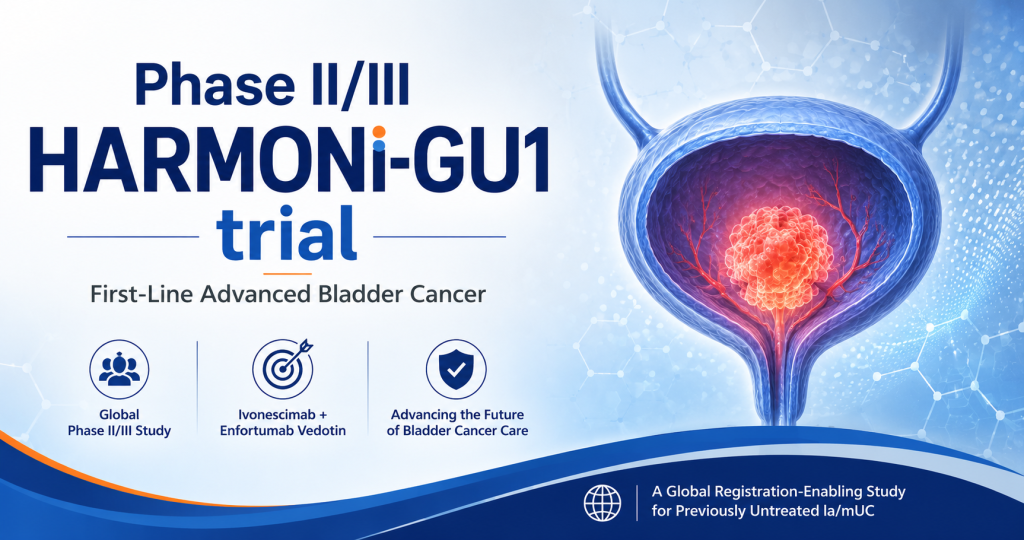
Summit Therapeutics launches the global Phase II/III HARMONi-GU1 trial evaluating ivonescimab plus enfortumab vedotin for advanced urothelial carcinoma.
Written By: Meghana Jinka, PharmD
Reviewed By: Pharmacally Editorial Team
Summit Therapeutics has announced the expansion of its global registration-enabling clinical development program for ivonescimab with the initiation of the Phase II/III HARMONi-GU1 trial in patients with previously untreated locally advanced or metastatic urothelial carcinoma (la/mUC). The study represents the first global registrational clinical trial of ivonescimab in a genitourinary (GU) cancer, further extending its development beyond non-small cell lung cancer (NSCLC) and colorectal cancer (CRC). Global clinical trial site activations are planned to begin in the fourth quarter of 2026.
HARMONi-GU1 Trial Design and Objectives
HARMONi-GU1 is a randomized, multi-regional Phase II/III registration-enabling study evaluating ivonescimab in combination with the antibody-drug conjugate enfortumab vedotin (EV) compared with pembrolizumab plus EV, a regimen widely regarded as the current global standard of care, as first-line treatment for patients with previously untreated la/mUC. Approximately 800 patients will be enrolled through the Phase III portion. The Phase II stage will identify the recommended Phase III dose (RP3D) of ivonescimab in combination with EV, while the Phase III portion will assess the co-primary endpoints of progression-free survival (PFS) and overall survival (OS).
Company Highlights Scientific Rationale for Ivonescimab in Bladder Cancer
Dr. Maky Zanganeh, President and Co-CEO of Summit Therapeutics, said the initiation of HARMONi-GU1 marks an important step in expanding ivonescimab into cancers with significant unmet medical needs. She noted that the dual roles of angiogenesis and immune evasion in urothelial carcinoma provide a strong scientific rationale for evaluating ivonescimab’s tetravalent PD-1/VEGF bispecific mechanism. Despite recent treatment advances, she added, many patients with advanced bladder cancer continue to experience disease progression and poor long-term outcomes, underscoring the need for therapies that can deliver more durable responses and improve survival.
Robert W. Duggan, Chairman and Co-CEO of Summit Therapeutics, said HARMONi-GU1 reflects the company’s strategy to expand ivonescimab across multiple solid tumors. He added that the growing clinical evidence and broad global development program support ivonescimab’s potential as a future treatment option while reinforcing Summit’s commitment to generating high-quality global clinical data.
Global Clinical Development Program Continues to Expand
Summit’s clinical development portfolio now spans lung, colorectal, pancreatic, head and neck, kidney, and bladder cancers. With the addition of HARMONi-GU1, ivonescimab is now being evaluated in 16 Phase III clinical trials across multiple tumor types and treatment settings, including five Summit-sponsored global studies, one cooperative group-sponsored multiregional study (ILLUMINE), and 10 Akeso-sponsored studies in China. Four completed Phase III NSCLC trials have reported positive results, with HARMONi-A and HARMONi-6 demonstrating statistically significant overall survival benefits, while all studies achieved a manageable and consistent safety profile.
Ivonescimab: A Potential First-in-Class PD-1/VEGF Bispecific Antibody
Ivonescimab is a potential first-in-class investigational PD-1/VEGF bispecific antibody engineered to combine immune checkpoint inhibition with anti-angiogenic activity in a single molecule. Its intentionally engineered tetravalent structure enables cooperative PD-1 and VEGF binding with higher avidity in the tumor microenvironment, where both targets are more highly expressed, with the goal of improving antitumor efficacy while maintaining a manageable safety profile. The antibody demonstrates a 6 to 7-day half-life after the first dose, increasing to approximately 10 days at steady state. More than 4,000 patients have received ivonescimab in clinical trials globally, and over 70,000 patients have been treated in commercial practice in China.
Ivonescimab received its first marketing approval in China in May 2024 but remains investigational in Summit’s licensed territories, including the United States, Europe, Japan, the Middle East, Africa, and South America. In addition, Summit’s Phase III HARMONi trial supported a Biologics License Application (BLA) accepted by the U.S. Food and Drug Administration (FDA) in January 2026, with a Prescription Drug User Fee Act (PDUFA) target action date of November 14, 2026.
Burden of Advanced Urothelial Carcinoma
Urothelial carcinoma accounts for approximately 90% of all bladder cancers. Globally, an estimated 635,264 new cases and 227,626 deaths occurred in 2024, while approximately 84,530 new cases are expected in the United States during 2026. Approximately 5% to 10% of patients present with advanced or metastatic disease at diagnosis, and many others develop recurrent or progressive disease following treatment for earlier-stage disease. Despite recent therapeutic advances, long-term survival remains limited for many patients, underscoring the continued need for more effective treatment options.
Reference

About the Writer
Meghana Jinka (LinkedIn) is a Pharm.D graduate with a strong interest in clinical pharmacy, clinical research, pharmacovigilance, and medical writing. She has developed expertise in evaluating scientific literature, interpreting clinical data, and communicating complex medical information in a clear and accessible manner. Through clinical training, patient counseling, and healthcare awareness activities, she has gained practical experience in evidence-based medicine and patient-centered care. Passionate about healthcare communication, Meghana is committed to developing accurate, engaging, and evidence-based healthcare documents that support healthcare professionals and the wider community.