
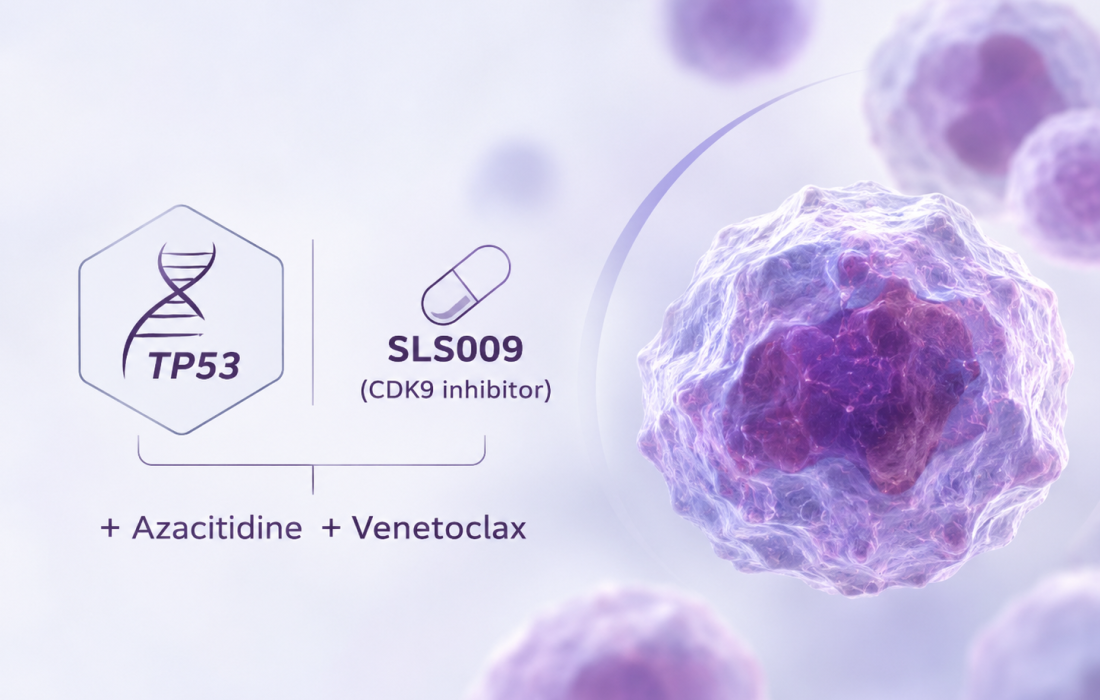
SELLAS reports a 57% response rate and 8.8-month median survival with SLS009 combination therapy in TP53-mutated AML following venetoclax failure.
Written By: Anshu Gupta, PharmD
Reviewed By: Pharmacally Editorial Team
SELLAS Life Sciences Group announced on 4 November 2026 that findings from its completed Phase 2 study of SLS009 (tambiciclib) in relapsed/refractory acute myeloid leukaemia (r/r AML) will be presented at the 68th American Society of Hematology (ASH) Annual Meeting, scheduled for 12–15 December 2026 in New Orleans, Louisiana.
The study evaluated SLS009, a highly selective cyclin-dependent kinase 9 (CDK9) inhibitor, in combination with azacitidine (AZA) and venetoclax (VEN) in patients whose disease relapsed or failed to respond following previous venetoclax-based treatment. Treatment resistance following venetoclax exposure remains a major therapeutic challenge, particularly in patients with adverse-risk disease characteristics.
Patient Population and Molecular Characteristics
The Phase 2 dose-ranging study (NCT04588922) enrolled 62 heavily pretreated patients, with a median age of 70 years. Patients had received a median of two previous treatment lines, with exposure extending to as many as eight lines. High-risk molecular abnormalities were common, including ASXL1 mutations in 41% of patients, RUNX1 mutations in 33%, and TP53 mutations in 29%. These characteristics reflect the difficult-to-treat population investigated following venetoclax-based treatment failure.
Overall Response Across Dose Levels
Among 59 evaluable patients in the efficacy population, the combination achieved an overall response rate (ORR) of 34% (20/59) across all dose levels. This comprised 12 complete remissions or complete remissions with incomplete haematological recovery (CR/CRi) and 8 cases of morphologic leukaemia-free state (MLFS). Subgroup analyses across all dose levels demonstrated ORRs of 38% in AML with myelodysplasia-related changes (AML-MR), 44% in monocytic AML, and 36% in TP53-mutated AML.
Selected-Dose Results Highlight Activity in High-Risk AML
At the selected dose of 30 mg twice weekly, higher response rates were observed in key adverse-risk subgroups. Patients with relapsed/refractory monocytic AML achieved an ORR of 54%, with a median overall survival (mOS) of 5.8 months. In patients with TP53-mutated AML, the ORR reached 57% (compared with 36% across all dose levels), accompanied by an mOS of 8.8 months.
Biological Rationale and Safety Findings
SELLAS is investigating CDK9 inhibition as a strategy to address biological mechanisms associated with venetoclax resistance, particularly dependence on myeloid cell leukaemia 1 (MCL-1). By targeting CDK9, SLS009 is intended to downregulate MCL-1, influence resistance-associated cellular survival pathways, and potentially restore sensitivity to venetoclax-based treatment.
Regarding safety, the company reported that the combination was well tolerated, with limited additive toxicities and treatment-related deaths. Non-haematological treatment-related adverse events were predominantly mild (Grade 1 or 2), particularly nausea and diarrhoea. A numerical breakdown of treatment-related deaths and a comprehensive safety dataset were not provided in the announcement.
Further Clinical Development and ASH Presentation
SELLAS is continuing the development of SLS009 in an ongoing 80-patient Phase 2 study involving newly diagnosed AML, including patients who become refractory early to azacitidine and venetoclax. The programme incorporates transcriptomic, genomic, and proteomic analyses to support patient identification and treatment selection. Initial topline findings are expected in the fourth quarter of 2026.
The completed relapsed/refractory AML study will be presented on 14 December 2026 during the ASH session titled Acute Myeloid Leukemias: Investigational Drug and Cellular Therapies (Poster III). The abstract, numbered 5155, is titled “Tambiciclib (SLS009), a highly selective CDK9 inhibitor, in combination with azacitidine and venetoclax in relapsed/refractory AML after prior venetoclax: Results from a Phase 2 study.” Dr. Joshua F. Zeidner is the lead author.
Clinical Interpretation
The reported findings indicate potential antileukaemic activity of SLS009 combined with azacitidine and venetoclax in patients with r/r AML following venetoclax-based treatment failure. The 57% ORR and 8.8-month median OS reported in TP53-mutated AML represent the most notable subgroup findings, particularly given the limited treatment options in this population. However, because the results stem from a single-arm Phase 2 study without a concurrent control group, additional comparative clinical trials will be necessary to establish long-term clinical benefit.
Reference
SELLAS Life Sciences to Present Positive Phase 2 Data Demonstrating Encouraging Response and Survival Outcomes with SLS009 Combination in High-Risk AML at ASH 2026, SELLASS Life Science, 04 November 2026
Study of SLS009 (Formerly GFH009) a Potent Highly Selective CDK9 Inhibitor in Patients with Hematologic Malignancies and High-Risk Newly Diagnosed AML, ClinicalTrials.gov ID NCT04588922

About the Writer
Anshu Gupta (LinkedIn) is a PharmD professional and healthcare writer with interests in clinical research, pharmacovigilance, regulatory affairs, and medical writing. She has presented research at academic conferences and completed certifications in Good Clinical Practice (GCP), ICH-GCP, and drug safety. Passionate about clinical trials and evidence-based medicine, she is committed to translating scientific evidence into accurate, reliable, and accessible healthcare content