
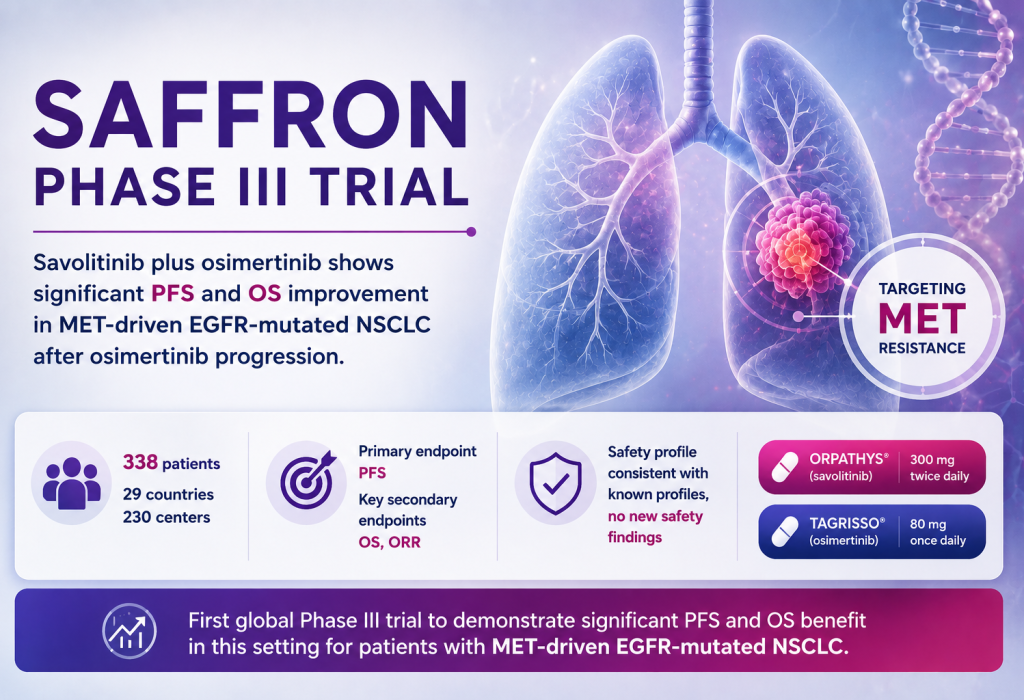
SAFFRON Phase III showed significant progression-free and overall survival benefits with savolitinib plus osimertinib in MET-driven EGFR-mutated NSCLC.
Written By: Kirti Kumbhar, M. Pharm (QA)
Reviewed By: Pharmacally Editorial Team
HUTCHMED and AstraZeneca reported positive high-level results from the SAFFRON Phase III trial, in which ORPATHYS (savolitinib) plus TAGRISSO (osimertinib) significantly improved both progression-free survival (PFS) and overall survival (OS) compared with doublet platinum-based chemotherapy in patients with epidermal growth factor receptor (EGFR)-mutated non-small cell lung cancer (NSCLC). The study enrolled patients whose tumors had high levels of mesenchymal-epithelial transition (MET) overexpression or amplification and whose disease had progressed after prior osimertinib treatment.
MET-Driven Resistance After Osimertinib
Third-generation EGFR tyrosine kinase inhibitors (TKIs) such as osimertinib have improved outcomes in EGFR-mutated NSCLC, but resistance remains a major challenge. MET overexpression or amplification is one of the most common mechanisms of acquired resistance after third-generation EGFR TKIs. HUTCHMED estimates that about 34% of tumors develop high levels of MET overexpression or amplification following progression on a third-generation EGFR TKI.
MET is a receptor tyrosine kinase involved in cell growth and survival. Increased MET signaling can provide an alternative pathway for tumor cells to bypass EGFR inhibition, contributing to disease progression. Savolitinib is an oral, highly selective MET TKI that inhibits aberrant MET signaling associated with receptor overexpression, gene amplification, and certain mutations.
SAFFRON Phase III Trial
SAFFRON (NCT05261399) was a randomized, open-label, multicenter Phase III trial involving 338 patients across 230 centers in 29 countries. Participants had locally advanced or metastatic EGFR-mutated NSCLC with MET overexpression or amplification and disease progression after first- or second-line treatment with osimertinib as the most recent therapy.
Patients received savolitinib 300 mg twice daily plus osimertinib 80 mg once daily or doublet platinum-based chemotherapy. PFS was the primary endpoint, while OS and objective response rate (ORR) were among the key secondary endpoints.
The combination produced statistically significant and clinically meaningful improvements in both PFS and OS versus chemotherapy. These results make SAFFRON the first global Phase III trial reported by the companies to demonstrate significant benefits in both endpoints in this treatment setting. Detailed efficacy data, including median survival estimates and hazard ratios, have not yet been disclosed.
The safety profile of savolitinib plus osimertinib was consistent with the known safety profiles of the individual agents, with no new safety findings reported.
Clinical and Regulatory Significance
The SAFFRON findings extend evidence from the SACHI Phase III trial (NCT05015608), which supported approval of savolitinib plus osimertinib in China for patients with EGFR-mutated NSCLC and MET amplification after progression on EGFR-TKI therapy. Earlier SAVANNAH Phase II results (NCT03778229) also established the MET biomarker thresholds used for prospective patient selection in SAFFRON.
Professor Shun Lu, principal investigator of SAFFRON, highlighted the clinical importance of identifying MET-driven resistance after osimertinib and the potential value of an oral, biomarker-directed treatment strategy.
Global Development Outlook
HUTCHMED and AstraZeneca will present detailed SAFFRON results at a forthcoming medical meeting and share the data with global regulatory authorities. The companies are pursuing potential global registrations of the combination.
Savolitinib plus osimertinib is already approved in China for eligible patients with locally advanced or metastatic EGFR-mutated NSCLC with MET amplification after progression on EGFR-TKI therapy. The combination has also received temporary authorization in Switzerland for patients with high MET overexpression or amplification following osimertinib.
Reference

About the Writer
Kirti Kumbhar (LinkedIn) is an M.Pharm graduate with experience in Quality Assurance at Lupin Limited and a strong interest in clinical research, regulatory affairs, and Trial Master File (TMF) management. She has developed knowledge of regulatory documentation, quality systems, compliance, and healthcare research through her professional experience. Passionate about clinical development and continuous learning, Kirti is committed to supporting high-quality healthcare documentation, regulatory excellence, and research-driven healthcare advancements.