
Rozanolixizumab reduced IgG by about 60% and improved fibromyalgia impact scores, but did not significantly reduce pain or fatigue in a phase 2A trial.
Written By: Anshu Gupta, PharmD
Reviewed By: Pharmacally Editorial Team
Rozanolixizumab produced a numerical improvement in pain-related interference among patients with severe fibromyalgia, but the effect did not reach conventional statistical significance in a phase 2A randomized trial published in The Lancet Rheumatology. The study evaluated weekly subcutaneous rozanolixizumab, an IgG-lowering monoclonal antibody developed by UCB, in 63 adults with severe disease.
The primary endpoint was the change in Brief Pain Inventory-Short Form (BPI-SF) interference score after 12 weeks. Rozanolixizumab produced a least-squares mean difference of −0.5 versus placebo (80% CI −1.0 to −0.1; p=0.065), meeting the prespecified one-sided 10% significance threshold. However, the result was not significant under a two-sided 5% threshold (95% CI −1.2 to 0.2; p=0.13).
Targeting IgG in Fibromyalgia
The mechanistic rationale was supported by passive-transfer studies showing that IgG from people with fibromyalgia can induce key clinical features, including pain-like behaviour, in mice. Separate studies found that fibromyalgia IgG can bind mouse and human satellite glial cells in the dorsal root ganglia, with higher anti-satellite glial cell IgG concentrations reported in patients with more severe widespread pain. However, validated assays were not available to select participants based on these antibodies, and their pathogenicity and relevant binding epitopes remain uncertain.
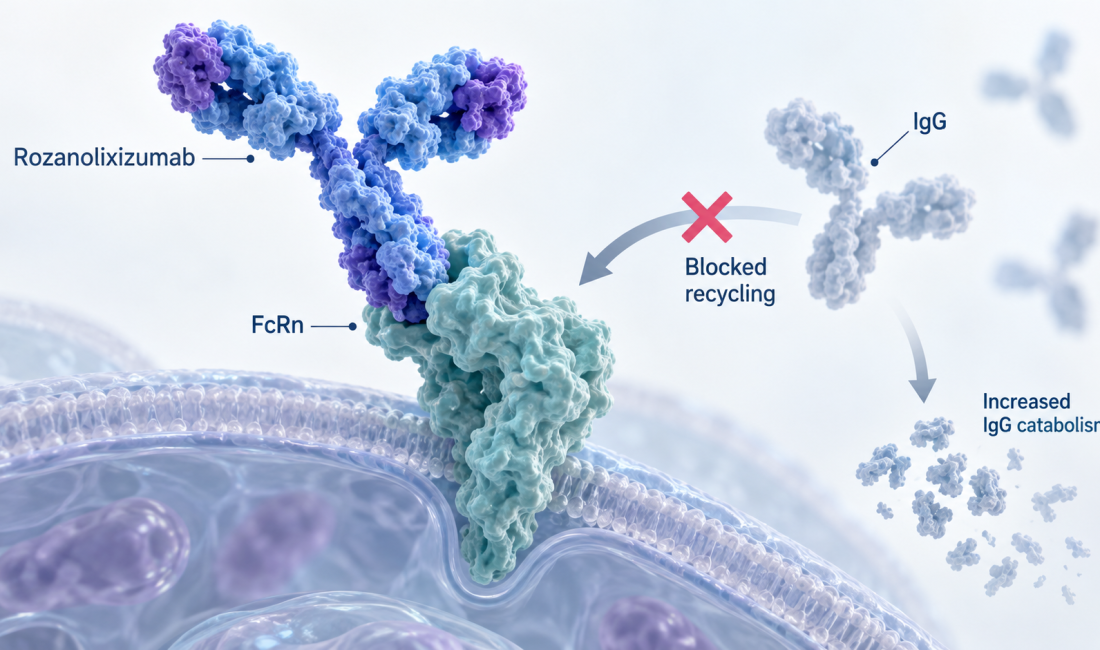
Rozanolixizumab is a humanized IgG4 monoclonal antibody that binds the neonatal Fc receptor (FcRn). Blocking FcRn reduces IgG recycling and accelerates IgG catabolism, lowering circulating IgG and potentially pathogenic autoantibodies. The drug is approved in multiple regions for generalized myasthenia gravis, where UCB reported in June 2026, that a pooled post hoc analysis of the Phase 3 MycarinG trial and MG0004 and MG0007 open-label extensions showed sustained symptom control with repeated, symptom-driven treatment cycles in 129 adults treated across up to 13 cycles.
63 Patients Received Weekly Treatment
The multicentre study enrolled adults aged 18–70 years with fibromyalgia diagnosed according to 2016 American College of Rheumatology criteria and severe symptoms. Both active-treatment sequences used a fixed 560 mg dose of rozanolixizumab administered once weekly by subcutaneous infusion. The continuous-treatment group received rozanolixizumab for 24 weeks, while the second active-treatment group received placebo for 12 weeks followed by 560 mg of rozanolixizumab once weekly for 12 weeks. The trial protocol specified a fixed 560 mg dose rather than describing weight-based dose adjustment.
Of 165 people screened between December 2022 and July 2024, 63 entered randomization and 55 completed all study phases. The trial used two 12-week double-blind treatment periods, followed by a two-week placebo run-out and five-week safety follow-up.
The Revised Fibromyalgia Impact Questionnaire (FIQR), a secondary endpoint, showed a clearer signal. After 10 weeks, rozanolixizumab improved the total FIQR score versus placebo by 8.4 points (95% CI −13.8 to −3.0; p=0.0026). All three FIQR domains also improved, including activities, symptoms and overall impact. However, these findings were not accompanied by improvements in the Pain Numeric Rating Scale or Fatigue Numeric Rating Scale.
IgG Fell by About 60%
Pharmacodynamic data confirmed that rozanolixizumab produced substantial IgG suppression. Total IgG fell by approximately 37% one week after treatment began and reached a steady state after about four weeks, with median reductions of 62% and 59% in the two rozanolixizumab treatment sequences.
The researchers found no clear relationship between the extent of total IgG reduction and clinical response. They noted that the study was not powered to establish such a relationship, and only seven of 39 patients with available data achieved more than a 70% IgG reduction.
Safety Was Consistent with Known Rozanolixizumab Experience
No serious treatment-emergent adverse events occurred among participants receiving rozanolixizumab during treatment periods. Headache was the most common adverse event, occurring in 41% of participants receiving rozanolixizumab during the first 12 weeks and 30% during the second 12 weeks. No cases of suspected aseptic meningitis were reported.
Biomarker Selection May Shape Future Development
The investigators concluded that rozanolixizumab did not demonstrate broad efficacy in this severe fibromyalgia population. Marked variability between individual responses suggests that a subgroup with pathogenic IgG autoantibodies could potentially respond differently.
However, validated assays for identifying these antibodies are not yet available, and the pathogenic role of anti-satellite glial cell antibodies remains uncertain. Future studies will need to identify relevant autoantigens, develop reliable biomarkers and determine whether IgG reduction benefits a biologically defined patient subgroup.
Reference
Goebel A, Meisner P, Rydevik G et al., Efficacy and safety of rozanolixizumab in severe fibromyalgia: a phase 2A randomised, double-blind, placebo-controlled, multicentre trial, The Lancet Rheumatology, September 16, 2026, https://doi.org/10.1016/S2665-9913(26)00252-3
A Proof-of-concept Study to Evaluate the Efficacy and Safety of Rozanolixizumab to Treat Adult Study Participants with Severe Fibromyalgia Syndrome, ClinicalTrials.gov ID NCT05643794

About the Writer
Anshu Gupta (LinkedIn) is a PharmD professional and healthcare writer with interests in clinical research, pharmacovigilance, regulatory affairs, and medical writing. She has presented research at academic conferences and completed certifications in Good Clinical Practice (GCP), ICH-GCP, and drug safety. Passionate about clinical trials and evidence-based medicine, she is committed to translating scientific evidence into accurate, reliable, and accessible healthcare content.