
Roche’s sefaxersen met the Phase 3 IMAgINATION endpoint, significantly reducing proteinuria in IgA nephropathy at 37 weeks versus placebo.
Written By: Anshu Gupta, PharmD
Reviewed By: Pharmacally Editorial Team
Roche’s investigational sefaxersen met the primary endpoint in the Phase III IMAgINATION study, showing a statistically significant and clinically meaningful reduction in proteinuria versus placebo at 37 weeks in adults with primary IgA nephropathy (IgAN). The liver-directed antisense oligonucleotide targets complement factor B mRNA and is the first RNA-targeted therapy being developed for IgAN.
Phase III Study Meets Primary Endpoint
The prespecified interim analysis showed that sefaxersen significantly reduced 24-hour urine protein-to-creatinine ratio (UPCR) compared with placebo at week 37. Proteinuria is a key marker of kidney injury in IgAN, and sustained reductions in urinary protein are associated with slower loss of kidney function.
The company has not yet disclosed the numerical magnitude of the UPCR reduction, confidence intervals, or p-value. Detailed interim results are expected to be presented at an upcoming medical congress and shared with health authorities.
The safety and tolerability profile remained consistent with earlier clinical studies, with no new safety signals identified.
Sefaxersen Targets Complement Factor B
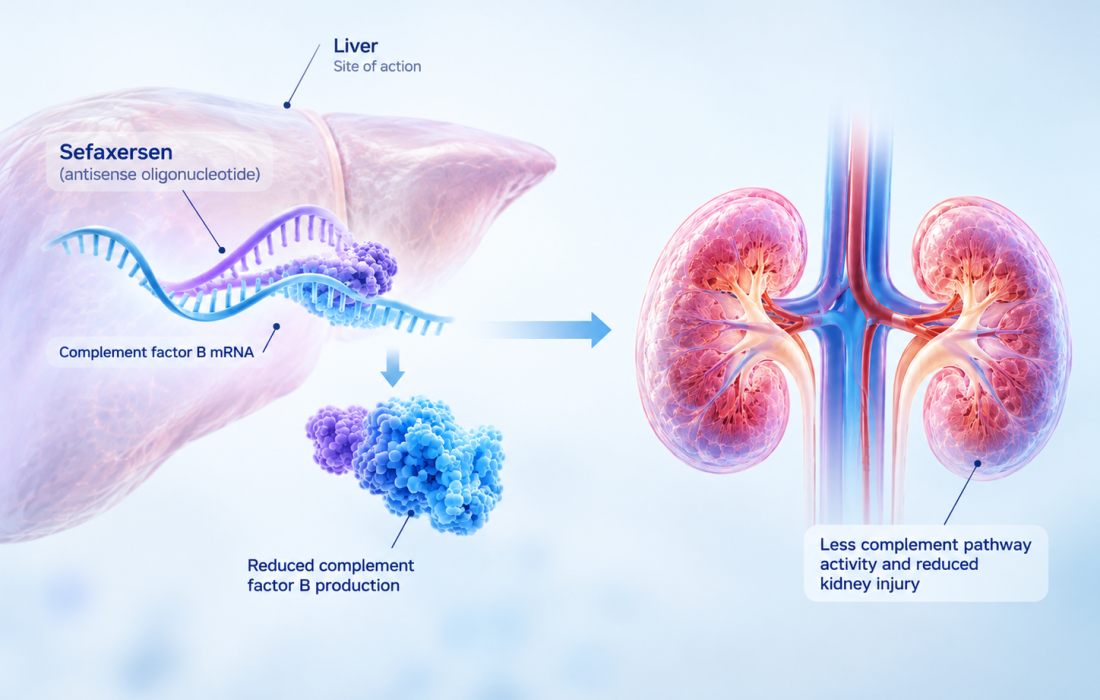
Sefaxersen is an investigational liver-directed antisense oligonucleotide that suppresses production of complement factor B by targeting its mRNA. Factor B is a key component of the alternative complement pathway, which contributes to inflammation and kidney injury in IgAN.
By reducing factor B production in the liver, sefaxersen is intended to provide sustained control of alternative complement pathway activity. Earlier Phase I and II studies reported reductions in both proteinuria and plasma complement factor B levels.
The therapy is administered as a once-monthly subcutaneous injection and is intended for self-administration, potentially providing a less frequent treatment schedule for people with IgAN.
IMAgINATION Enrolled 459 Patients
IMAgINATION (NCT05797610) is a Phase III, multicentre, randomised, double-blind, placebo-controlled study evaluating subcutaneous sefaxersen in adults with primary IgAN at high risk of disease progression.
The trial enrolled 459 participants who were randomised 1:1 to receive sefaxersen or placebo for 105 weeks. The primary endpoint is the change from baseline in urine protein-to-creatinine ratio at week 37.
The study will remain blinded to evaluate longer-term kidney function through week 105, with estimated glomerular filtration rate (eGFR) serving as the key measure. Participants may transition to open-label treatment after week 105 or following the common-close timepoint, depending on the study protocol and investigator decision.
IgA Nephropathy Can Progress to Kidney Failure
IgAN, also known as Berger’s disease, is a chronic autoimmune kidney disease and the most common form of primary glomerulonephritis. In the disease, immune complexes containing immunoglobulin A accumulate in the kidneys and activate the complement system, contributing to glomerular inflammation and progressive kidney damage.
IgAN is typically diagnosed before age 40 and affects at least 25 adults per million worldwide each year. Up to 50% of patients may progress to end-stage kidney disease within 20 years of diagnosis, creating a substantial need for therapies that preserve kidney function over the long term.
The updated KDIGO 2025 guidelines highlight the importance of addressing both the immune mechanisms underlying IgAN and the downstream consequences of kidney injury.
Kidney Function Data Will Determine Next Steps
Levi Garraway, Roche’s chief medical officer and head of global product development, said the interim findings demonstrate sefaxersen’s potential to affect a key surrogate marker associated with kidney disease progression.
The next major milestone will be the full presentation of the interim dataset, followed by the week-105 assessment of kidney function. The longer-term eGFR results will be important for determining whether the reduction in proteinuria translates into preservation of renal function.
Roche licensed sefaxersen from Ionis Pharmaceuticals for development in complement-mediated diseases. The company plans to share the interim findings with regulators as it evaluates the next steps toward potential regulatory submissions in IgAN.
Reference
Positive interim data shows Roche’s sefaxersen significantly reduces proteinuria in people with IgA nephropathy (IgAN), Roche, 23 September 2026
A Study to Evaluate the Efficacy and Safety of Sefaxersen (RO7434656) in Participants with Primary Immunoglobulin A (IgA) Nephropathy at High Risk of Progression (IMAGINATION), ClinicalTrials.gov ID NCT05797610

About the Writer
Anshu Gupta (LinkedIn) is a PharmD professional and healthcare writer with interests in clinical research, pharmacovigilance, regulatory affairs, and medical writing. She has presented research at academic conferences and completed certifications in Good Clinical Practice (GCP), ICH-GCP, and drug safety. Passionate about clinical trials and evidence-based medicine, she is committed to translating scientific evidence into accurate, reliable, and accessible healthcare content.