
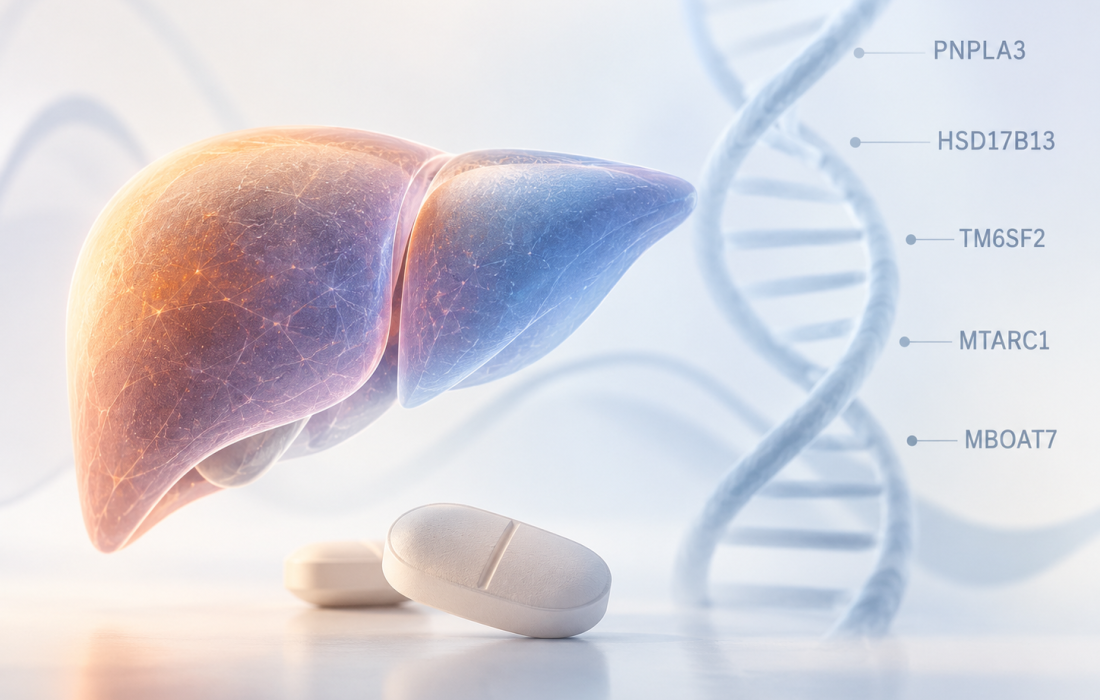
Rezdiffra showed consistent MASH resolution, fibrosis improvement and liver-fat reductions across common genetic risk groups in a MAESTRO-NASH analysis.
Written By: Khushi Patel, PharmD
Reviewed By: Pharmacally Editorial Team
Madrigal Pharmaceuticals has announced the publication of a prespecified secondary analysis from the Phase 3 MAESTRO-NASH trial in the Journal of Hepatology, evaluating whether common genetic risk variants associated with metabolic dysfunction-associated steatohepatitis (MASH) influenced patient response to Rezdiffra (resmetirom). The analysis included 738 patients who consented to genetic testing and completed baseline and Week 52 liver biopsies.
The analysis found that Rezdiffra treatment was associated with consistent improvements across major efficacy measures, including MASH resolution, fibrosis improvement, MRI-based liver-fat reduction, and biomarkers, across several common genetic risk groups. The variants evaluated included PNPLA3, HSD17B13, TM6SF2, MTARC1, and MBOAT7, which have been associated with MASH progression and disease severity.
Consistent Treatment Responses Across Genetic Risk Groups
The secondary analysis evaluated whether genetic differences altered the treatment response to resmetirom. Across the major efficacy endpoints, the investigators reported no meaningful difference in treatment response based on individual MASH genetic risk variants or a composite genetic risk score.
Responses to resmetirom were consistent across PNPLA3, HSD17B13, TM6SF2, MTARC1, and MBOAT7 risk groups for MASH resolution, fibrosis improvement, and MRI-PDFF reduction. The treatment effect also remained consistent after accounting for sex and Hispanic ethnicity.
The findings therefore suggest that the treatment effects observed with Rezdiffra were broadly consistent across the common genetic risk groups evaluated, including groups associated with increased risk of MASH progression.
PNPLA3 Subgroup Findings
The analysis provided specific results for patients grouped according to PNPLA3 risk status.
For MASH resolution, the response among Rezdiffra-treated patients was 38.4%, 30.8%, and 30.5% across low-, intermediate-, and high-risk PNPLA3 genotypes, respectively. Corresponding rates in the placebo group were 12.9%, 5.1%, and 11.7%.
For fibrosis improvement, rates among Rezdiffra-treated patients were 34.2%, 29.5%, and 31.4% across the three PNPLA3 risk groups, compared with 14.1%, 13.7%, and 15.0% among placebo-treated patients.
These findings indicate that the observed treatment response was maintained across the PNPLA3 risk categories evaluated rather than being restricted to patients with a particular genetic risk profile.
Genetic Risk and Metabolic Characteristics
The analysis also identified differences in metabolic characteristics among some genetic risk groups. Patients carrying high-risk PNPLA3 or HSD17B13 genotypes had lower frequencies of certain traditional metabolic risk factors, including diabetes and hypertension.
Despite having fewer of these conventional metabolic risk factors, some patients with higher genetic risk could still have substantial liver fibrosis. The findings highlight the contribution of genetic factors to MASH disease severity alongside metabolic risk factors.
Analysis Limitations
The investigators noted several limitations that are important when interpreting the findings.
The analysis was not prospectively powered to detect small genotype-by-treatment interactions, and only selected common genetic variants were assessed. In addition, some genotype groups had limited numbers of patients. As a result, smaller genotype-specific treatment effects or differences associated with rarer genetic variants cannot be excluded.
Therefore, the findings support consistency of Rezdiffra treatment effects across the genetic groups studied but do not establish that genetic variation has no influence on treatment response in all patients with MASH.
Implications for Rezdiffra Development
Rezdiffra is a once-daily oral thyroid hormone receptor-beta (THR-β) agonist used with diet and exercise to treat adults with MASH and moderate to advanced liver fibrosis, but not cirrhosis. Its approval is based on improvements in MASH and liver fibrosis, with ongoing studies intended to confirm clinical benefit.
The current analysis adds to the clinical characterization of Rezdiffra by examining whether common genetic risk factors associated with MASH progression are linked to differences in treatment response.
Madrigal is also pursuing a precision-medicine strategy targeting specific genetic drivers of MASH. In May 2026, the company announced MGL-0795, formerly ARO-PNPLA3, a clinical-stage small interfering RNA (siRNA) asset targeting PNPLA3. The company plans to consult with the FDA regarding the design of a Phase 2 combination trial evaluating MGL-0795 with Rezdiffra.
Safety
In the overall MAESTRO-NASH trial, which enrolled 966 patients, Rezdiffra was generally well tolerated, with serious adverse events occurring at similar frequencies across treatment groups. Safety was not the primary focus of the newly published genetic subgroup analysis.
What the Findings Mean
The published analysis provides evidence that the treatment effects of Rezdiffra were consistent across the selected common genetic risk groups evaluated in MAESTRO-NASH. This includes genetic variants associated with increased risk of MASH progression and liver-related complications.
However, the analysis was a secondary study and was not designed to detect small genotype-specific differences. The results therefore support broad consistency of response across the genetic groups studied, rather than establishing that genetic factors cannot influence individual treatment response.
The findings add to the clinical evidence surrounding resmetirom as treatment of noncirrhotic MASH with moderate to advanced fibrosis and may also help inform future research into genetically defined approaches to MASH treatment.
Reference
Madrigal Announces Publication in the Journal of Hepatology Demonstrating Consistent Rezdiffra Efficacy Across Common MASH Genetic Risk Variants, Madrigal, 06 October 2026
A Phase 3 Study to Evaluate the Efficacy and Safety of MGL-3196 (Resmetirom) in Patients With NASH and Fibrosis (MAESTRO-NASH), ClinicalTrials.gov ID NCT03900429
Chalasani N et al, Effects of MASH risk genotypes on resmetirom efficacy in patients with MASH and fibrosis, Journal of Hepatology, 05 October 2026, https://doi.org/10.1016/j.jhep.2026.08.037

About the Writer
Khushi Patel is a Pharm.D (Linkedin) professional with a strong foundation in clinical pharmacy, patient-centered care, regulatory affairs, and pharmacovigilance, with published work on Brugada syndrome.
Her interests include regulatory affairs, pharmacovigilance, guideline integration, multimodal therapy, pharmacogenomics, and antibiogram utilization, with a focus on evidence-based clinical decision-making and medication safety.
As a Pharmacally healthcare writer, she translates clinical and scientific evidence into clear, accurate, and clinically relevant healthcare content, while continuously developing her expertise in evolving pharmacy practice.