
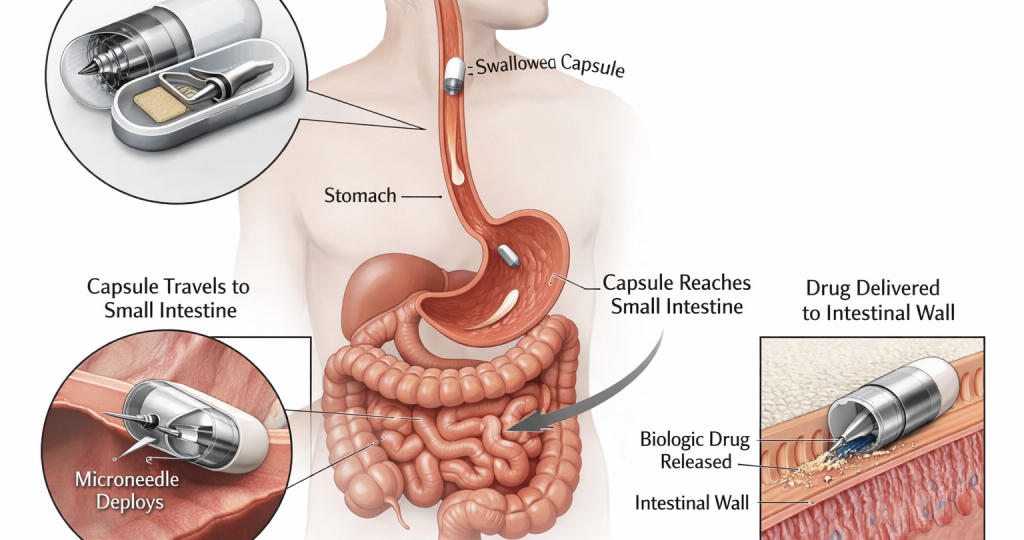
Rani Therapeutics’ oral RT-114 achieved over 150% systemic exposure versus matched subcutaneous dosing in a Phase 1 obesity study with favorable safety.
Written By: Samiksha Jadhav, BPharm
Reviewed By: Pharmacally Editorial Team
Rani Therapeutics has reported positive initial Phase 1 data showing that its investigational oral therapy RT-114 achieved systemic exposure exceeding that of an equivalent subcutaneous dose of PG-102, a finding that distinguishes the program from many oral biologic delivery approaches. The therapy also demonstrated a favorable safety profile in healthy volunteers, supporting continued development as a potential oral alternative to injectable obesity treatments.
RT-114 Uses Microneedle Technology to Deliver an Oral Biologic
RT-114 combines Rani Therapeutics’ proprietary RaniPill® Capsule with PG-102, a GLP-1/GLP-2 dual agonist developed by ProGen Co., Ltd. for the treatment of obesity. GLP-1-based therapies have transformed obesity management, but most currently approved biologic treatments require regular subcutaneous injections, which may affect long-term treatment adherence for some patients.
The RaniPill® Capsule uses a tiny dissolvable microneedle that deploys in the small intestine to deliver the biologic directly into the intestinal wall, enabling systemic absorption while avoiding conventional injections. After drug deployment, the empty capsule shell passes safely through the gastrointestinal tract and is excreted naturally. Unlike peptide tablets that rely on gastrointestinal absorption enhancers, RT-114 delivers the biologic after crossing the intestinal barrier, representing a distinct approach among oral obesity therapies currently in development.
Phase 1 Study Shows Systemic Exposure Exceeding Injection
The ongoing Phase 1 program (NCT06891287) is evaluating the safety, tolerability, pharmacokinetics, pharmacodynamics, and bioavailability of oral RT-114 compared with subcutaneous PG-102.
In the single-dose, open-label Phase 1a study, 30 healthy volunteers were randomized to receive identical 12 mg doses of PG-102 either orally through the RaniPill® Capsule or by subcutaneous injection.
RT-114 achieved bioavailability greater than 150% relative to the matched 12 mg subcutaneous dose. Achieving systemic exposure that exceeds an equivalent injectable dose is uncommon for oral biologic delivery technologies, many of which have historically produced substantially lower exposure than subcutaneous administration. The finding represents the study’s principal scientific advance and supports the RaniPill® platform’s ability to deliver biologic medicines orally.
Pharmacokinetic analyses also showed comparable elimination half-lives between treatment groups, measuring 5.6 days for RT-114 and 5.3 days for subcutaneous PG-102, indicating similar systemic persistence after absorption.
Safety Findings Support Continued Clinical Development
No serious adverse events occurred in either treatment group, and investigators reported no adverse events attributable to the RaniPill® Capsule itself.
Treatment-related adverse events included nausea, vomiting, and diarrhea, all of which were mild, transient, and consistent with the established safety profile of GLP-1/GLP-2 dual agonists.
The absence of capsule-related safety concerns further supports continued evaluation of the oral delivery platform in obesity and other biologic indications.
Expanded Phase 1a Cohort Will Inform Repeat-Dose Study
Based on the initial results, Rani Therapeutics has expanded the Phase 1a study by adding another cohort of 15 healthy volunteers to further characterize the relationship between oral and subcutaneous pharmacokinetics.
Participants in the expansion cohort will receive two separate 12 mg doses of PG-102 via the RaniPill®, for a total administered dose of 24 mg. These data will help optimize dose selection for the planned Phase 1b study.
The Phase 1b trial is expected to begin later in 2026 and will evaluate eight weeks of repeat RT-114 dosing in patients with obesity, with primary assessments focused on safety, tolerability, and pharmacodynamic effects. If the repeat-dose study is successful, the program would be expected to advance into Phase 2 clinical development, subject to regulatory review and discussions with health authorities. Initial Phase 1b results are anticipated in 2027.
Executive Perspective and Development Outlook
Rani Chief Executive Officer Talat Imran said the study exceeded internal expectations by demonstrating systemic exposure substantially above matched subcutaneous administration while maintaining the expected safety profile of a GLP-1/GLP-2 dual agonist. He added that the higher-than-anticipated exposure may allow evaluation of a broader range of therapeutic serum concentrations using practical oral dosing regimens, prompting the expansion of the Phase 1a study to refine dose selection.
RT-114 is being developed under a global collaboration established in 2024 between Rani Therapeutics and ProGen. The companies jointly share development costs and future commercialization profits and losses. Rani is leading development through Phase 1 and will oversee commercialization in the United States, Canada, Europe, the United Kingdom, and Australia following initiation of Phase 2 studies, while ProGen will lead development and commercialization across the remaining global markets.
Reference

About the Writer
Samiksha Vikram Jadhav (LinkedIn) is a B. Pharm graduate with a strong academic foundation in pharmaceutical sciences, pharmacology, and drug development. She specializes in pharma market research, with a focused interest in mergers and acquisitions, strategic partnerships, and global pharma and biotech deals. Her work centers on analyzing industry transactions, market positioning, and business strategies, translating complex developments into clear, accurate, and insightful scientific and commercial reporting.