
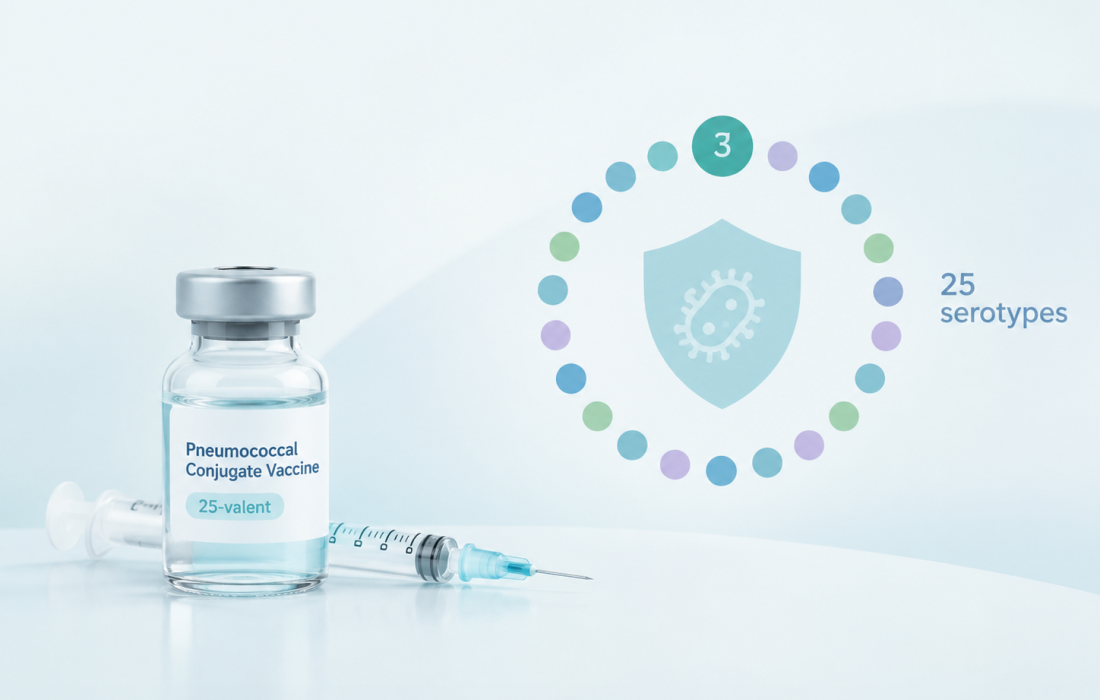
Pfizer reports Phase 2 results for its 25-valent pediatric pneumococcal vaccine, showing immune responses across 25 serotypes and higher serotype 3 antibody concentrations than PREVNAR 20.
Written By: Mayuresh Salvi, PharmD
Reviewed By: Pharmacally Editorial Team
Pfizer reported detailed Phase 2 results for its investigational 25-valent pneumococcal conjugate vaccine candidate, PF-07872412 (25vPnC), in healthy infants on October 24, 2026. Presented at IDWeek 2026 in Washington, D.C., the findings showed immune responses against all 25 targeted serotypes following a four-dose series, with safety and tolerability findings comparable to PREVNAR 20. The results support continued Phase 3 development, although clinical protection has not yet been established.
Immune Responses Across 25 Serotypes
The Phase 2 study (NCT06524414) evaluated the safety, tolerability and immunogenicity of 25vPnC against PREVNAR 20 in healthy infants. Participants received four doses at 2, 4, 6 and 12–15 months of age, with immune responses assessed one month after the third and fourth doses.
The candidate targets the 20 serotypes covered by PREVNAR 20 and adds five more: 15A, 23A, 23B, 24F and 35B. Pfizer reported immune responses against all 25 serotypes, including functional responses in an opsonophagocytic activity (OPA) assay after the fourth dose. OPA assesses whether antibodies can facilitate immune-cell-mediated bacterial killing.
These findings indicate that the candidate can generate antibody responses across its expanded serotype panel. However, immunogenicity results alone do not establish how effectively it prevents invasive pneumococcal disease (IPD).
Higher Antibody Concentrations Against Serotype 3
The most notable comparative finding was the stronger antibody response against pneumococcal serotype 3, a contributor to residual disease despite existing conjugate vaccines.
One month after dose three, serotype 3 immunoglobulin G antibody geometric mean concentrations (GMCs) were 4.22 with 25vPnC and 0.48 with PREVNAR 20, an approximately 8.8-fold difference. One month after dose four, the respective GMCs were 13.85 and 0.92, representing an approximately 15-fold difference.
Pfizer uses next-generation conjugation technology designed to enhance the immune response against this serotype. The company estimates that serotype 3 accounts for 10.6% of IPD cases among US children younger than five years.
The magnitude of the antibody differences is relevant because serotype 3 remains a challenge for pneumococcal disease prevention. Nevertheless, higher antibody concentrations should not be interpreted as evidence of superior clinical protection. Further clinical evidence is needed to determine whether these differences translate into fewer infections or invasive disease cases.
Phase 2 Safety Findings and Phase 3 Progress
Rates of local reactions, systemic events and adverse events were balanced between the 25vPnC and PREVNAR 20 groups. Reported adverse events were consistent with conditions commonly diagnosed in this age group, and no serious adverse events considered related to vaccination were identified.
These findings support continued evaluation but do not fully characterize uncommon adverse events or establish the candidate’s safety profile across broader populations.
Pfizer reported that three Phase 3 studies began earlier in 2026, with up to 6,830 participants planned across the programme. The studies compare 25vPnC with PREVNAR 20. The company has also completed enrolment in a separate Phase 3 manufacturing lot-consistency study.
The five additional serotypes are estimated by Pfizer, using US surveillance data, to account for approximately 30% of pediatric IPD cases beyond those addressed by PREVNAR 20. The company estimates that the 25 targeted serotypes collectively account for approximately 84% of IPD cases among US children younger than five years.
These figures describe the estimated distribution of disease-causing serotypes, not the proportion of cases the investigational vaccine has demonstrated it can prevent.
Clinical Interpretation
The findings combine broad serotype-specific immunogenicity with a substantially higher serotype 3 antibody response than PREVNAR 20. The functional OPA results add evidence of antibody activity against all 25 targeted serotypes, while the observed safety findings support further investigation.
The central question is whether these immunological findings translate into meaningful clinical protection. Phase 3 studies will provide additional evidence on immune responses and safety and help support regulatory assessment. Until those data are available, 25vPnC remains investigational, and its potential clinical advantage over PREVNAR 20 cannot be established from the Phase 2 results alone.
References
Pfizer’s 25-Valent Pediatric Pneumococcal Conjugate Vaccine Candidate Shows Robust Phase 2 Data at IDWeek 2026, Pfizer Inc., October 24, 2026,
A Study to Learn About How a New Pneumococcal Vaccine Works in Infants, ClinicalTrials.gov ID NCT06524414

About the Writer
Mayuresh Sunil Salvi (Linkedin) is a PharmD professional and healthcare writer with a strong interest in pharmacovigilance, drug safety, and emerging medical research. He is passionate about exploring new drug discoveries, clinical research, and advances in evidence-based medicine. His interests also include ward rounds, prescription audits, and treatment analysis to support rational pharmacotherapy and improved patient care.