
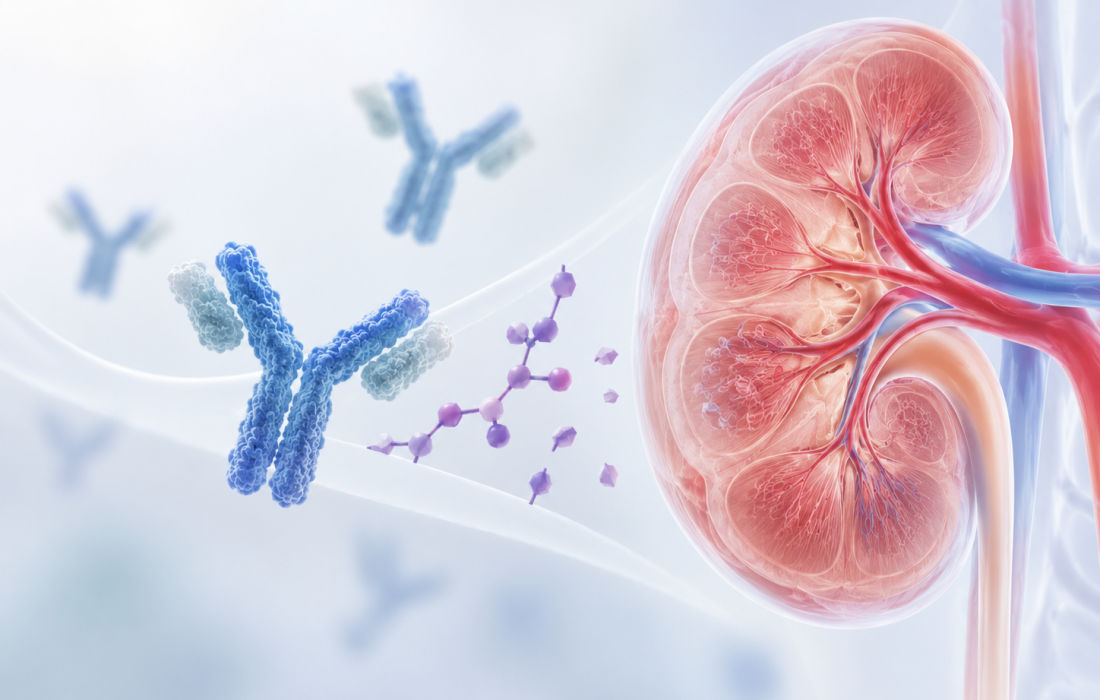
Palleon reports faster clinical responses and higher remission rates with HLX79/E-602 plus rituximab in Phase 2 primary membranous nephropathy results.
Written By: Saniya Katakdhond, PharmD
Reviewed by: Pharmacally Editorial Team
Palleon Pharmaceuticals has reported Phase 2 results for HLX79/E-602 (efgitasialase alfa), an investigational sialidase-Fc fusion protein, in patients with primary membranous nephropathy (pMN). The findings were presented during a late-breaking oral session at the American Society of Nephrology (ASN) Kidney Week 2026 in Denver.
The study, conducted in China by Palleon’s partner Shanghai Henlius Biotech, evaluated HLX79/E-602 in combination with the rituximab biosimilar HANLIKANG against rituximab alone. The randomized, double-blind, placebo-controlled Phase 2 trial (NCT07038382) enrolled 26 patients across three dose cohorts of 10, 20 and 30 mg/kg. Treatment was administered weekly for four weeks, with re-dosing planned at six months.
The company reported the most notable efficacy findings in the 30 mg/kg combination cohort, where patients experienced a shorter median time to first clinical response and higher observed remission rates than those receiving rituximab alone.
Phase 2 Results Show Earlier Clinical Responses
The median time to first clinical response was three weeks with HLX79/E-602 at 30 mg/kg plus rituximab, compared with 11 weeks with rituximab alone.
The difference was also reflected in the reported remission rates. At Week 24, complete or partial remission was achieved by six of seven patients (86%) in the combination group, compared with four of six patients (67%) in the control group.
By Week 36, all seven patients in the combination group had achieved complete or partial remission, including three complete remissions. In the rituximab-alone group, three of six patients (50%) achieved complete or partial remission.
These findings suggest that the combination may accelerate clinical response and increase the proportion of patients achieving remission. However, the comparisons involved small groups, and the reported results do not establish statistical superiority over rituximab alone.
Safety Findings Support Further Evaluation
Palleon reported that HLX79/E-602 was well tolerated across the evaluated doses, with no severe adverse events attributed to the investigational treatment. The company also described the regimen as suitable for outpatient administration.
The ASN abstract reported that treatment-emergent adverse events were predominantly Grade 1–2. It also described one Grade 3 serious adverse event that was assessed as unrelated to either study drug.
Although these findings provide an initial assessment of tolerability, 26 enrolled patients are insufficient to characterize uncommon adverse events or establish the long-term safety of repeated treatment. Larger studies will be needed to confirm the safety profile.
Glycan Editing Offers a Complementary Therapeutic Approach
Primary membranous nephropathy is an autoimmune kidney disease in which immune-mediated injury to the glomeruli causes protein leakage into the urine. Persistent disease activity can contribute to progressive kidney damage and, in some patients, kidney failure.
Rituximab is an established treatment option, but clinical responses may take months, and some patients do not achieve remission.
HLX79/E-602 is designed to introduce a different approach through glycan editing. The investigational protein enzymatically removes sialic acid from cell-surface glycans. According to Palleon, modifying these structures may alter the activity of disease-associated immune cells and improve responses to existing treatment.
Combining glycan editing with rituximab could therefore provide complementary immune modulation. However, the proposed mechanism should be distinguished from the clinical evidence: the Phase 2 findings do not yet establish how much of the observed response difference is attributable to glycan editing or whether the effect will persist over time.
Clinical Interpretation: Remission Rates Need Confirmation
The most notable signal is the difference in median time to first clinical response, at three weeks with the combination versus 11 weeks with rituximab alone. The higher observed remission rates at Weeks 24 and 36 provide additional support for further investigation.
Earlier disease control could be clinically relevant in pMN, where persistent proteinuria and ongoing immune-mediated injury can contribute to kidney damage. Nevertheless, the reported findings do not demonstrate long-term kidney protection, sustained improvement in kidney function or a reduced risk of kidney failure.
The remission comparisons also require caution. Week 36 results were reported for seven combination-treated patients and six controls, despite the trial enrolling 26 patients across three dose cohorts. The available reporting does not fully explain the difference between the overall enrollment and these smaller efficacy-analysis groups. The reported percentages should therefore be interpreted in the context of the limited evaluable population.
Further studies must establish whether the early response advantage translates into durable remission, improved kidney outcomes and an acceptable safety profile with repeated treatment.
What the Results Mean for HLX79/E-602
Palleon’s Phase 2 findings provide an early clinical signal for glycan editing as a potential addition to rituximab in primary membranous nephropathy. The shorter time to first clinical response and higher observed remission rates justify continued evaluation, but they do not establish comparative superiority or long-term clinical benefit.
Larger controlled studies will be needed to confirm the efficacy findings, clarify the response across dose groups and determine whether the combination delivers sustained disease control and meaningful kidney outcomes.
Reference
Palleon Pharmaceuticals Presents Phase 2 Results for HLX79/E-602 in Primary Membranous Nephropathy at ASN Kidney Week 2026, Palleon Pharmaceuticals, 23 October 2026
A Study to Evaluate the Efficacy, Safety, and Tolerability of Human Sialidase Fusion Protein (HLX79) in Combination With Rituximab Injection Versus Placebo in Patients With Active Glomerulonephritis, ClinicalTrials.gov ID NCT07038382

About the Writer
Saniya Sanjay Katakdhond (Linkedin) is a Doctor of Pharmacy professional with hands-on experience in patient case review, clinical documentation, medical record analysis, and patient care.
Her hospital experience has strengthened her understanding of clinical conditions, treatment approaches, and multidisciplinary healthcare practices.
With ICH-GCP certification and a research-oriented approach, she brings clinical insight and attention to detail to healthcare content development.
As a healthcare writer, Saniya focuses on translating clinical knowledge and patient-care experience into clear, accurate, and evidence-informed medical content.