
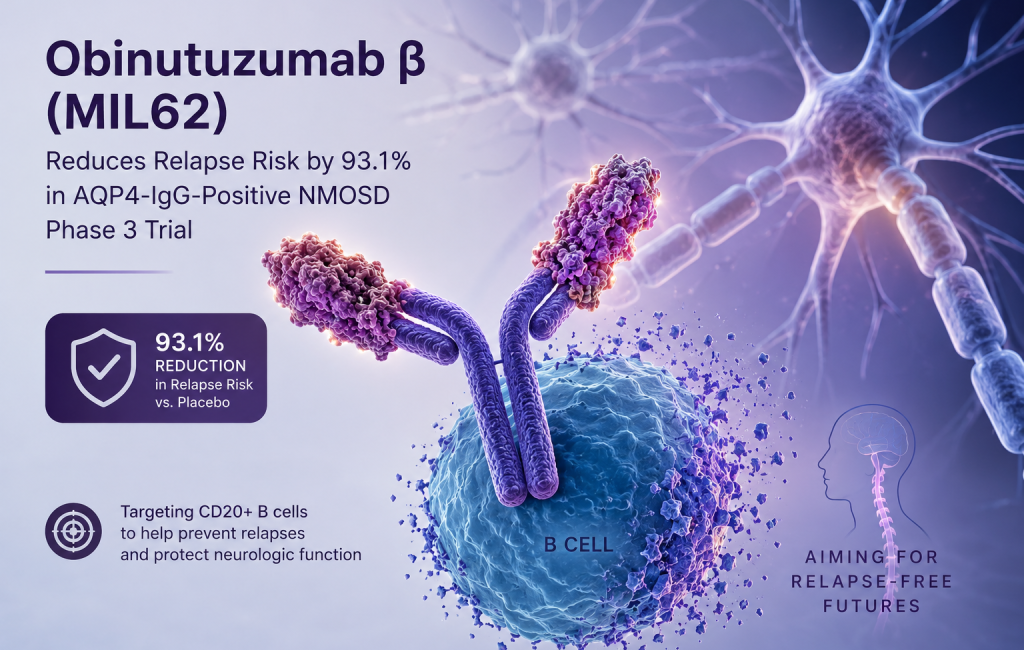
Obinutuzumab β reduced the hazard of relapse by 93.1% versus placebo in a phase 3 trial of AQP4-IgG-positive NMOSD, Nature Medicine reports.
Written By: Anamika Koshti, PharmD
Reviewed By: Pharmacally Editorial Team
A phase 3 randomized controlled trial published in Nature Medicine has shown that obinutuzumab β, a glycoengineered type II anti-CD20 monoclonal antibody, significantly reduced the risk of relapse in patients with aquaporin-4-immunoglobulin G-positive (AQP4-IgG+) neuromyelitis optica spectrum disorder (NMOSD). Obinutuzumab β (MIL62) is a glycoengineered form of the type II anti-CD20 antibody obinutuzumab, distinguished by a different Fc glycosylation profile designed to enhance antibody-dependent cellular cytotoxicity.
Known by its development code MIL62, obinutuzumab β met the primary endpoint of the BeInmost trial (NCT05314010), significantly reducing the hazard of adjudicated relapse compared with placebo over 52 weeks.
The findings provide randomized phase 3 evidence for a newer-generation type II glycoengineered anti-CD20 antibody in AQP4-IgG-positive NMOSD, a rare autoimmune disorder of the central nervous system.
BeInmost Phase 3 Trial Design
The BeInmost trial (NCT05314010) was a multicenter, randomized, double-blind, placebo-controlled phase 3 study conducted at 32 sites in China, followed by an open-label extension.
Of 123 patients screened, 91 adults aged 18 to 70 years with AQP4-IgG-positive NMOSD and an Expanded Disability Status Scale (EDSS) score of 7.0 or lower were randomized in a 1:1 ratio to receive intravenous obinutuzumab β or placebo.
Patients assigned to obinutuzumab β received 1,000 mg intravenously on days 1 and 15. Participants who remained relapse-free through week 24 received two additional infusions at weeks 25 and 27.
All participants received a standardized glucocorticoid bridge consisting of oral prednisone 20 mg daily for four weeks followed by tapering.
The primary endpoint was time to first adjudicated relapse through week 52.
Obinutuzumab β Significantly Reduced Relapses
The primary endpoint was met.
Adjudicated relapse occurred in 2 of 45 patients (4.4%) receiving obinutuzumab β compared with 21 of 46 patients (45.7%) receiving placebo.
The hazard ratio for first adjudicated relapse was 0.069 (95% CI, 0.016–0.296; P<0.0001), corresponding to a 93.1% relative reduction in the hazard of relapse compared with placebo.
The estimated 52-week relapse-free rate was 94.8% with obinutuzumab β compared with 28.4% with placebo.
The treatment effect was consistent across prespecified subgroups, including sex, age, baseline EDSS score and relapse history.
Secondary Efficacy Outcomes
Obinutuzumab β produced favorable results across key secondary and exploratory endpoints:
- Annualized Relapse Rate: The adjudicated ARR was significantly lower with obinutuzumab β than placebo ( vs. ; ).
- Hospitalization: Relapse-related hospitalizations occurred in 4.4% of patients in the treatment group compared with 45.7% receiving placebo ().
- Disability Progression: EDSS change favored obinutuzumab β with a between-group difference of points ().
- Biomarkers & Imaging: Active MRI lesion measures were substantially reduced, and serum AQP4-IgG titers declined over time in the treatment arm, demonstrating sustained biological activity. Best-corrected visual acuity remained stable across both groups.
Safety Profile
Treatment-emergent adverse events occurred at similar rates in the two groups, affecting 95.6% of patients receiving obinutuzumab β and 95.7% of those receiving placebo.
Treatment-related adverse events were reported more frequently with obinutuzumab β than with placebo. Infusion-related reactions and laboratory abnormalities were among the reported treatment-related events.
Importantly, grade 3 or higher treatment-related adverse events occurred at comparable rates between the groups, affecting 6.7% of patients receiving obinutuzumab β and 6.5% receiving placebo.
One death occurred in the obinutuzumab β group following a post-treatment relapse complicated by disseminated infection. The event should be considered in the context of the severe underlying disease and the patient’s subsequent clinical course.
Overall, the randomized trial did not identify a major imbalance in severe treatment-related adverse events between obinutuzumab β and placebo, although longer-term safety monitoring remains important for a B-cell-depleting therapy.
Why Obinutuzumab β May Have Activity in NMOSD
Obinutuzumab β is a humanized type II anti-CD20 monoclonal antibody designed to produce enhanced B-cell depletion.
The antibody has a near-completely afucosylated Fc region, which enhances antibody-dependent cellular cytotoxicity compared with rituximab and conventional obinutuzumab. Its type II anti-CD20 design also promotes direct B-cell killing.
These properties are intended to produce deeper and more sustained depletion of CD20-positive B cells. The biological activity observed in the BeInmost trial is consistent with the rationale for targeting B cells in AQP4-IgG-positive NMOSD.
Clinical and Regulatory Context
CD20-directed B-cell depletion has been used in NMOSD for many years, but much of the evidence for earlier therapies has come from retrospective studies, open-label studies and other non-randomized evidence.
The BeInmost study therefore provides important randomized evidence for a newer-generation anti-CD20 therapy specifically in patients with AQP4-IgG-positive NMOSD.
The findings, however, should be interpreted within the population studied. The trial enrolled Chinese adults with AQP4-IgG-positive disease, and the results cannot automatically be extrapolated to patients with seronegative NMOSD or other antibody-associated demyelinating disorders.
Obinutuzumab β has also undergone regulatory development in China, but regulatory status should be considered separately from the clinical efficacy findings reported in the Nature Medicine trial.
Limitations of the Study
Several limitations should be considered when interpreting the findings.
First, the randomized population was relatively small, with only 91 patients receiving study treatment.
Second, the study was conducted at sites in China and enrolled patients with AQP4-IgG-positive NMOSD. The generalizability of the results to other geographic populations and to seronegative disease remains uncertain.
Third, the trial compared obinutuzumab β with placebo rather than another approved biologic therapy for NMOSD. Therefore, the study does not establish comparative efficacy against other targeted treatments.
Finally, the randomized controlled efficacy assessment covered 52 weeks. Longer-term follow-up will be important for evaluating the durability of relapse prevention and the safety of sustained B-cell depletion.
What the Findings Mean for Patients
For adults with AQP4-IgG-positive NMOSD, the BeInmost findings provide strong randomized evidence that obinutuzumab β can substantially reduce the risk of disease relapse over one year compared with placebo.
Only 2 of 45 patients receiving obinutuzumab β experienced an adjudicated relapse compared with 21 of 46 patients receiving placebo. The resulting hazard ratio of 0.069 indicates a markedly lower hazard of relapse with treatment.
The safety findings were broadly comparable between groups for severe treatment-related adverse events, although infusion-related reactions and other treatment-related events occurred with obinutuzumab β.
The results are encouraging but do not establish the drug’s efficacy in seronegative NMOSD or demonstrate superiority over other approved biologic therapies. Longer-term and comparative studies will help define the role of obinutuzumab β in the evolving treatment landscape of NMOSD.
Reference

About the Writer
Anamika Koshti (LinkedIn) is a PharmD professional and healthcare writer with interests in clinical research, pharmacovigilance, and evidence-based medicine. She has authored peer-reviewed publications on Alzheimer’s disease and PCOS, presented research at national conferences, and gained hands-on experience in medical content development and clinical data interpretation. She is committed to translating complex medical research into accurate, accessible content for healthcare professionals and patients.