
NRG Therapeutics reports a novel NLRX1-mediated mPTP mechanism for NRG5051, with anti-inflammatory and neuroprotective effects in ALS mouse models
Written By: Siddhi Bhadekar, M. Pharm (QA)
Reviewed By: Pharmacally Editorial Team
UK-based NRG Therapeutics, a Stevenage-headquartered clinical-stage neuroscience company, presented preclinical and mechanistic data on its lead clinical candidate, NRG5051, in a poster session at the ALS Association’s ALS Nexus conference, held August 23-26, 2026. The company is developing NRG5051 to address mitochondrial dysfunction in neurodegenerative diseases, including amyotrophic lateral sclerosis (ALS), also known as motor neuron disease (MND), and Parkinson’s.
NLRX1-Mediated Inhibition of the Mitochondrial Permeability Transition Pore
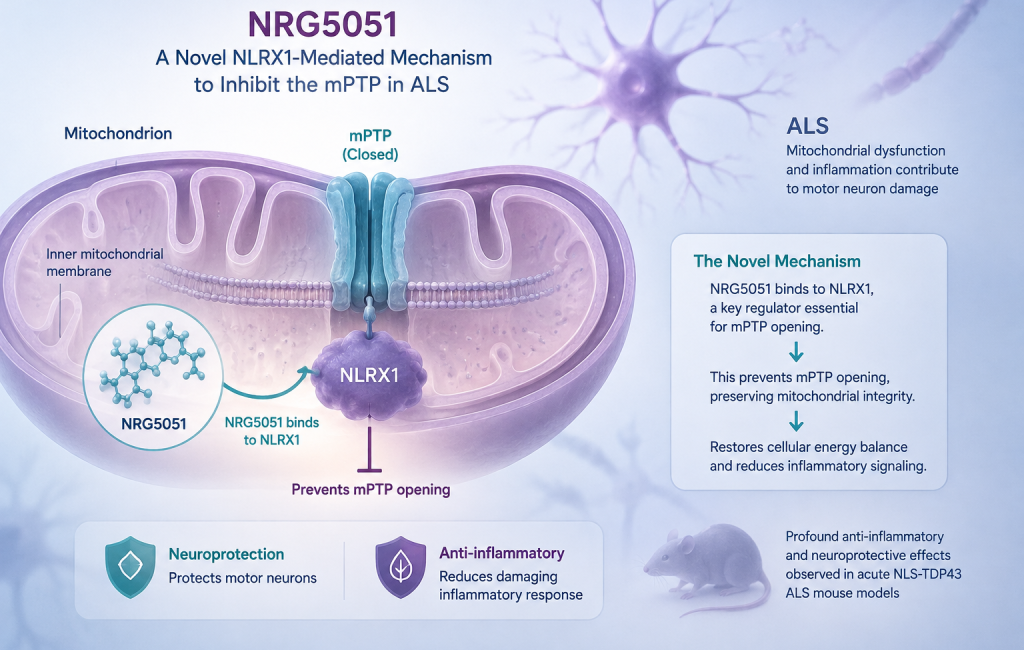
NRG5051 is described by the company as a first-in-class, orally bioavailable and CNS-penetrant next-generation inhibitor of the mitochondrial permeability transition pore (mPTP), an inner mitochondrial membrane channel. In the newly presented poster, NRG Therapeutics disclosed that NRG5051 acts through a novel NLRX1-mediated mechanism of action.
The scientists at NRG and their collaborators at WEHI were among the first to demonstrate that NLRX1 is essential for mPTP opening, establishing it as a key component or regulator of pore function. NLRX1 belongs to the NOD-like receptor family, a group of proteins that sense cellular stress and regulate immune responses. Unlike other members of this family, NLRX1 is localized to the mitochondria.
The mPTP is a key inner mitochondrial membrane channel implicated in the toxic effects of misfolded TDP43, which accumulates in mitochondria and triggers energetic failure and a damaging interferon response.
Anti-Inflammatory and Neuroprotective Effects Observed in ALS Mouse Models
Data presented at ALS Nexus, from research partly funded by the ALS Association and Innovate UK, showed that NRG5051 displays profound anti-inflammatory and neuroprotective effects in acute NLS-TDP43 ALS mouse models, including reduced plasma neurofilament light (NfL) chain, a translatable fluid biomarker of neuronal damage.
The preclinical findings, together with the newly disclosed NLRX1-mediated mechanism, support NRG Therapeutics’ rationale for investigating NRG5051 as a potential disease-modifying treatment for ALS. However, the findings reported to date are preclinical, and the potential clinical benefit of NRG5051 remains to be established in human studies.
Phase 1 Trial Status and Path to Patient Dosing
NRG5051 is currently being evaluated in a randomized, double-blind Phase 1 clinical trial designed to assess safety, tolerability and pharmacokinetic parameters in healthy volunteers. Dosing in ALS patients is scheduled for later 2026, with findings from the patient-dosing phase expected to inform dose selection for future Phase 2 proof-of-concept trials in ALS patients planned for 2027.
NRG Therapeutics is also developing NRG5051 for Parkinson’s disease, although the August 24 announcement specifically outlines the upcoming patient-dosing and Phase 2 plans in ALS.
Company Statement on the Disease-Modifying Rationale
NRG Therapeutics co-founder and chief executive officer Neil Miller said the newly disclosed mechanism provides further support for the company’s development strategy for NRG5051. He said that prevention of mPTP opening via NLRX1 restores mitochondrial integrity and protects the function of vulnerable neurons, and that NRG5051 has the potential to be a disease-modifying medicine capable of slowing or preventing the progression of ALS and other neurodegenerative diseases.
Unmet Need in Sporadic ALS
ALS is a rare, rapidly progressing neurodegenerative disease with high unmet medical need. Despite recent success in treating patients with the very rare SOD1 genetic form of ALS, the majority of patients with sporadic disease remain poorly treated by existing medicines. The unmet need has driven interest in approaches that target mechanisms implicated in neuronal dysfunction, including mitochondrial dysfunction and mPTP activity.
Reference

About the Writer
Siddhi Rajendra Bhadekar (Linkedin) is an M.Pharm professional with expertise in medical and scientific writing, literature review, publication writing, and evidence synthesis, supported by four peer-reviewed publications.
She brings working knowledge of ICH-GCP, MedDRA, pharmacovigilance, ADR/AE reporting, clinical data management, and regulatory documentation.
With experience across pharmaceutical R&D, Quality Control, and Quality Assurance, she combines scientific research skills with strong attention to accuracy and detail.
Her background in manuscript development, publication planning, and scientific communication enables her to translate complex healthcare information into clear, reliable content.